


As Hollywood rolls out the red carpet for the Oscars, a world away in remote eastern India, activists say the story of the blockbuster sci-fi film Avatar — nominated for nine awards — is being played out.
Set in the fantasy world of Pandora, Avatar tells the story of the Na’vi — a clan of blue-hued humanoids whose existence is threatened by a mining corporation which wants to exploit a vast store of mineral deposits which lies beneath a giant sacred tree.
In India’s impoverished but mineral-rich state of Orissa, hundreds of indigenous tribespeople are battling to stop London-listed Vedanta Resources Plc from extracting bauxite from what they say is their sacred mountain.
“The fundamental story of Avatar — if you take away the multi-colored lemurs, the long-trunked horses and warring androids — is being played out today in Niyamgiri mountain in India’s Orissa state,” said Stephen Corry, director of the British charity Survival International. “Like the Na’vi of Avatar, the Dongria Kondh tribe are also at risk.”
Vedanta says its mine would not violate the rights
of indigenous tribespeople, saying that all its projects
are conducted within the law and using international
best practices.
“It is a myth that people don’t want development. The tribals want their children to go to school and have enough to eat,” said Mukesh Kumar, CEO of Vedanta’s alumina refinery, located at the foot of the mountain, which will process the bauxite.
“If the mine goes ahead, Vedanta will help them to achieve this.”
NGOs like ActionAid say around 8,000 people will be affected by Vedanta’s mining plans which have been stalled since 2005 due to legal wrangles over environmental and social concerns. Vedanta says it expects approval from authorities in the coming months.
Since 2007, four international investors — including the Church of England — have sold off their stock in the company citing ethical concerns over the project.
Last month, Britain’s Joseph Rowntree Charitable Trust sold its US$2.9 million share, saying Vedanta was “pushing industrialization to the detriment of the lives of local people.”
While the box-office hit’s story to save the Na’vi’s “Tree of Souls” is a battle between good and evil, the fight for Niyamgiri mountain appears more a dilemma of industrialization versus tribal rights.
The tussle in the lush mountain forests of Niyamgiri between the Dongria Kondh people and Vedanta highlights a broader standoff between industry and villagers and tribesmen in India’s mineral belt — made up of the country’s most underdeveloped states of Orissa, Jharkhand and Chhattisgarh.
Steel companies like Arcelor Mittal and POSCO are facing resistance from establishing plants, not only from villagers and tribesmen, but from Maoist insurgents who for decades have been waging a war against industrialization.
Companies and the federal government argue that in a country where around 40 percent of the population lives below the poverty line, exploiting lucrative deposits of minerals such as iron ore, bauxite, coal and manganese is the only answer.
Last month, the mines minister said India planned to raise the compensation for people displaced by large mining projects in a move that could sooth opposition to leases but will raise costs.
Vedanta, which has already built an alumina refinery at the foot of the mountain in Lanjigarh town, in anticipation of gaining clearance to mine, says the planned project will not affect the tribespeople or the environment.
And the multinational has also launched a campaign to win hearts and minds through a range of corporate social responsibility activities, which includes building schools, and health clinics and income-generation projects.
Vedanta’s Kumar says the impoverished town was a mere assortment of tribal villages with little infrastructure and public services before Vedanta arrived.
“The refinery has improved people’s lives,” said Kumar, adding that the number of malaria cases and families
living below the poverty line has fallen since the refinery
was established.
Signs on everything from roads and bridges to traffic police booths are adorned with the company’s name and logo. Schools, clinics and even electricity poles are labeled “Vedanta” in bold blue.
Many local tribespeople remain skeptical.
At a clearing at the foot of Niyamgiri, hundreds of Kondh tribespeople gather to worship the mountain god, Niyam Rajah — the provider of food, water, shelter and medicine.
Women, wrapped in brightly colored saris with gold rings pierced through their noses, emerge from the dense forests to join tribal men at the annual ceremony to pay homage to the mountain.
A bearded old man, wearing a white loincloth and waving an axe, dances around an altar as the air fills with incense and the rhythmic beating of drums. His axe eventually falls on a goat — a sacrifice to their god.
“We have lived here for thousands of years and have always worshipped Niyam Rajah in our villages,” said Mukuna Majhi, a bare-chested elderly man, carrying an axe over his shoulder.
Centuries-old trees, hundreds of species of plants with medicinal properties and the scores of perennial streams that flow down the mountain will be lost, say activists.
While both activists and Vedanta claim the support of the local population, the Kondh tribes of Niyamgiri are divided.
“Some of the villages want the mine, but many do not,” said Tudu Majhi, 46, from the village of Khemdipadhar, near the planned site of the mine. “We want development but does it have to be at the expense of our mountain?”


Recently the Chinese Nationalist Party (KMT) and its Mini-Me partner in the legislature, the Taiwan People’s Party (TPP), have been arguing that construction of chip fabs in the US by Taiwan Semiconductor Manufacturing Co (TSMC, 台積電) is little more than stripping Taiwan of its assets. For example, KMT Legislative Caucus First Deputy Secretary-General Lin Pei-hsiang (林沛祥) in January said that “This is not ‘reciprocal cooperation’ ... but a substantial hollowing out of our country.” Similarly, former TPP Chair Ko Wen-je (柯文哲) contended it constitutes “selling Taiwan out to the United States.” The two pro-China parties are proposing a bill that

Institutions signalling a fresh beginning and new spirit often adopt new slogans, symbols and marketing materials, and the Chinese Nationalist Party (KMT) is no exception. Cheng Li-wun (鄭麗文), soon after taking office as KMT chair, released a new slogan that plays on the party’s acronym: “Kind Mindfulness Team.” The party recently released a graphic prominently featuring the red, white and blue of the flag with a Chinese slogan “establishing peace, blessings and fortune marching forth” (締造和平,幸福前行). One part of the graphic also features two hands in blue and white grasping olive branches in a stylized shape of Taiwan. Bonus points for
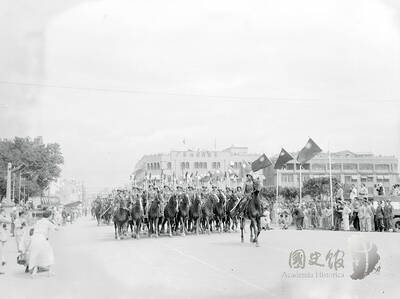
March 9 to March 15 “This land produced no horses,” Qing Dynasty envoy Yu Yung-ho (郁永河) observed when he visited Taiwan in 1697. He didn’t mean that there were no horses at all; it was just difficult to transport them across the sea and raise them in the hot and humid climate. “Although 10,000 soldiers were stationed here, the camps had fewer than 1,000 horses,” Yu added. Starting from the Dutch in the 1600s, each foreign regime brought horses to Taiwan. But they remained rare animals, typically only owned by the government or

“M yeolgong jajangmyeon (anti-communism zhajiangmian, 滅共炸醬麵), let’s all shout together — myeolgong!” a chef at a Chinese restaurant in Dongtan, located about 35km south of Seoul, South Korea, calls out before serving a bowl of Korean-style zhajiangmian —black bean noodles. Diners repeat the phrase before tucking in. This political-themed restaurant, named Myeolgong Banjeom (滅共飯館, “anti-communism restaurant”), is operated by a single person and does not take reservations; therefore long queues form regularly outside, and most customers appear sympathetic to its political theme. Photos of conservative public figures hang on the walls, alongside political slogans and poems written in Chinese characters; South


 RSS
RSS