


With so many in Taiwan’s celebrity firmament embroiled in scandals over the past few years, 2010 may turn out to be the year when some turn to religion to change their evil ways. But don’t count on it.
“God is better than sex,” screamed a T-shirt worn by actor and singer Vanness Wu (吳建豪) while attending a Christian conference late last week, according to a report in the United Daily News.
After arriving at the Festival of God’s Power Conference (神大能醫治布道會), the 31-year old heartthrob — who recently changed his first name to Van Ness — proceeded to disclose details of his changed lifestyle since being baptized two years ago.
In a tell-all to the media scrum following him, Wu confessed to losing his virginity aged 17 and “dating” six women in the past. Those wild days are behind him, though, as he told the assembled gossip hounds that he signed a “celibacy card” in 2008 and prays for one hour every day — this in addition to surreptitious prayers for friends and colleagues. He said that he manages to avoid temptation by putting God first.
He also confirmed rumors that he’d been involved with singer and actress Vivian Hsu (徐若瑄), claiming he could no longer lie about their past relationship. (Incidentally, Hsu has been spotted in the past at Xingtian Temple (行天宮) praying for divine intervention to help her find a mate).
When asked if he planned to become a pastor, Wu replied that he’d leave it up to God. If that wasn’t odd enough, CTV showed a clip of Wu’s hand placed on the head of a middle-aged woman, a sight that could have come right out of America’s Bible Belt.
All this talk of clean living is hard to swallow. Several media outlets implied just as much by juxtaposing images of Wu at the conference with those of him lying naked on a fully dressed Ady An (安以軒), his co-star in the soap opera Autumn’s Concerto (下一站,幸福). Perhaps Wu’s abstinence pledge has an opt-out clause for television.
Singer and actor Jay Chou (周杰倫) may need Wu’s help in calling on the Almighty for a miracle to salvage Pandamen (熊貓人), a new television program which he directs. The drama series about two heroic pandas that protect a city received the lowest rating for its 10pm time slot last Friday, according to a report on NOWnews.
Bloggers complained Pandamen had a childish plot and seemed to cater specifically to viewers in China. One would expect, then, that it would have received rave reviews when it aired on Guangzhou Television last month. But the NT$110 million show barely registered, with only 5,000 viewers tuning in on its third day, making it the lowest-rated show in the station’s history.
And now to more mundane news. The Apple Daily released the results of its “Queen of the Bra” (內衣皇后) poll. Joe Chen’s (陳喬恩) mammalian protuberances (33D) blew away the competition with 52 percent of the votes, coming out victorious in the ongoing lingerie battle against her To Love You Is My Destiny (命中注定我愛你) co-star and undergarment rival Bianca Bai (白歆惠). Bai’s tatas, practically exploding out of a 33B cup, placed third with 14 percent.
Actress Cheryl Yang (楊謹華) came second with 22 percent, and singer Landy Wen (溫嵐) placed last with 3 percent. Pop Stop awaits Apple’s “Queen of the Thong” poll with baited breath, and wonders when the “King of the Thong” contest kicks off.
Yahoo Kimo, meanwhile, came up with its own poll on who is the top male idol, which seems more of a promotional gimmick for popular boy band F4 than anything else.
Jerry Yan (言承旭) topped the poll of 170,000 votes with 30.8 percent, beating out fellow F4 band members Van Ness Wu and Vic Chou (周渝民), both of whom tied with 26 percent. Perhaps Yan has been praying in secret.
And finally, Chinese actress Zhang Ziyi (章子怡) is in a little hot water lately over allegations that she embezzled money donated to her charity to help victims of the 2008 Sichuan earthquake.
Zhang had publicly pledged the equivalent of NT$4.7 million to China’s Red Cross for victims of the disaster that killed an estimated 68,000 people. China’s media and bloggers have been in a tizzy over revelations that she donated only part of that total, leading to speculation that she had funneled the rest into her own personal account.
The Red Cross confirmed on Monday that it had received the balance owed, according to a report on Sina.com.


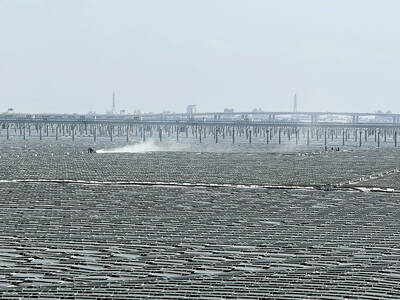
The arithmetic is straightforward and uncomfortable. By the end of 2025, Taiwan had committed itself to a 50-30-20 electricity mix — half natural gas, 30 per cent coal, 20 per cent renewables. The Ministry of Economic Affairs’s (MOEA) own monthly energy reports tell a different story. Natural gas reached 47.8 per cent of generation last year. Coal stood at 35.4 per cent, comfortably above its target ceiling. Renewables came in at 13.1 per cent, well short of the 20 per cent Taipei had pledged a decade earlier. Installed renewable capacity reached roughly half of the 12 gigawatts (GW) the government
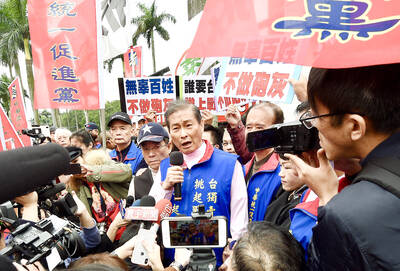
There are shadowy cabals plotting to sell out Taiwan to be annexed by China, by invasion if necessary. Fortunately, they are buffoons. In 2019, former Bamboo Union gangster and founder of the China Unification Promotion Party (CUPP), Chang An-le (張安樂, colorfully known as “White Wolf”), led a protest at the Legislative Yuan against comments made by then-premier Su Tseng-chang (蘇貞昌) that in the event of an attack by China, he would never surrender, but would protect the nation by fighting to the end, even if he only had a broom. Chang had party members bring a wooden casket that they
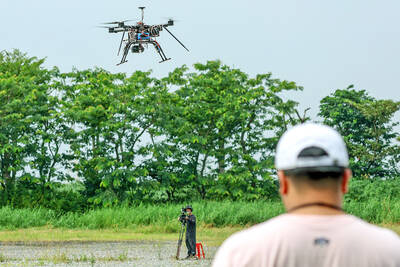
Taiwan’s drone exports are taking off, fuelled by the war in Ukraine, as Taiwanese companies seek a stake in the fast-growing global market for unmanned aerial vehicles (UAV). Low-cost drones used for reconnaissance and strikes are in high demand as governments around the world boost defense spending in the face of intensifying conflicts. A relative new player in the increasingly competitive industry, Taiwan’s pitch is to be an “Asian hub” for the production of UAVs and components free of Chinese materials, or “non-red.” That means its UAVs can be up to three times more expensive than their Chinese competitors, like the world’s biggest
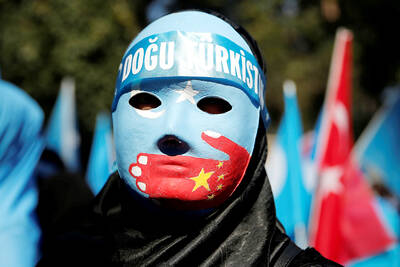
It seems every few days one bumps into one of those “real man” comments in which Taiwan is urged to “face reality” or similar, and “make a deal,” with the speaker implying that soon it will be too late. “Deal” advocates always present themselves as having a superior grip on reality, and the manly ability to make the “hard choice.” Their testosterone-laden language often echoes that of Taiwan sellout advocates. Note that such commentary always specifies a process (“make a deal, work with, make progress”), never the end state of what occupation by a violent authoritarian colonialist state will entail. In


 RSS
RSS