


The fallow plots of farmland on the edge of the artists’ village of Songzhuang (宋莊) are a symbol of Chinese contemporary art’s recent boom and bust cycle.
When prices for Chinese art soared, there were grand plans to build more galleries and studios in this artists’ hamlet near Beijing. Yet today, after art prices plunged by some 60 percent in the past year, the expansion plans have floundered.
After a white-hot stint, the financial crisis has battered China’s art landscape, shrinking investment in grand schemes like Songzhuang, shuttering galleries in Beijing’s pioneering 798 arts district and deflating bloated egos, valuations and excesses.
“The Chinese contemporary market was over-swollen before. I felt it wasn’t very healthy,” said Nan Xi (南溪), a former Chinese army officer turned artist whose works, huge pointillist ink-brush canvasses which he displays in his spacious Songzhuang villa, fetched around half a million yuan (roughly US$70,000) at the peak of the market.
In the good days, ferocious bidding in auction rooms at the market’s peak in 2007 and last year caused prices to spiral skyward with buyers and speculators treating contemporary artwork almost like stocks or tradeable commodities.
What resulted was a glut of average art at inflated prices and a growing community of millionaire artists, some more drawn by the opportunities to make vast amounts of cash than any artistic vision.
“The financial crisis has been a good lesson for us; to better know what the market is, and art’s relationship to it. Having too much money is not good for an artist’s development,” said Nan.
China’s leading auction house, Beijing Poly International Auction, which is famous for its repatriation of looted bronze animal heads from the West, has seen business in Chinese contemporary art plunge over 50 percent in the past year.
“A lot of buyers have been pushed out, including the speculators. The collectors who are left are now able to pay more reasonable money for reasonable things,” said Li Da (李達), Poly’s general manager.
He gives the example of a large Zhang Xiaogang (張曉剛) bloodline painting which fetched US$2.5 million in May and says that painting would have sold for more than twice that amount if it had been auctioned in 2007.
Melancholy canvasses by Zhang, one of China’s A-list artists which includes the likes of Liu Xiaodong (劉小東), Zeng Fanzhi (曾凡志), Fang Lijun (方立均) and Yue Minjun (岳敏君), sold at up to US$6 million a piece at the market peak.
Those valuations have, like many others, since fallen some 66 percent according to an index on Chinese art Web site Artron.net.
Since 2007, the overall market for Chinese contemporary art has shrunk over 54 percent according to Artron. Sotheby’s and Christie’s, which both pared back their sales of Chinese contemporary art in Hong Kong, have struggled to consign outstanding works, with sellers still wary of fragile sentiment.
At Sotheby’s autumn sales, bidding was mixed for contemporary art with Zhang Xiaogang’s Comrade one of few pieces testing the US$1 million dollar mark.
Without an across-the-board recovery in China’s economy and a return to the days of huge wealth creation, Li said she doesn’t see a comeback in Chinese contemporary art prices anytime soon.
Auctioneers and dealers say collectors have become more selective since the crash, spurning lesser works while seeking value in younger artists beyond China in Asia and in the West.
“Through this consolidation, there will be better discernment of good artists and good works and their inherent value” said Li of the Poly Group. “The true connoisseurs of Chinese contemporary art, the collectors are left ... and they will be able to pay reasonable money for reasonable things.”
Misung Shim, the head of Seoul Auction, which sold a large work of British artist Damien Hirst in Hong Kong this month for US$2.2 million, an auction record for the artist in Asia, sees growing opportunities beyond China’s art scene.
“We are trying to open the Western art market in Hong Kong rather than the Chinese paintings market,” she said.
Over the past three decades, Chinese contemporary art has writhed out of the wilderness
of Chairman Mao Zedong’s (毛澤東) Cultural Revolution purges and upheavals like the Tiananmen Square massacre in 1989, later piggy-backing on China’s economic and political rise, to catch the eye of the global art community.
While plunging prices of avant-garde art worldwide represents a big potential upside, major art investors such as Philip Hoffman of the Fine Art Fund in London are putting their money more in conservative, safer bets, with recent Asian sales in New York and Hong Kong showing strong demand and prices for traditional categories of Chinese art, including classic ink brush paintings, imperial scholars’ objects, and Ming and Qing dynasty ceramics.
“We’ve allocated more to porcelain and ancient art, but we’ve allocated very little to Chinese contemporary,” Hoffman said.
“I’ve been amazed to see how the recession has not been affecting the very best [traditional] Chinese art.”
At its peak, the Chinese contemporary art market was seen by some to be highly manipulated and speculative.
Auction houses were accused of collusion with artists to inflate prices, critics and curators blamed for hyping up artists reputations for hard cash, and artists churned out works straight for auction, production-style with an army of assistants, rather than going through the traditional primary market of art galleries first.
“In a Chinese context, the phenomenon of auctions in the art market is a very new thing,” said Ingrid Dudek, a contemporary Chinese art specialist with Christie’s.
“A lot of the results were driven by private collectors, indicating not necessarily speculation, but of enormous demand ... maybe that did make the correction hurt a little bit more too because you didn’t have a dealer network that was there.”
Now though, galleries and dealers seem to be making a comeback, with artists seeing the worth of being patiently backed and promoted to ensure reputations and valuations are less vulnerable to market volatilities.
“Some other galleries think going to auction is a test of the market value [of an artist] so they can make faster money. But we try to do the opposite,” said Federico Keller of Hong Kong’s Connoisseur Contemporary gallery, which specializes in Asian and younger Chinese artists.
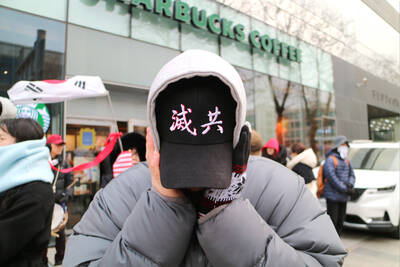
On a harsh winter afternoon last month, 2,000 protesters marched and chanted slogans such as “CCP out” and “Korea for Koreans” in Seoul’s popular Gangnam District. Participants — mostly students — wore caps printed with the Chinese characters for “exterminate communism” (滅共) and held banners reading “Heaven will destroy the Chinese Communist Party” (天滅中共). During the march, Park Jun-young, the leader of the protest organizer “Free University,” a conservative youth movement, who was on a hunger strike, collapsed after delivering a speech in sub-zero temperatures and was later hospitalized. Several protesters shaved their heads at the end of the demonstration. A
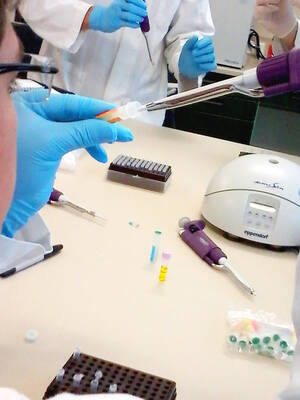
Google unveiled an artificial intelligence tool Wednesday that its scientists said would help unravel the mysteries of the human genome — and could one day lead to new treatments for diseases. The deep learning model AlphaGenome was hailed by outside researchers as a “breakthrough” that would let scientists study and even simulate the roots of difficult-to-treat genetic diseases. While the first complete map of the human genome in 2003 “gave us the book of life, reading it remained a challenge,” Pushmeet Kohli, vice president of research at Google DeepMind, told journalists. “We have the text,” he said, which is a sequence of
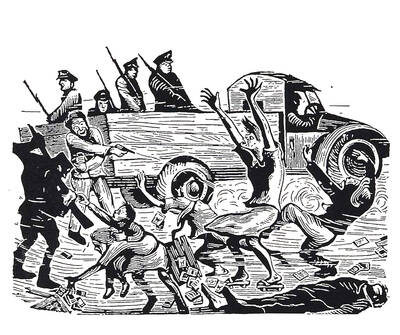
In August of 1949 American journalist Darrell Berrigan toured occupied Formosa and on Aug. 13 published “Should We Grab Formosa?” in the Saturday Evening Post. Berrigan, cataloguing the numerous horrors of corruption and looting the occupying Republic of China (ROC) was inflicting on the locals, advocated outright annexation of Taiwan by the US. He contended the islanders would welcome that. Berrigan also observed that the islanders were planning another revolt, and wrote of their “island nationalism.” The US position on Taiwan was well known there, and islanders, he said, had told him of US official statements that Taiwan had not
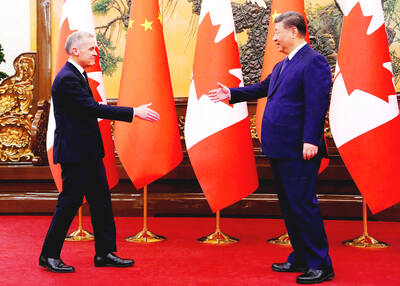
Britain’s Keir Starmer is the latest Western leader to thaw trade ties with China in a shift analysts say is driven by US tariff pressure and unease over US President Donald Trump’s volatile policy playbook. The prime minister’s Beijing visit this week to promote “pragmatic” co-operation comes on the heels of advances from the leaders of Canada, Ireland, France and Finland. Most were making the trip for the first time in years to refresh their partnership with the world’s second-largest economy. “There is a veritable race among European heads of government to meet with (Chinese leader) Xi Jinping (習近平),” said Hosuk Lee-Makiyama, director


 RSS
RSS