


Claudia Albino, a washerwoman who earns about US$3 a day and lives in a one-room hovel with her family in this bleak town high in the Andes, might seem at first to have nothing to do with Ira Rennert, the reclusive New York billionaire who built one of the largest homes in the US, an Italianate mansion sprawling over more than 6,000m² in the Hamptons.
But Rennert’s privately held industrial empire includes the smelter with a towering smokestack that overlooks Albino’s home, so the health and economic fate of her and thousands of others here rest on the corporate maneuvers he is carrying out.
La Oroya has been called one of the world’s 10 most polluted places by the Blacksmith Institute, a nonprofit group that studies toxic sites. But for several months, the Peruvian smelting company in Rennert’s empire has claimed that low metals prices prevented it from completing a timely cleanup to lower the emissions that have given this town such an ignoble distinction.
The tensions here over the lead emissions and the smelter’s financial meltdown is precisely the kind of dire mix of foreign investment and environmental contamination feared by indigenous groups elsewhere in Peru, particularly in the country’s Amazon basin, where protests over similar issues left dozens dead this month.
Citing financial difficulties, the Peruvian operators of the smelter, who have already idled most of its operations, have threatened to shut down entirely for several months, putting in danger 3,000 jobs at the plant and thousands more who rely on it like Albino, who washes clothes for the wives of smelter workers.
Last week, some workers and residents protested against the possible closing, halting traffic and commerce along the highway that descends from La Oroya to the capital, Lima. Then on Tuesday, the government signaled that it might be open to extending the October deadline for the cleanup. Officials involved in talks on Wednesday said that one possible solution to the impasse would involve giving workers some control of the plant.
“This man Rennert, I’ve heard of him on television, of his great wealth and the homes he has around the world,” said Albino. “As for me, I cannot afford to test the lead levels in my daughters’ blood any longer,” she said, attributing the stunted growth of her youngest daughter, 7, to the smelter’s emissions.
Residents of La Oroya, with a population of 35,000, talk about the lead in their blood like people elsewhere discuss the weather. Ninety-seven percent of children under the age of 6 had lead levels that would be considered toxic by the Centers for Disease Control and Prevention in the US, according to a 2005 study by scientists from Saint Louis University. But while some here seethe against Rennert and the company, Doe Run Peru, others defend them for providing work, making for a sharply divided town.
“We are thankful to Doe Run,” said Elizabeth Canales, 40, a seamstress and a member of a company-supported group that teaches hygiene to poor families here. “It truly saddens me because I don’t know if this is happening because there’s a misunderstanding.”
In a town where billboards with utopian images of happy families promote the company’s deeds, some publicly praise Doe Run Peru while requesting, amid fear of retribution, anonymity to vent their anger at the company. “This town is owned by one company, and we vassals cannot be seen as disloyal to our owners,” said one longtime worker.
The discord between those for and against the company festers in La Oroya’s labyrinthine streets, packed with stands selling foods like seasoned guinea pig and bars catering to the plant’s workers, who largely move here from other parts of Peru and earn salaries that dwarf those of other residents.
Insults and threats are common. Some workers at the plant recently paraded an effigy of Archbishop Pedro Barreto, an outspoken critic of the company’s environmental record, burning it at the culmination of their protest.
“When insults don’t work, the company resorts to intimidation, and when that fails, to blackmail, which is what it’s doing now by saying it will shut the plant unless it gets an extension for its cleanup,” said Pedro Cordova, 50, a production mechanic at the smelter who is suing the company over health claims related to a lung ailment.
Environmental activists in La Oroya said they saw parallels between Doe Run Peru’s strategies here and those employed elsewhere by Renco, Rennert’s holding company. Even as his fortune remained intact, they contend, some Renco companies in the US faced complaints over environmental contamination and went into bankruptcy earlier this decade.
Through a spokesman in New York, Rennert declined to be interviewed, and Renco would say only that it was in talks aimed at “reaching a viable solution.”
Doe Run Peru claims that it has “dramatically reduced” the toxic emissions at the smelter since buying it from Peru’s government in 1997, leading to “a radical improvement in environmental conditions.”
Still, researchers contend Doe Run Peru has misled officials by using 1997, the year it took control of the smelter, as a point of comparison for pollution levels, since contamination climbed that year. “Doe Run Peru has overseen an absolute increase in contamination in La Oroya,” said Corey Laplante, who researched La Oroya at the Peruvian Society for Environmental Law in Lima.
Despite being pressed by workers here to find a solution, officials in Lima last week said they had concerns about taking over or intervening in the company, pointing to legal battles that could arise from taking some control of a foreign-owned asset.
News reports that Renco had tried this month to buy the Swedish automaker Saab, led angry residents here to ask why Doe Run Peru could not complete its cleanup or prevent a shutdown of the smelter at a time when metal prices have begun to climb again. Nearly everyone here wants the smelter to remain open and for the cleanup to proceed. But with Peru forging closer ties to the US through its new trade deal with Washington, some here question the benefits of such a pact.
“It’s like we’re pawns in a game,” said Rosa Amaro, 52, a leader of an environmental group here. “What I still fail to understand is why we are exposed to the risks of an American investment,” she added, “but not to the environmental protections enjoyed by the citizens of the United States.”
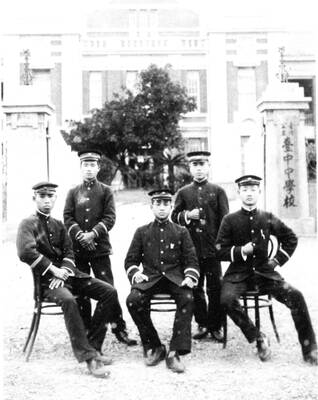
April 28 to May 4 During the Japanese colonial era, a city’s “first” high school typically served Japanese students, while Taiwanese attended the “second” high school. Only in Taichung was this reversed. That’s because when Taichung First High School opened its doors on May 1, 1915 to serve Taiwanese students who were previously barred from secondary education, it was the only high school in town. Former principal Hideo Azukisawa threatened to quit when the government in 1922 attempted to transfer the “first” designation to a new local high school for Japanese students, leading to this unusual situation. Prior to the Taichung First
The Ministry of Education last month proposed a nationwide ban on mobile devices in schools, aiming to curb concerns over student phone addiction. Under the revised regulation, which will take effect in August, teachers and schools will be required to collect mobile devices — including phones, laptops and wearables devices — for safekeeping during school hours, unless they are being used for educational purposes. For Chang Fong-ching (張鳳琴), the ban will have a positive impact. “It’s a good move,” says the professor in the department of
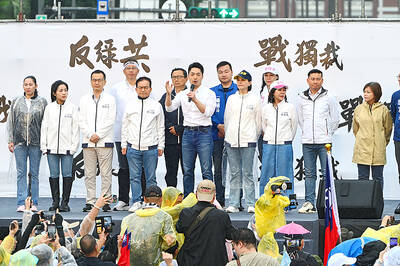
On April 17, Chinese Nationalist Party (KMT) Chairman Eric Chu (朱立倫) launched a bold campaign to revive and revitalize the KMT base by calling for an impromptu rally at the Taipei prosecutor’s offices to protest recent arrests of KMT recall campaigners over allegations of forgery and fraud involving signatures of dead voters. The protest had no time to apply for permits and was illegal, but that played into the sense of opposition grievance at alleged weaponization of the judiciary by the Democratic Progressive Party (DPP) to “annihilate” the opposition parties. Blamed for faltering recall campaigns and faced with a KMT chair
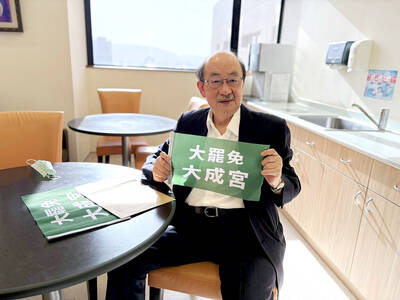
Article 2 of the Additional Articles of the Constitution of the Republic of China (中華民國憲法增修條文) stipulates that upon a vote of no confidence in the premier, the president can dissolve the legislature within 10 days. If the legislature is dissolved, a new legislative election must be held within 60 days, and the legislators’ terms will then be reckoned from that election. Two weeks ago Taipei Mayor Chiang Wan-an (蔣萬安) of the Chinese Nationalist Party (KMT) proposed that the legislature hold a vote of no confidence in the premier and dare the president to dissolve the legislature. The legislature is currently controlled


 RSS
RSS