


Ever thought about picking up dog poop or catching mosquitoes for a living? Well, now you can. Since late last year, the central government has begun offering such short-term work to jobless people in order to keep them working and the unemployment rate under control.
Around 73,000 of these jobs have been provided all over Taiwan. They range from picking up dog poop to keeping streets clean to catching mosquitoes and include helping police spot stolen vehicles, cleaning gutters, inspecting toilets, trimming lawns, and supervising garbage disposal and recycling.
The unusual program is part of a US$15 billion public spending plan by the government to bolster the economy during the current recession, which saw the country’s export-dependent economy decline by a record 10 percent in the first quarter from last year.
The workers are paid NT$800 a day and work five days a week for six months. With the unemployment rate hitting record highs, many people apply for these jobs despite the relatively low pay. Applicants include vocational school or college graduates who cannot find anything better, as well as people with mortgages to pay, kids to raise or credit card bills piling up.
Kao Shu-fang (高淑芳), a 45-year-old mother of three, has been catching mosquitoes for Kaohsiung City to prevent dengue fever outbreaks during the 2009 World Games, which will be held there next month.
“I had never heard of this kind of work before, but as I learn more about it, I find it interesting,” said Kao, who used to sell baby formula at hospitals but has not been able to find work in the past two years.
The job is not as simple as it sounds — she and her colleagues must visit 100 households each day and convince people to let them in to remove standing water, get rid of mosquito larvae and catch the mosquitoes, which they send to a laboratory to test for the dengue virus.
“It takes patience and a good attitude to convince people to let you into their homes,” Kao said.
The salary, while low, helps Kao and her husband make ends meet. With a mortgage and college tuition for their eldest child to pay, the couple is barely getting by.
“The situation isn’t good. It’s so hard to find work ... Late last year, my husband was put on unpaid leave. So in our family, money is tight,” Kao said. “This job definitely helps. The NT$800 a day I make can at least pay for food.”
MANY HANDS MAKE LIGHT WORK
The government-funded program is also helping various local government offices by sending them helping hands to do the kind of work they normally do not have enough manpower to do.
“To fight dengue fever, we need a lot of people ... We need people to find these places that have standing water. Without finding them, there will be mosquito infestations, so we really need the temporary workers,” said Chen Chaur-dong (陳朝東), head of the insect communicable disease prevention section of Kaohsiung City Department of Health’s Center for Disease Control and Prevention (高雄市政府衛生局疾病管制處蟲媒傳染病防止股).
There are a lot of mosquitoes this year because the past winter has been warm, and the last thing the city wants is for there to be dengue fever outbreaks when thousands of athletes and spectators from all over the world descend on the city to watch the Games.
Meanwhile, the Taipei City Police Department’s crime investigation division’s crime prevention division (台北市政府警察局刑事警察大隊預防組), which received 20 temporary workers, is also seeing the benefits.
The workers raise public awareness about crime prevention by handing out leaflets and talking to local residents face-to-face about locking their cars, parking in well-lit public places and avoiding telephone scams. They have also helped find stolen vehicles by running license plate numbers through handheld devices — a task police officers have little time to do.
“In the past, these tasks were done by police officers, but they’re very time-consuming. Now with 20 temporary workers, our police officers can focus their time on doing more important work, such as catching criminals,” said Chen Ming-chih (陳明志), chief of the section.
“By spending time educating people, the temporary workers are also helping to reduce the number of people who fall victim to crime,” Chen said.
Critics, however, say these jobs are not real jobs and are not a long-term solution to Taiwan’s unemployment problem. Others have wondered about workers clipping away at lawns that do not seem to need much trimming.
“The program is aimed more at beautifying the jobless figures, keeping them lower than they would be,” said Son Yu-liam (孫友聯), secretary general of Taiwan Labour Front (台灣勞工陣), a workers’ rights group. “People who do these jobs are desperate for work, but what they really need are long-term, stable jobs, not jobs that end in six months, which will leave them unemployed again.”
A STOPGAP SOLUTION
But government officials in charge of the program argue it’s better than nothing. They say many of the workers are providing useful services, including babysitting children from disadvantaged families, or helping librarians shelve books; services local governments do not have time to do and/or could not afford to hire people to do.
“Of course they’re useful. Many people criticize that the jobs are cleaning, janitorial work, but they at least expose the workers to a work environment, build up their confidence and they also can earn some income to weather this period,” said Sophie Ho (賀麗娟), director of the Council of Economic Planning and Development’s manpower planning department (行政院經濟建設委員會人力規劃處), which helped the central government develop the program.
Keeping people busy also helps prevent domestic violence and suicides, Ho said. Taiwan already suffers from a suicide rate above the global average. Suicides, domestic violence and child abuse are all on the rise.
“These programs can reduce problems caused by unemployment, such as suicide and crime,” said Ho. In the short term, “it’s at least contributing to society in some way.”
The jobs have helped to keep under control Taiwan’s unemployment rate, which rose to a record high of 5.81 percent in March and fell slightly to 5.76 percent in April.
However, Ho said there are no plans to create more such work.
“That’s all the government can do. There’s a limit. Otherwise, the grass will be cut to bareness,” she said, half-jokingly.
To be sure, Taiwan’s government has also created many regular jobs especially in its infrastructure construction program, but low-skilled people with no chance of finding jobs that pay a decent wage are putting their hopes on the temporary work program.
With the economy predicted to fall for three straight quarters this year and the unemployment rate in April falling only slightly since March, many workers, such as Kao, hope to be hired permanently.
Her husband, a middle manager at a publicly listed iron and steel company, has lost about half his income after being put on unpaid leave.
“Life is OK for now, but I’m afraid one day we won’t have any income,” Kao said.
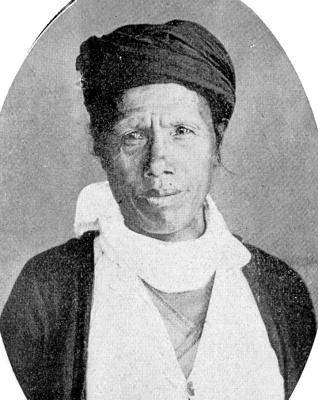
May 11 to May 17 Traversing the southern slopes of the Yushan Range in 1931, Japanese naturalist Tadao Kano knew he was approaching the last swath of Taiwan still beyond colonial control. The “vast, unknown territory,” protected by the “fierce” Bunun headman Dahu Ali, was “filled with an utterly endless jungle that choked the mountains and valleys,” Kano wrote. He noted how the group had “refused to submit to the measures of our authorities and entrenched themselves deep in these mountains … living a free existence spent chasing deer in the morning and seeking serow in the evening,” even describing them as

Yesterday, the Democratic Progressive Party (DPP) nominated legislator Puma Shen (沈伯洋) as their Taipei mayoral candidate, the Chinese Nationalist Party (KMT) put their stamp of approval on Wei Ping-cheng (魏平政) as their candidate for Changhua County commissioner and former legislator Tsai Pi-ru (蔡壁如) of the Taiwan People’s Party (TPP) has begun the process to also run in Changhua, though she has not yet been formally nominated. All three news items are bizarre. The DPP has struggled with settling on a Taipei nominee. The only candidate who declared interest was Enoch Wu (吳怡農), but the party seemed determined to nominate anyone

In a sudden move last week, opposition lawmakers of the Chinese Nationalist Party (KMT) and Taiwan People’s Party (TPP) passed a NT$780 billion special defense budget as a preemptive measure to stop either Chinese leader Xi Jinping (習近平) or US President Donald Trump from blocking US arms sales to Taiwan at their summit in Beijing, said KMT heavyweight Jaw Shaw-kong (趙少康), speaking to the Taipei Foreign Correspondents Club on Wednesday night in Taipei. The 76-year-old Jaw, a political talk show host who ran as the KMT’s vice presidential candidate in 2024, says that he personally brokered the deal to resolve
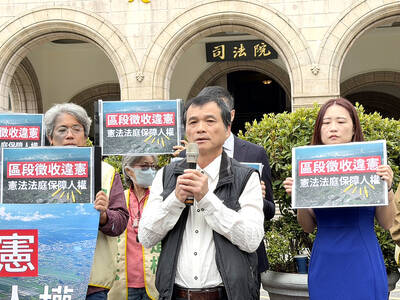
What government project has expropriated the most land in Taiwan? According to local media reports, it is the Taoyuan Aerotropolis, eating 2,500 hectares of land in its first phase, with more to come. Forty thousand people are expected to be displaced by the project. Naturally that enormous land grab is generating powerful pushback. Last week Chen Chien-ho (陳健和), a local resident of Jhuwei Borough (竹圍) in Taoyuan City’s Dayuan District (大園) filed a petition for constitutional review of the project after losing his case at the Taipei Administrative Court. The Administrative Court found in favor of nine other local landowners, but


 RSS
RSS