


Baimurat Allaberiyev, a diminutive native of Tajikistan who has herded sheep, picked cotton and toiled in construction, hardly looks like Russia’s latest musical sensation.
But Allaberiyev has remarkable talent that sets him apart from the millions of Central Asians who come to Russia to escape crushing poverty at home.
A musical prodigy, he can perform Bollywood showstoppers as a one-man band, equipped with nothing but an uncanny falsetto and a metal bucket.
That — and the miraculous star-making powers of the Internet — have turned this 37-year-old into a cult celebrity here.
Allaberiyev won fame after shaky videos shot with mobile phones surfaced on the Internet that showed him performing songs like “Jimmy Jimmy Jimmy Aaja” from the 1983 Bollywood classic Disco Dancer.
Set against grim backdrops such as a construction site or a storeroom full of boxes, the videos became a viral sensation. They have now been viewed more than 400,000 times on YouTube, the video-sharing Web site.
Allaberiyev — who is widely known as “Tajik Jimmy” despite the fact that he is actually an ethnic Uzbek — now has a record deal and has given concerts in Moscow and St Petersburg.
His success is striking given that Central Asians suffer widespread discrimination in Russia and are often targeted in racist attacks.
Despite his budding musical career, Allaberiyev remains down to earth and has not quit his day job hauling cardboard boxes at the Rio shopping center in Kolomna, a town 100km southeast of Moscow.
“I can’t quit working here,” Allaberiyev said in an interview, surrounded by the sleek glass and metal of the shopping mall. “But if someone asks me to do a concert, I’ll go and perform.”
But fame has led to surreal changes for Allaberiyev, who has been compared to Susan Boyle, the middle-aged Scottish woman who soared to fame when her audition on Britain’s Got Talent became a smash hit on YouTube.
Allaberiyev spoke to AFP the same day he was filmed by a television crew and visited by a local newspaper photographer.
He recalled how his talents were noticed after he arrived in Russia in 2008 to build the Rio shopping center, working side by side with laborers from across the former Soviet Union.
“When I worked on the construction site, I used to sing songs to myself. Then all the guys — Russians, Uzbeks, Tajiks — would come up and film me,” said Allaberiyev, who looks much older than his 37 years.
“And they’d say, ‘Jimmy, now we’re going to put that on the Internet.’ And it got on the Internet and lots of people downloaded my songs and heard them.
“And that’s how I became a star.”
Music came early to Allaberiyev, who was born on a collective farm in what was then the Soviet republic of Tajikistan, close to the Afghan border, one of 10 brothers and sisters.
Encouraged by a musician uncle, Allaberiyev enrolled in after-school music classes, while a projectionist brother introduced him to the colorful world of Indian musicals.
Relatives noticed that Allaberiyev could break into a falsetto and sing the female parts of Bollywood songs, as well as the male ones.
No less impressive was his ability to memorize a song within several days by repeatedly listening to it on tape, and then re-create it with perfect rhythm, without even knowing the language.
“My uncle used to play drums. He used to tell me, when you grow up, I’ll buy you drums and a synthesizer,” Allaberiyev said.
But history interfered when the Soviet Union collapsed in 1991 and civil war broke out in newly independent Tajikistan. The country plunged into deep poverty.
Allaberiyev spent some time herding sheep in Tajikistan, then picking cotton in more prosperous Kazakhstan.
He sang for friends and performed at the occasional wedding, but was only noticed by a broader public after coming to Russia.
The videos that brought him fame reflect the grittiness of migrant workers’ lives as well as Allaberiyev’s exuberant love of performance.
In one movie, after he is done singing, a man dressed in a suit walks into the storeroom and commands: “Let’s go. Get dressed and get out of here.”
Allaberiyev went mainstream after local journalists tracked him down and one of them introduced him to a music producer, Ilya Bortnyuk, head of the Light Music promoting company in St Petersburg.
Bortnyuk agreed to let “Tajik Jimmy” be the opening act for the politically outspoken British electronica group Asian Dub Foundation when it visited St Petersburg in April.
When Allaberiyev’s performance got an enthusiastic reception from the hip club-going crowd, Bortnyuk was so impressed that he signed a record deal with him that same night.
“I consider him a very talented person,” Bortnyuk told AFP.
The producer said he would seek to preserve Allaberiyev’s aura of raw talent as they worked together in the recording studio.
“We will not impose any strict conditions on him. For instance, he might not need any instrument other than an aluminum bucket,” Bortnyuk said.
Despite his newfound fame, Allaberiyev faces the same risks as other Central Asians in Russia.
One April evening, he was riding a train when he was attacked by a group of strangers who knocked out his two front teeth.
Allaberiyev said the attackers were not skinheads and that he was assaulted “for no reason” — but violence against Central Asians motivated by racist hatred is frequent in Russia.
In fact, before Allaberiyev’s rise to fame, the best-known Internet video featuring a Tajik was perhaps The Execution of a Tajik and a Dagestani, a notorious clip apparently created by Russian ultranationalists.
The video, which surfaced online in 2007, shows masked men decapitating one dark-skinned man and shooting another in the head after they are forced to kneel under a Nazi flag.
But Allaberiyev says he feels comfortable in Russia, and he says his fame has helped shield him from another problem that plagues migrants — police harassment.
For many Central Asians in Russia, being stopped by the police means they must pay a bribe or face jail and deportation.
But not Allaberiyev. “The police all know me,” he said. “They say, Jimmy, you’re a good singer, you’re our star! And they let me go.”

Taiwan’s overtaking of South Korea in GDP per capita is not a temporary anomaly, but the result of deeper structural problems in the South Korean economy says Chang Young-chul, the former CEO of Korea Asset Management Corp. Chang says that while it reflects Taiwan’s own gains, it also highlights weakening growth momentum in South Korea. As design and foundry capabilities become more important in the AI era, Seoul risks losing competitiveness if it relies too heavily on memory chips. IMF forecasts showing Taiwan widening its lead over South Korea have fueled debate in Seoul over memory chip dependence, industrial policy and

“China wants to unify with Taiwan at the lowest possible cost, and it currently believes that unification will become easier and less costly as time passes,” wrote Amanda Hsiao (蕭嫣然) and Bonnie Glaser in Foreign Affairs (“Why China Waits”) this month, describing how the People’s Republic of China (PRC) is playing the long game in its quest to seize Taiwan. This has been a favorite claim of many writers over the years, easy to argue because it is so trite. Very obviously, if the PRC isn’t attacking Taiwan, it is waiting. But for what? Hsiao and Glaser’s main point is trivial,
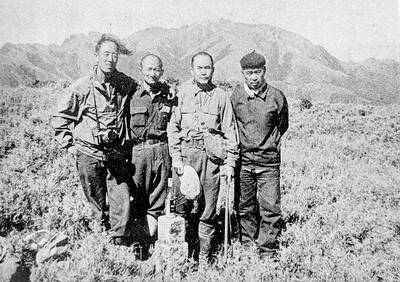
May 18 to May 24 Gathered on Yangtou Mountain (羊頭山) on Dec. 5, 1972, Taiwan’s hiking enthusiasts formally declared the formation of the “100 Peaks Club” (百岳俱樂部) and unveiled the final list of mountains. Famed mountaineer Lin Wen-an (林文安) led this effort for the Chinese Alpine Association (中華山岳協會). Working with other experienced climbers, he chose 100 peaks above 10,000 feet (3,048m) that featured triangulation points and varied in difficulty and character. The list sparked an alpine hiking craze, inspiring many to take up mountaineering and competing to “conquer” the summits. A common misconception is that the 100 Peaks represent Taiwan’s 100 tallest

In a sudden move last week, opposition lawmakers of the Chinese Nationalist Party (KMT) and Taiwan People’s Party (TPP) passed a NT$780 billion special defense budget as a preemptive measure to stop either Chinese leader Xi Jinping (習近平) or US President Donald Trump from blocking US arms sales to Taiwan at their summit in Beijing, said KMT heavyweight Jaw Shaw-kong (趙少康), speaking to the Taipei Foreign Correspondents Club on Wednesday night in Taipei. The 76-year-old Jaw, a political talk show host who ran as the KMT’s vice presidential candidate in 2024, says that he personally brokered the deal to resolve


 RSS
RSS