


A string of salacious novels, a high-flying lifestyle, a glamorous presence and consistently provocative opinions characterize Shobhaa De, India’s best-selling English-language author. In this new book — to be published in London next week — she embarks on a round-up of aspects of life in modern India, from sex to money and fashion to politics, coming up with a sequence of racy taunts, unsupported assertions and gushing enthusiasms.
This isn’t a book to look to for measured analysis or a systematic thesis. De’s style is essentially that of the magazine columnist faced with readers with short attention spans — catchy phrases, a would-be-shocking honesty, exclamation points in abundance, and paragraphs that end with Right now! You bet! Scary! or Crazy or what?
De’s cast of mind and her style are, of course, connected. Superstar India, you feel, is a book intended to be read in short bursts between eating a chapatti and reaching for a glass of lassi, and prompting exclamations of Really? I don’t believe it! Too shocking! and How dare she? The effect is augmented by Penguin’s decision to highlight what it deems to be key sentences in bold type, and scatter the pages with other sentences reprinted large, magazine-style. This has the effect of drawing your attention to the text, while at the same time ensuring you’re never tempted to take any of it too seriously.
A section on her first visit to China is typical of De’s approach. She arrives in Shanghai (“the glitzy city on steroids that’s attracting the world’s high-rollers”) and finds its airport superior to the one at Mumbai (“Have garbage. Will throw.”). She thinks the Chinese have got the tourism business right too — “... the basic infrastructure, good roads, decent hotels, clean and well-organized sites, inexpensive food and no touts or beggars harassing the unwary.” But in other ways China has a lot in common with De’s homeland — fake goods openly on display in licensed shops, seriousness in putting the family first, and a willingness to answer personal questions without batting an eyelid. “Just like India! ... I love it!”
“What is the truth in China?” she writes. “Nobody knows. And nobody cares.” Should India be afraid of China? You bet! “With the world’s biggest standing army and the soaring territorial ambitions they have, there’s no way we can sit back and relax.” Again, “Chinese chicks will buy the lot — hand creams, face creams, butt creams. Chinese women will all want to be Zhang Zilin (張梓琳).” On the other hand, if China and India were to combine their economic energies, they could dominate the world.
This is a book that you imagine was written by someone with a flowery hat and a tight-fitting sari, sweeping you through airports with her redoubtable energy and unstoppable flow of opinions. Come along, darlings, it’s the Chinese next, and I bet you can’t wait to hear what I think of them, now can you?
It’s hard to unravel the author’s genuine feelings from all this tangle of chatter. She does have a lot to say about women, though any suggestion that she’s a feminist is received with horror in Indian academic circles. Indian women are still too used to playing second fiddle, she asserts, and she sees Indian men as terrified by a woman with her own opinions and a disposable income. Marriage for money, on the other hand, she perceives as only natural. Sex is probably more frequently indulged in by the younger generation, she believes, though underneath the boasts and bravado many traditional attitudes prevail.
Money is an even more prominent topic in Superstar India than sexual attitudes. De is the mother of six and the financial habits of the young — brash, aggressive, ignorant, and obsessed with brands and labels — come in for some criticism. She sees herself as stranded between her own father’s adherence to austerity, and even sacrifice, and the affluent young’s penchant for cool spending, living for the moment, and succumbing to “the urge to splurge.”
In this, De is what she is in many other spheres of life — on the one hand still the affluent rebel who mentions the unmentionable almost as a matter of course, but at the same time also the responsible matriarch. When it comes to religion, for instance, she’s quite happy with modern, laborsaving shortcuts when preparing for the great festivals such as Diwali, while also hoping that India’s traditions, including its spiritual ones, will survive. (Are the young concerned about poverty and interested in snake charmers? She’s not too sure).
She can be sardonic. “When all else fails, we pull out Gandhi,” she writes, and counts four Paris restaurants named after the Mahatma. Vegetarian and teetotal establishments? “Hell, no — beef pasanda and Burgundies galore on all these menus.” And she’s been almost everywhere. She recounts meeting the UK’s Prince Charles (“Jug Ears”) and telling him the novels she writes are “bodice-rippers,” takes a few days off in St Moritz, and eats at “a very posh Steak House in Dubai.”
There are many serious points, though — that it suits politicians to keep minorities insecure (“Hate creates vote banks. Tolerance doesn’t. It’s that simple”), that food shortages are mostly man-made, as the Nobel laureate Amartya Sen demonstrated, and that the single-child Chinese girl marrying the single-child Chinese boy will have to look after two sets of aging parents, her own and her husband’s. Poverty, domestic violence, dowry-deaths, the treatment of Muslims, the way Western women on their own in India tend to get groped — none of these are swept under the carpet.
“Am I being a cynical bitch?” she asks at one point. Probably not. This garrulous book tells you a lot about modern India, even though it’s best taken in rather small doses.

The small platform at Duoliang Train Station in Taitung County’s Taimali Township (太麻里) served villagers from 1992 to 2006, but was eventually shut down due to lack of use. Just 10 years later, the abandoned train station had become widely known as the most beautiful station in Taiwan, and visitors were so frequent that the village had to start restricting traffic. Nowadays, Duoliang Village (多良) is known as a bit of a tourist trap, with a mandatory, albeit modest, admission fee of NT$10 giving access to a crowded lane of vendors with a mediocre view of the ocean and the trains
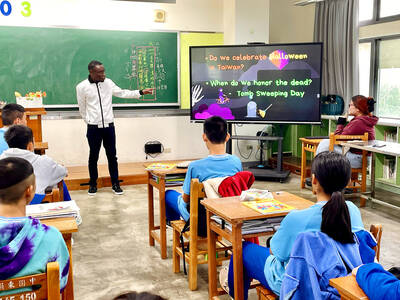
For many people, Bilingual Nation 2030 begins and ends in the classroom. Since the policy was launched in 2018, the debate has centered on students, teachers and the pressure placed on schools. Yet the policy was never solely about English education. The government’s official plan also calls for bilingualization in Taiwan’s government services, laws and regulations, and living environment. The goal is to make Taiwan more inclusive and accessible to international enterprises and talent and better prepared for global economic and trade conditions. After eight years, that grand vision is due for a pulse check. RULES THAT CAN BE READ For Harper Chen (陳虹宇), an adviser
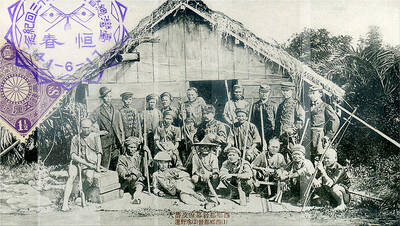
Traditionally, indigenous people in Taiwan’s mountains practice swidden cultivation, or “slash and burn” agriculture, a practice common in human history. According to a 2016 research article in the International Journal of Environmental Sustainability, among the Atayal people, this began with a search for suitable forested slopeland. The trees are burnt for fertilizer and the land cleared of stones. The stones and wood are then piled up to make fences, while both dead and standing trees are retained on the plot. The fences are used to grow climbing crops like squash and beans. The plot itself supports farming for three years.
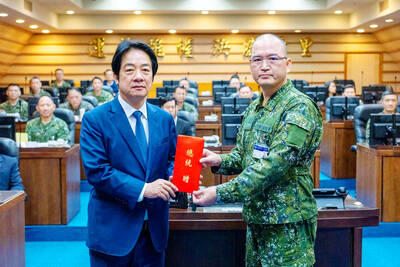
President William Lai (賴清德) on Nov. 25 last year announced in a Washington Post op-ed that “my government will introduce a historic US$40 billion supplementary defense budget, an investment that underscores our commitment to defending Taiwan’s democracy.” Lai promised “significant new arms acquisitions from the United States” and to “invest in cutting-edge technologies and expand Taiwan’s defense industrial base,” to “bolster deterrence by inserting greater costs and uncertainties into Beijing’s decision-making on the use of force.” Announcing it in the Washington Post was a strategic gamble, both geopolitically and domestically, with Taiwan’s international credibility at stake. But Lai’s message was exactly


 RSS
RSS