


Standing before a two-story-tall pile of chicken manure, Lee Richardson pondered how times had changed.
“When I left school and started working the land, this stuff was seen as farmer’s gold,” said Richardson, 38, a fifth-generation chicken grower, explaining that the waste was an ideal fertilizer for the region’s sandy soil. “Now, it’s too much of a good thing.”
How to handle the 295 million kilograms of chicken manure produced in Maryland each year has sparked a fierce debate between environmentalists and the state’s powerful poultry industry. State officials hope to bring Maryland in line with most other US states next month by enacting new rules for where, how and how long chicken farmers can spread the manure on their fields or store it in outdoor piles.
“We don’t let hog or dairy farms spread their waste unregulated, and we wouldn’t let a town of 25,000 people dump human manure untreated on open lands,” said Gerald W. Winegrad, a public policy professor at the University of Maryland who is a former state senator. “So why should we allow a farm with 150,000 chickens do it?”
As the amount of cropland in Maryland has shrunk and the number of chickens raised has grown to 570 million, these mountains of manure have become a liability because the excess is washing into the Chesapeake Bay, one of the nation’s most polluted estuaries, and further worsening the plight of the fishermen who ply its waters.
But the chicken farmers say that they are already doing their part to protect the environment and that the proposed regulations come as the industry is reeling from record-high energy and feed prices.
“This will absolutely kill anyone coming into the poultry industry,” Kenny Bounds, a government affairs officer for Mid-Atlantic Farm Credit, said at one of three public hearings in the last month, where farmers objected to the regulations and said the rules might push some growers out of the state.
The poultry industry in Maryland, the state’s most lucrative form of agriculture and one of its largest employers, has expanded to feed the nation’s growing hunger for cheap chicken.
‘ONE OF THE BAY’S BIGGEST POLLUTERS’
The lower prices, however, are possible only from huge economies of scale. And the bigger the farms, the more birds and the more manure there are to handle.
State officials have started to realize that there are consequences to being able to sell skinless, boneless chicken breast for roughly just over US$4 per kilogram when virtually no other protein source with so little fat is that cheap, Winegrad said.
Environmentalists and state officials have also become frustrated that after more than a decade of spending over US$100 million a year in state money on restoration efforts, the Chesapeake, unlike most other mid-Atlantic waterways, has only grown more polluted.
As the phosphorous and nitrogen levels in the bay have grown, so have the algae that deplete oxygen needed by other aquatic life.
In the past two decades, working oystermen on the bay have dropped to less than 500, from 6,000. The crab population has fallen by 70 percent.
“A lot of chicken farmers are already doing the right thing when it comes to pollution,” said Larry Simns, president of the Maryland Watermen’s Association, adding that he thought the poultry regulations would be a step in the right direction. “But there needs to be more done to make sure that everyone does the right thing.”
Under the state’s proposed rules, 75 to 100 of the 800 largest poultry farmers in Maryland would have to apply for permits to handle manure. State officials would also begin inspecting these farms unannounced and levying heavy fines if violations are not eventually corrected. The rules would not affect smaller farms.
Michele Merkel, a lawyer with the Waterkeeper Alliance, an environmental advocacy group, said the permits did not go far enough. Too few farms would be required to have them, Merkel said, and they allow farmers to pile the waste in their fields open to the rain for 90 days, while most other states permit it to be uncovered for only 14 days.
Maryland is most famous for its blue crabs, oysters and watermen, so it has a lot to lose from polluting these waters, Merkel said.
“That’s exactly why it’s never made sense to me,” she said, “that the state is so unwilling to really regulate one of the bay’s biggest polluters.”
The economic might of the poultry industry is certainly part of the reason.
Concentrated in Somerset, Wicomico and Worcester and counties along the state’s Eastern Shore, the industry contributes more than US$700 million annually to the Maryland economy.
For every job added on a chicken farm, seven related jobs are created in slaughterhouses, construction and trucking, according to industry estimates.
Just inland from the shore, the scope of the farms overwhelms the senses. The 150m-long chicken houses stretch from the roadways like airplane hangars.
Inside each house, 20,000 to 35,000 chickens cramp the floors farther than the eye can see. Feed and water are delivered in automated pipes that stretch the length of the houses.
Corn and soy fields separate the houses from the roads, and three-quarters of the state’s crop go toward feeding the birds.
THE AROMA OF AMMONIA
Gigantic fans suction ammonia from the birds’ waste, filling the air for kilometers around.
Under the proposed regulations, chicken growers would be required to maintain a 11m-wide filter strip of vegetation along streams and ditches, or not to apply manure within 15m of streams or 3m of ditches, and they would be required to keep manure piles more than 30m from streams. The permits would also assess fines of up to US$32,500 per day if farmers did not correct problems after being told to do so.
The liability for the manure would fall to the growers who raise the chickens, rather than the larger companies that own the birds, provide the feed and drop off a new batch of chicks every eight weeks.
Bill Satterfield, director of the local poultry trade association, Delmarva Poultry Industry Inc, said the farmers were an important engine for the state’s economic well-being.
“We’re also already doing our part when it comes to the environment,” Satterfield said.
Farmers already work to plant trees and environmental buffers around chicken houses and feed the birds an ingredient to cut down on the phosphorous in their manure. They also recycle some of their manure in the world’s largest chicken manure recycling plant, which produces organic fertilizer pellets that can be shipped elsewhere.
Storm runoff from urban areas, lawn fertilizers and pollution from cars and sewage treatment plants also play major roles in polluting the bay. But US Environmental Protection Agency officials say that agriculture is the largest single source of pollutants and sediment in the Chesapeake Bay, accounting for over 40 percent of the nitrogen and phosphorous and over 70 percent of the sediment.
State officials say that animal manure produces more phosphorus and nearly the same amount of nitrogen pollution as all human wastewater from treatment plants in the state.
Although the dairy and hog industry in states near the bay produce more kilograms of manure, poultry waste has more than twice the concentration of pollutants per kilogram. Reducing pollution from agriculture is also about a tenth as costly as it is to achieve the same reductions from urban development, state and federal environmental officials say.
“The reason to focus on poultry,” said Tom Simpson, executive director of Water Stewardship, an environmental nonprofit agency, “is that sewage treatment plants have already been required to reduce their pollution and storm water runoff from cities, and large dairy and hog farms have permits that can be used to limit their water pollution.”
But in the past two decades, the poultry industry has carved a special role for itself in terms of the oversight it receives, and it has twice defeated state efforts to impose permits.
FOXES IN CHARGE OF THE HENHOUSE
Maryland is one of the only states where the poultry industry is regulated by the state Department of Agriculture, whose primary mission is helping farmers, and not by the state Department of the Environment, which is charged with enforcing pollution laws.
Most other states with large poultry farms already require the permits and regular inspections.
In Maryland, however, chicken farmers have only had to file nutrient management plans with state agriculture officials, describing how they control their chicken waste each year.
These documents are not public. The guidelines for manure storage are optional, and the fine for not filing a plan is US$350.
Standing in front of his pickup truck with a bumper sticker that said “It’s not farmland without farmers,” Richardson shook his head in frustration.
“As far as I can tell, the current system works fine except a few bad apples,” he said. “What they are proposing now is just more cost for us growers and more time doing paperwork.”
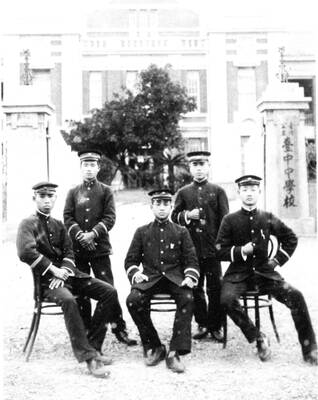
April 28 to May 4 During the Japanese colonial era, a city’s “first” high school typically served Japanese students, while Taiwanese attended the “second” high school. Only in Taichung was this reversed. That’s because when Taichung First High School opened its doors on May 1, 1915 to serve Taiwanese students who were previously barred from secondary education, it was the only high school in town. Former principal Hideo Azukisawa threatened to quit when the government in 1922 attempted to transfer the “first” designation to a new local high school for Japanese students, leading to this unusual situation. Prior to the Taichung First
The Ministry of Education last month proposed a nationwide ban on mobile devices in schools, aiming to curb concerns over student phone addiction. Under the revised regulation, which will take effect in August, teachers and schools will be required to collect mobile devices — including phones, laptops and wearables devices — for safekeeping during school hours, unless they are being used for educational purposes. For Chang Fong-ching (張鳳琴), the ban will have a positive impact. “It’s a good move,” says the professor in the department of
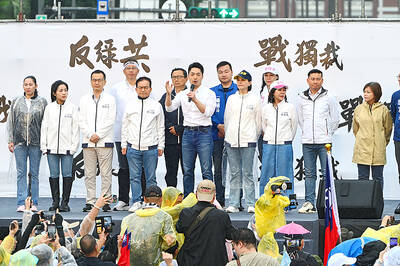
On April 17, Chinese Nationalist Party (KMT) Chairman Eric Chu (朱立倫) launched a bold campaign to revive and revitalize the KMT base by calling for an impromptu rally at the Taipei prosecutor’s offices to protest recent arrests of KMT recall campaigners over allegations of forgery and fraud involving signatures of dead voters. The protest had no time to apply for permits and was illegal, but that played into the sense of opposition grievance at alleged weaponization of the judiciary by the Democratic Progressive Party (DPP) to “annihilate” the opposition parties. Blamed for faltering recall campaigns and faced with a KMT chair
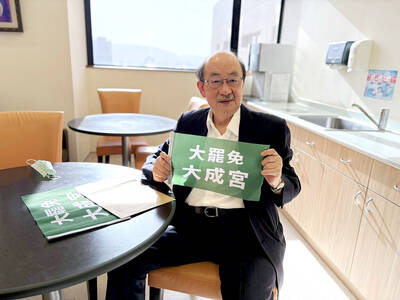
Article 2 of the Additional Articles of the Constitution of the Republic of China (中華民國憲法增修條文) stipulates that upon a vote of no confidence in the premier, the president can dissolve the legislature within 10 days. If the legislature is dissolved, a new legislative election must be held within 60 days, and the legislators’ terms will then be reckoned from that election. Two weeks ago Taipei Mayor Chiang Wan-an (蔣萬安) of the Chinese Nationalist Party (KMT) proposed that the legislature hold a vote of no confidence in the premier and dare the president to dissolve the legislature. The legislature is currently controlled


 RSS
RSS