


“When the composer first asked me to write the libretto for an opera he had in mind about George Mackay, I declined. I think he thought of me because I’d combined music and theater as double majors for my degree in the US, as well as because of my experience with opera here in Taipei. But I sensed he also wanted a Christian to do the job, and I knew I didn’t fit that requirement,” said Joyce Chiou (邱瑗) in her stylish office at the National Symphony Orchestra’s (NSO, 國家交響樂團) Taipei premises. Together with her other work she’s the orchestra’s Executive Director.
“Later, though, I had second thoughts, largely as a result of discovering MacKay’s support of the education for women here in Taiwan. I’d assumed beforehand that everything he did was really a part of his wider program as a missionary — basically that he wanted people to be educated in order to make them Christians. But once I got to know more about him I saw he was a more complex figure, and I so changed my mind.”
Chiou puts on a CD of some early work on The Black Bearded Bible Man, the massive opera about the 19th-century Canadian missionary to Taiwan, George MacKay, that will be given its world premiere in Taipei with the NSO on Nov. 27.
“That’s an American, singing in Taiwanese!” she said excitedly. “Isn’t that amazing? It’s Thomas Meglioranza from New York. OK, his wife’s Taiwanese, but he’d never attempted to learn the language until he got this part.
“The opera’s almost all sung in Taiwanese, with only 10 percent in English, such as when MacKay first arrives on the island and doesn’t yet know the language. Actually, this was also part of the problem for me in accepting the commission. I’d spoken Taiwanese as a child here in Taiwan, but I wasn’t too confident about writing in it, especially with rhymes. Did you know MacKay himself wrote a Taiwanese-English dictionary, using the Roman alphabet for Taiwanese?”
I said that judging from the CD, the music was going to be lyrical rather than abstruse.
“I think Gordon wanted it to be more contemporary, but then when he saw my words he realized it was going to have to be more accessible,” Chiou replied, referring to the opera’s composer Gordon Shi-wen Chin (金希文).
As well as producing and helping direct operas, Chiou has written a guide to Broadway musicals, and another called Behind the Mask: Phantom of the Opera, so I guessed in advance that her approach would probably be fairly lyrical and popular.
I asked whether, if MacKay wasn’t going to be presented only as a missionary, he was going to be shown as a man with conflicts.
“Oh yes,” she says. “I actually had a church service in the first draft, but it didn’t seem very dramatic so I cut it. Instead, I concentrated on the theatrical values of conflict and tension. The opera opens with his death, and all the rest is flashback, until you come to his death again at the end, and then in essence we repeat the first scene.”
This is a powerful technique, showing something that the audience doesn’t understand the first time round but which, by the time it repeats itself, is understood by everyone; this bodes well for the opera.
Among the other important characters are MacKay’s Taiwanese wife (sung by Chen Mei-ling (陳美玲) and two of his male followers, sung by the Korean tenor Choi Seung-jin and Taiwan’s Liau Chong-boon (廖聰文). The opera, over three hours long and with two intervals, will be directed by Germany’s Lukas Hemleb and conducted by Chien Wen-pin (簡文彬).
“There’s no extant film of MacKay, but I believe the production will use a lot of film nonetheless, made up from the many black-and-white still photos of him that do survive. MacKay had always wanted to come to the Far East, but he wandered around a lot — Fujian Province, Guandong, southern Taiwan — before settling in Tamshui. He said it was the sight of Guanyin Mountain (觀音山) that convinced him it was the right place,” Chiou said.
“There’s a lot of choral writing in the score. I had the sense that, with some important exceptions, the Taiwanese tended to act in groups rather than as individuals in those days, and as Gordon Chin has also written a lot of choral music in the past, there’s a lot in this opera. I took my inspiration for how to use people singing in groups from ancient Greek tragedy and from Les Miserables.”
Chiou started to work in her present position with the NSO in June, 2006. She had worked for the National Chiang Kai-shek Cultural Center in various roles before that, and had gained extensive experience in university administration during a long stay in Vancouver from 1997 to 2004.
But The Black Bearded Bible Man seemed a more interesting topic than administration, so we returned to that.
“I did a lot of my research about MacKay at Oxford College in Tamshui,” Chiou said. “They have a small library devoted to him. He died in Tamshui in 1901, aged 58.” He’d been there 29 years, apart from a brief period in Hong Kong. His last six years in Taiwan were during the Japanese occupation, but Chiou said she hadn’t included this as the opera was long enough as it was. But anti-foreigner sentiment during the Sino-French war of 1884 to 1885 formed a potent element in the plot, she added.
“Essentially I present MacKay as a man who wanted to improve the lot of the Taiwanese people in any way he could. The villagers were afraid of him at first so he began learning Taiwanese from the children. He practiced dentistry and founded hospitals. All in all, the more I read about him the more I came to admire him,” Chiou said.
As I left, I found myself wondering how many affluent modern Taiwanese will be interested in seeing a stage show about their under-privileged past. But it was too late to ask Chiou her opinion on the matter. She’d obviously be optimistic anyway, I decided. The attendances at the four performances at the end of the month will settle the question one way or the other.
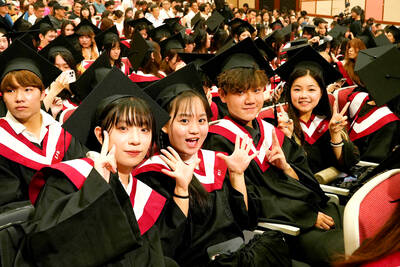
Taiwan’s English education system is being pulled apart by three opposing forces. Bilingual Nation 2030 pulls students toward English and global communication. Artificial Intelligence (AI) readiness pulls them toward digital judgment, verification and AI-mediated work. But Taiwan’s old exam culture pulls them back toward memorization, grammar drills, timed reading and correct answers. If the education system keeps using old exams to define success, it risks producing graduates who are neither genuinely bilingual nor genuinely AI-ready, but trained for tasks machines can already perform. The first force is Bilingual Nation 2030. Launched in 2018, the policy aimed to “help Taiwan’s workforce connect
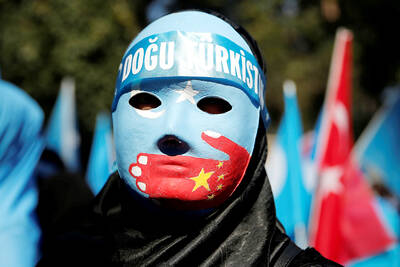
It seems every few days one bumps into one of those “real man” comments in which Taiwan is urged to “face reality” or similar, and “make a deal,” with the speaker implying that soon it will be too late. “Deal” advocates always present themselves as having a superior grip on reality, and the manly ability to make the “hard choice.” Their testosterone-laden language often echoes that of Taiwan sellout advocates. Note that such commentary always specifies a process (“make a deal, work with, make progress”), never the end state of what occupation by a violent authoritarian colonialist state will entail. In

“Taiwan’s Opposition Leader Comes to US With a Message Straight Out of Beijing” read a May 31 headline in the Wall Street Journal. Top US administration officials and members of Congress almost certainly read the WSJ, and if there was a bullet point takeaway that people in Washington should absorb ahead of Chinese Nationalist Party (KMT) Chair Cheng Li-wun’s (鄭麗文) arrival in DC on June 9, that headline is it. The last few columns have discussed this very topic, and the timing is not coincidental. While those top officials likely do not read the Taipei Times, judging by the number
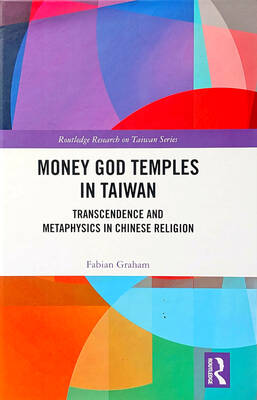
As someone who normally steers clear of books with “transcendence” or “metaphysics” in their subtitles, this reviewer — a casual observer of local belief systems since the 1990s — found Fabian Graham’s Money God Temples in Taiwan a challenging read. Those who’ve only dipped their toes into temple culture will likely need to parse several sections with special care if they’re to keep up with the author, a British ethnographic researcher whose previous books have investigated religious practices among ethnic Chinese in Southeast Asia. This scholarly volume examines a facet of Taiwan’s religious landscape that didn’t exist a century ago, and


 RSS
RSS