


Orz Boyz (囧男孩), a feature debut by award-winning playwright, novelist and director Yang Ya-che (楊雅吉吉), tackles a genre not much favored in Taiwanese cinema — children’s film. With witty dialogue, an affectionate mood and two untutored child actors, his effort is a triumph that can be enjoyed by children and adults alike.
The film tells a bittersweet tale about two best friends in elementary school. Branded as the school’s biggest troublemakers, the two friends, Liar No. 2 (played by Pan Chin-yu) and older classmate Liar No. 1 (played by Li Kuan-i), are inseparable. Together they tease girls, play pranks on classmates, summon imaginary ghosts, and more. Their teacher, unable to cope, sends them to the library to repair books every day. Instead of fixing books, the more literate No. 1 becomes a great storyteller, reading stories to his one-man audience, No. 2. Their imaginations run wild, allowing the two to escape from their troubled home lives.
The friends decide to save money to go to a water park together. The spiral waterslide at the park, as they believe, is a portal to Oz, a wonderland where children turn instantly into adults and live happily ever after.
Competently scripted and directed, the film doesn’t rely on expensive CGI effects to recreate the fantastic world of childhood. Instead, the children’s whimsical cosmos is brought to life through innocent escapades and imaginative games. Hints are given of the boys’ difficult family situations to build up psychological depth. The audience gradually learns that No. 2 and his baby cousin are being raised by their elderly grandmother and that No. 1 lives in a shack on a bend of the Tamsui River with his mentally disturbed father.
By alternating the boys’ lives with charming animation sequences inspired by Oscar Wilde’s The Happy Prince and the Brothers Grimm’s Pied Piper of Hamelin, Yang ingeniously leaves room for the audience to reflect and reminisce on fragments of their own memories. Animator Fish’s contribution to the film is worth a special mention for his work in realizing a dreamy Taiwanese cityscape lit by neon signs and filled with concrete buildings, above which the Happy Prince stands.
But it is the two child actors who are the real stars of the show and give the film its special glow. Though neither has been formally trained in acting, they are as natural as the most experienced veterans and share amazing onscreen chemistry. Comedians by nature, they create some of the film’s most hilarious moments with veteran actress Mei Fang (梅芳), whose grandmother character is arguably the most lovable adult role seen on the big screen in years.
Orz Boyz (囧男孩) proves that with a well-written story and strong cast, local productions can be more attractive than Hollywood blockbusters, for here are familiar scenes of traditional markets, street life and school life, grandparent figures and childhood memories that speak directly to a local audience.

Taiwan’s English education system is being pulled apart by three opposing forces. Bilingual Nation 2030 pulls students toward English and global communication. Artificial Intelligence (AI) readiness pulls them toward digital judgment, verification and AI-mediated work. But Taiwan’s old exam culture pulls them back toward memorization, grammar drills, timed reading and correct answers. If the education system keeps using old exams to define success, it risks producing graduates who are neither genuinely bilingual nor genuinely AI-ready, but trained for tasks machines can already perform. The first force is Bilingual Nation 2030. Launched in 2018, the policy aimed to “help Taiwan’s workforce connect
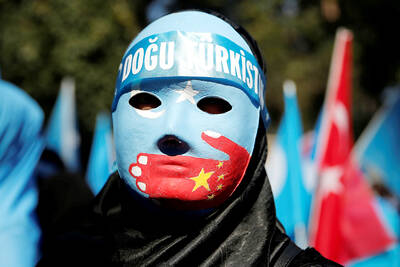
It seems every few days one bumps into one of those “real man” comments in which Taiwan is urged to “face reality” or similar, and “make a deal,” with the speaker implying that soon it will be too late. “Deal” advocates always present themselves as having a superior grip on reality, and the manly ability to make the “hard choice.” Their testosterone-laden language often echoes that of Taiwan sellout advocates. Note that such commentary always specifies a process (“make a deal, work with, make progress”), never the end state of what occupation by a violent authoritarian colonialist state will entail. In

There are shadowy cabals plotting to sell out Taiwan to be annexed by China, by invasion if necessary. Fortunately, they are buffoons. In 2019, former Bamboo Union gangster and founder of the China Unification Promotion Party (CUPP), Chang An-le (張安樂, colorfully known as “White Wolf”), led a protest at the Legislative Yuan against comments made by then-premier Su Tseng-chang (蘇貞昌) that in the event of an attack by China, he would never surrender, but would protect the nation by fighting to the end, even if he only had a broom. Chang had party members bring a wooden casket that they
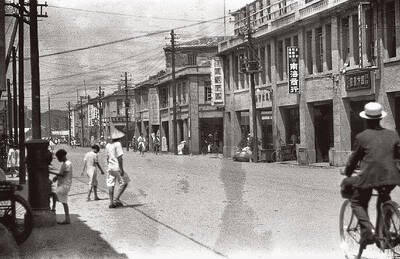
June 1 to June 7 "If all Taiwanese were as afraid of dying as you, then what would happen?” Physician Shih Chiang-nan (施江南) reportedly said this to his wife Chen Chiao-tung (陳焦桐) after she urged him to stop intervening on behalf of Taiwanese soldiers stranded overseas after serving in the Japanese Army during World War II. Shih had clashed with high-ranking officials over the issue, engaged in several heated arguments with Taiwan governor-general Chen Yi (陳儀) and allegedly shouted at general Ko Yuan-fen (柯遠芬), chief of staff of the Taiwan Garrison Command, over


 RSS
RSS