


Let me be blunt: You Don’t Mess With the Zohan is the finest post-Zionist action-hairdressing sex comedy I have ever seen. That it is the only one I have ever seen — and why is that? what cultural deficiency or ideological conspiracy has prevented this genre from flourishing? — does not much detract from my judgment.
Directed by Dennis Dugan from a script by Judd Apatow, Robert Smigel and Adam Sandler (who also stars), Zohan has its share of scatology, crude sexual humor and queasy homophobia, the basic elements from which male-centered Hollywood comedies are constructed these days. There are supporting roles for stand-up comedians (Ahmed Ahmed, Nick Swardson) and Saturday Night Live veterans (Rob Schneider, Kevin Nealon), a few oddball cameos (Shelley Berman, Chris Rock) and exquisitely random “as themselves” appearances by John McEnroe and Mariah Carey. Why not? Less amusingly, there are also some lumpy computer-assisted special effects, an overstuffed plot and a scattering of awkwardly executed gags. But a lot of the crude bodily-function jokes are actually pretty funny, not least because they are supplemented by more hummus-based humor than you might have thought possible.
You might also think, as I certainly did, that the Israeli-Palestinian conflict presents a singularly unpromising source of laughs. But as Yitzhak Rabin once said, enough of blood and tears. He did not go on to propose semen, urine, shampoo or hummus as substitutes, but those are, for Dugan, Smigel, Apatow and Sandler, the substances that come most readily to hand. (So does a made-up but scarily realistic Israeli soft drink called Fizzy-Bubbeleh.)
And the filmmakers spray all this stuff around in a brave and noble cause. US diplomatic efforts have so far proved inadequate to the task of bringing peace to the Middle East, but You Don’t Mess With the Zohan taps into deeper and more durable sources of American global power in its quest for a plausible end to hostilities. Ancient grievances and festering hatreds are no match for the forces of sex, money, celebrity and exuberant, unapologetic stupidity.
Zohan (Sandler) certainly seems to think so, though he might express his views differently, and certainly with a thicker accent. A highly skilled military operative who specializes in counterterrorism, he is basically a less anguished version of the character played by Eric Bana in Munich. The brilliant opening sequence places him in a tableau that would bring a tear to Theodor Herzl’s eye. Whether it would be a tear of joy or dismay I will leave to more seasoned polemicists, but there is something both appealing and authentic about a vision of the Jewish state on its 60th birthday that emphasizes lithe young bodies frolicking, flirting and playing Hacky Sack on the beach. If you will it, it is no dream.
But only part of Zohan’s life is carefree, and it’s the other part — the job that requires heavy weapons, deadly stealth and hand-to-hand combat with a superterrorist called the Phantom (John Turturro) — that drives him into the diaspora. Zohan may have a picture of Moshe Dayan on his bedroom wall, but his real idol is Paul Mitchell, the American hair-care mogul whose outdated styles Zohan studies as if they were pages of the Talmud. He wants to stop fighting and cut “silky smooth” hair. And so, like everyone else with a dream, he migrates to New York, where he finds an entry-level job at a salon run by a pretty Palestinian named Dalia (Emmanuelle Chriqui).
A romance between them seems at once inevitable and unthinkable, but the taboos that You Don’t Mess With the Zohan is unwilling to smash are few indeed. The movie is principally interested in establishing its main character as a new archetype in the annals of Jewish humor. He’s a warrior and also, to an extent undreamed of in the combined works of Philip Roth, Woody Allen and Howard Stern, a sexual hedonist, so utterly free of neurosis or inhibition that it’s hard to imagine him and Sigmund Freud occupying the same planet, much less the same cultural-religious tradition.
Sex, for Zohan, is like hummus: there is an endless supply, and no occasion on which it could be judged inappropriate. He is always on the make, but Sandler’s natural sweetness inoculates the character against sleaziness. In his feathery 1980s haircut and loud, half-buttoned shirts, Zohan joins a long tradition, stretching back from Will Ferrell through Steve Martin to the great Jerry Lewis himself, of goofballs who mistake themselves for studs and turn out to be right.
The film’s image of Israelis as hopelessly behind the pop-culture curve — Zohan’s musical taste belongs to the same era as his hairdo — is itself something of an anachronism. The hip-hop-inflected Hebrew pop on the soundtrack (by Hadag Nachash) provides some evidence that real Israelis are much cooler than the ones on screen. And the willingness of the American Jewish filmmakers to mock their Middle Eastern cousins is also a subtle, unmistakable sign of cultural maturity.
“Subtle” and “maturity” may seem like odd words to use about a movie that wrings big laughs from pelvic gyrations, indoor Hacky Sack and filthy-sounding fake-Hebrew and -Arabic words. But much as it revels in its own infantilism, You Don’t Mess With the Zohan is also brazenly self-confident in its refusal to pander to the imagined sensitivity of its audience. In this it differs notably from Albert Brooks’s Looking for Comedy in the Muslim World, which approached some of the same topics with misplaced thoughtfulness and tact.
I suppose some Middle East policy-scolds may find reasons to quarrel with Zohan, either for being too evenhanded or not evenhanded enough in its treatment of Israelis and Palestinians. Did I mention that it’s a comedy? Seriously, though, the movie’s radical, utopian and perfectly obvious point is that the endless collection and recitation of political grievances is not funny at all, and that political strife is a trivial distraction from the things that really matter. There is so much hummus, and so little time.

If one asks Taiwanese why house prices are so high or why the nation is so built up or why certain policies cannot be carried out, one common answer is that “Taiwan is too small.” This is actually true, though not in the way people think. The National Property Administration (NPA), responsible for tracking and managing the government’s real estate assets, maintains statistics on how much land the government owns. As of the end of last year, land for official use constituted 293,655 hectares, for public use 1,732,513 hectares, for non-public use 216,972 hectares and for state enterprises 34 hectares, yielding

The small platform at Duoliang Train Station in Taitung County’s Taimali Township (太麻里) served villagers from 1992 to 2006, but was eventually shut down due to lack of use. Just 10 years later, the abandoned train station had become widely known as the most beautiful station in Taiwan, and visitors were so frequent that the village had to start restricting traffic. Nowadays, Duoliang Village (多良) is known as a bit of a tourist trap, with a mandatory, albeit modest, admission fee of NT$10 giving access to a crowded lane of vendors with a mediocre view of the ocean and the trains
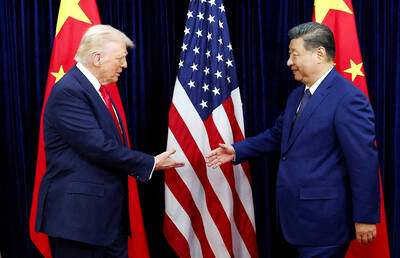
The March/April volume of Foreign Affairs, long a purveyor of pro-China pablum, offered up another irksome Beijing-speak on the issues and solutions for the problems vexing the People’s Republic of China (PRC) and the US: “America and China at the Edge of Ruin: A Last Chance to Step Back From the Brink” rang the provocative title, by David M. Lampton and Wang Jisi (王緝思). If one ever wants to describe what went wrong with US-PRC relations, the career of Wang Jisi is a good place to start. Wang has extensive experience in the US and the West. He was a visiting

One of the challenges with the sheer availability of food in today’s world is that lots of us end up spending many of our waking hours eating. Whether it’s full meals, snacks or desserts, scientists have found that it’s not uncommon for us to be mindlessly grazing at some point during all of our 16 or so waking hours. The problem? As soon as this food hits the bloodstream in the form of glucose, it initiates the release of the hormone insulin. This in turn activates a switch present in every one of our cells, which is responsible for driving cell


 RSS
RSS