


It’s been a good year for Kou Chou Ching (拷秋勤), the hip-hop group known for sampling traditional Taiwanese music and rapping in Hoklo (commonly known as Taiwanese) and Hakka. The outfit gained mainstream recognition when its latest album was nominated for several Golden Melody Awards — Taiwan’s equivalent of the Grammy Awards. The group enjoys a steady gigging schedule, and just completed a mini-tour of Tokyo rock clubs at the invitation of Japanese indie label People’s Records.
I met three of Kou Chou Ching’s five members, MCs Fan Chiang (范姜) and FishLin and DJ J-Chen, at a coffee shop near their studio in Shilin (士林). The mild-mannered and down-to-earth MCs, who look and dress like typical university students, quietly teased their slightly goofy DJ, who sported an obvious “hip-hop” look with his trucker’s mesh hat.
Taipei Times: How did Japanese audiences respond to your music?
J-Chen: The audiences didn’t understand the [language] of our music, but they were very willing to listen to the melodies, and move to the beat — this doesn’t happen in Taiwan. In Taiwan, they put their hands under their arms, and mostly just look at you coldly. When we tell them to raise their hands in the air, they’ll raise them but lower them right away. In Japan, they’ll just dance, dance, dance.
TT: Why do Japanese audiences dance so much? Aren’t they in the same position as Taiwanese audience members who don’t understand Hakka, for example?
JC: That’s because of the music, and not because of …
FishLin: ... whether or not you can communicate in the language.
Fan Chiang: [The Japanese seem] to care more about whether the music sounds good or not. In Taiwan, you don’t often get the feeling that people actually enjoy music for the sake of music. For example, say you’re enjoying the music, you might start dancing. This is not as common in Taiwan.
TT: Why is that?
JC: Personality.
FC: The Taiwanese are generally shyer.
FL: If you’re really getting into it and start dancing, people will stare at you.
JC: They’ll think you’re strange … and they’ll take a step back.
FC: Mainly it’s because they’re shy. It’s like in school — when you’re in class and you raise your hand when the teacher asks if there are any questions, people think you’re strange/weird.
TT: But don’t you think this is changing for the better?
JC: Very slowly!
FL: In Taiwan, there are some scenes that are pretty entertaining, with a [good] atmosphere — last year we went to the Taike Rock Concert (台客搖滾嘉年華) ...
JC: Everyone, even the baimin (白民, ordinary folks), enjoyed it.
FC: It’s the same with the Ho-Hai-Yan music festival.
FL: If it’s a more official event held by somebody like the Council for Hakka Affairs or the Government Information Office, not as many people come to hear music — or else they come to listen to Hakka folk music or more normal, intimate music.
As the global hip-hop phenomenon has made a clear mark on the fashion and pop music industries, Kou Chou Ching has distinguished itself by defying the genre’s conventional stereotypes. There is no “gangsta” romance in their music; instead they rap about how Taiwanese kids need to avoid violence. There is little desire for bling and wealth. The group is preparing to sell its own line of hip-hop clothing, but with the profits marked for charity organizations and NGOs. Yet, the group’s members do not dwell on what sets them apart; their main interest lies in all things music.
TT: What’s the current state of Taiwan’s hip-hop scene?
FL: In Tainan, there used to be a group of rappers that focused a lot on freestyle and rapping skills. But right now it seems like the creativity is happening in Taipei — because in Tainan, even though they did a lot of rapping, not many people were writing their own music.
They would use foreign instrumentals ... but they didn’t really write their own music. What makes Taipei’s scene great is more people here write their own music. Maybe it’s because of the US and Japan’s influence ... there are a few hip-hop jazz groups starting to come out now in Taipei ... It used to be that a lot of people wanted to learn American gangsta rap, more hard-core, tougher stuff. But now it’s becoming more diversified.
FC: But I think one problem is that there’s no new generation ... Many groups out there now are already two or three years old, and even fewer new groups are coming out. This isn’t just happening in hip-hop but it’s also the same for indie bands ... There are fewer new bands nowadays that are making good music and have a big following.
JC: It’s hard for bands in Taiwan to keep it going because of [compulsory] military service ... It often causes bands to break up.
TT: But wouldn’t a band just continue on after they finish their service?
J-Chen: People then get jobs … they give up the dream of doing music.
TT: Where’s Taiwan hip-hop headed?
FC: It’s moving toward many styles ... before everyone just liked gangsta rap. More groups are also releasing their own CDs.
TT: What’s in store musically for Kou Chou Ching?
FL: I think that you don’t only need hip-hop beats to rap … Our beats in the future will probably include drum n’ bass, house, to which we will add rap. We don’t just listen to hip-hop but a lot of other music too, so we’ll be trying other styles.
TT: So you’re leaning towards electronic music.
FL: Electronic, but reggae too. But we will keep adding traditional [Taiwanese music samples] to electronic and maybe even reggae music. We’ve starting to realize that they are compatible.
TT: Where do you get your music samples?
FL: For traditional music, night markets. Some places in the countryside, temples sell their own CDs of traditional opera music.
FC: On Huaxi Street (華西街) there’s a place that sells cassette tapes [of old Taiwanese songs]. We’ll buy tapes there to make into samples … I’ve also had this idea of recording on the street, where you sometimes see these tough old ladies bawling someone out … the way they yell — that feeling is a lot like rap. And it’s very rhythmic. We could tape that and put it to a rhythm track, make an intro to a song. I think that would be really cool.
Kou Chou Ching’s next show is on Thursday, 8:30pm, at the Ilan County Stadium (宜蘭縣立體育館). Visit the group’s blog at blog.roodo.com/kou/ or Web site at www.kou.com.tw for details.
[This interview has been edited and condensed.]
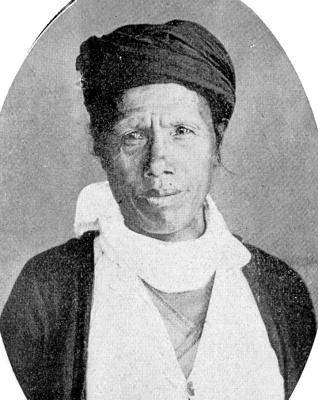
May 11 to May 17 Traversing the southern slopes of the Yushan Range in 1931, Japanese naturalist Tadao Kano knew he was approaching the last swath of Taiwan still beyond colonial control. The “vast, unknown territory,” protected by the “fierce” Bunun headman Dahu Ali, was “filled with an utterly endless jungle that choked the mountains and valleys,” Kano wrote. He noted how the group had “refused to submit to the measures of our authorities and entrenched themselves deep in these mountains … living a free existence spent chasing deer in the morning and seeking serow in the evening,” even describing them as

As a different column was being written, the big news dropped that Chinese Nationalist Party (KMT) caucus whip Fu Kun-chi (傅?萁) announced that negotiations within his caucus, with legislative speaker Han Kuo-yu (韓國瑜) of the KMT, party Chair Cheng Li-wun (鄭麗文), Taichung Mayor Lu Shiow-yen (盧秀燕) and Taiwan People’s Party (TPP) Chair Huang Kuo-chang (黃國昌) had produced a compromise special military budget proposal. On Thursday morning, prior to meeting with Cheng over a lunch of beef noodles, Lu reiterated her support for a budget of NT$800 or NT$900 billion — but refused to comment after the meeting. Right after Fu’s

Yesterday, the Democratic Progressive Party (DPP) nominated legislator Puma Shen (沈伯洋) as their Taipei mayoral candidate, the Chinese Nationalist Party (KMT) put their stamp of approval on Wei Ping-cheng (魏平政) as their candidate for Changhua County commissioner and former legislator Tsai Pi-ru (蔡壁如) of the Taiwan People’s Party (TPP) has begun the process to also run in Changhua, though she has not yet been formally nominated. All three news items are bizarre. The DPP has struggled with settling on a Taipei nominee. The only candidate who declared interest was Enoch Wu (吳怡農), but the party seemed determined to nominate anyone
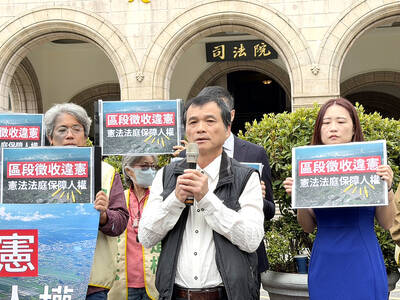
What government project has expropriated the most land in Taiwan? According to local media reports, it is the Taoyuan Aerotropolis, eating 2,500 hectares of land in its first phase, with more to come. Forty thousand people are expected to be displaced by the project. Naturally that enormous land grab is generating powerful pushback. Last week Chen Chien-ho (陳健和), a local resident of Jhuwei Borough (竹圍) in Taoyuan City’s Dayuan District (大園) filed a petition for constitutional review of the project after losing his case at the Taipei Administrative Court. The Administrative Court found in favor of nine other local landowners, but


 RSS
RSS