


Dressed in traditional Ukrainian Cossack attire, the all-female bandura ensemble Tcharivni Strouny will make its debut appearance in Taiwan on Wednesday. The group aims to introduce local audiences to the ancient plucked string instrument and a musical tradition that has been suppressed at various times through history.
The bandura combines elements of a lute and box zither, and its use dates back to the sixth century. From the 16th to 18th centuries the folk instrument underwent significant changes in the hands of Zaporozhian Cossacks who lived in Central Ukraine. The kobzar tradition was formed as Ukrainian itinerant Cossack bards popularized kobza music. The terms bandura and kobzar were interchangeable until the 20th century.
Sung to the accompaniment of the bandura, Tcharivni Strouny’s repertoire includes psalms, chants, folk songs and dumy, Ukrainian epics mainly concerned with historical events and religious beliefs.
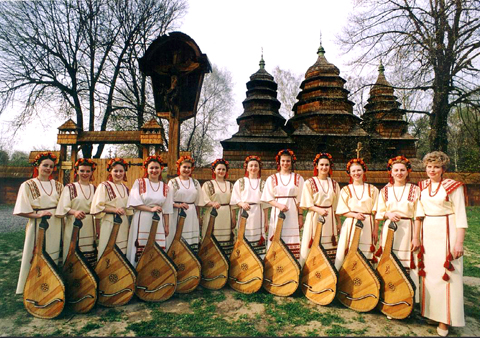
PHOTO COURTESY OF TCHARIVNI STROUNY
It’s because of their association with aspects of Ukrainian history and religious elements that bandurists and kobzari were systematically persecuted by authorities that once occupied the region, especially during Stalin’s purges of the 1930s.
Today, the bandura is taught at the nation’s major conservatories and ensembles have become increasingly popular both at home and abroad, including Tcharivni Strouny — Magic Strings & Voices. Founded by Iryna Sodomora in 1973, the award-winning group has participated in numerous national and international competitions, and performed across the globe from Croatia, Hungary, France to Canada and the US.
For Tcharivni Strouny’s Taiwan performances, conductor and lead soloist Sodomora will lead 12 bandura players and singers aged between 15 and 22 as well as violin and flute players. The bill includes a colorful mix of Western classical music from the likes of Mozart, and contemporary compositions by Ukrainian bandura artists and traditional songs.
Instead of dealing with the weighty subjects of history and religion, the folk melodies mainly address romances between beautiful girls and young men, laments for lost love as well as a husband’s complaints about his fastidious mother-in-law.

On a harsh winter afternoon last month, 2,000 protesters marched and chanted slogans such as “CCP out” and “Korea for Koreans” in Seoul’s popular Gangnam District. Participants — mostly students — wore caps printed with the Chinese characters for “exterminate communism” (滅共) and held banners reading “Heaven will destroy the Chinese Communist Party” (天滅中共). During the march, Park Jun-young, the leader of the protest organizer “Free University,” a conservative youth movement, who was on a hunger strike, collapsed after delivering a speech in sub-zero temperatures and was later hospitalized. Several protesters shaved their heads at the end of the demonstration. A
Google unveiled an artificial intelligence tool Wednesday that its scientists said would help unravel the mysteries of the human genome — and could one day lead to new treatments for diseases. The deep learning model AlphaGenome was hailed by outside researchers as a “breakthrough” that would let scientists study and even simulate the roots of difficult-to-treat genetic diseases. While the first complete map of the human genome in 2003 “gave us the book of life, reading it remained a challenge,” Pushmeet Kohli, vice president of research at Google DeepMind, told journalists. “We have the text,” he said, which is a sequence of
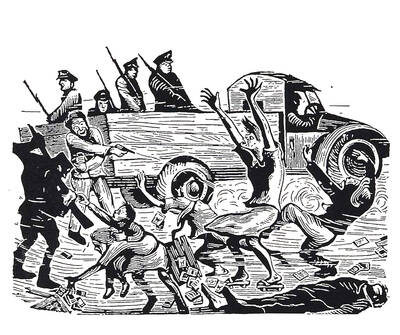
In August of 1949 American journalist Darrell Berrigan toured occupied Formosa and on Aug. 13 published “Should We Grab Formosa?” in the Saturday Evening Post. Berrigan, cataloguing the numerous horrors of corruption and looting the occupying Republic of China (ROC) was inflicting on the locals, advocated outright annexation of Taiwan by the US. He contended the islanders would welcome that. Berrigan also observed that the islanders were planning another revolt, and wrote of their “island nationalism.” The US position on Taiwan was well known there, and islanders, he said, had told him of US official statements that Taiwan had not
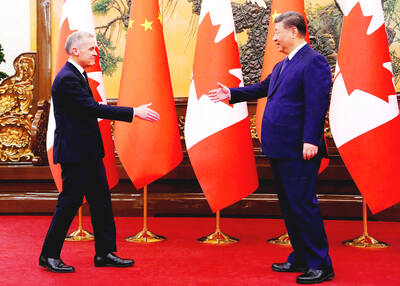
Britain’s Keir Starmer is the latest Western leader to thaw trade ties with China in a shift analysts say is driven by US tariff pressure and unease over US President Donald Trump’s volatile policy playbook. The prime minister’s Beijing visit this week to promote “pragmatic” co-operation comes on the heels of advances from the leaders of Canada, Ireland, France and Finland. Most were making the trip for the first time in years to refresh their partnership with the world’s second-largest economy. “There is a veritable race among European heads of government to meet with (Chinese leader) Xi Jinping (習近平),” said Hosuk Lee-Makiyama, director


 RSS
RSS