


When Chris Jordan talks about how he became an artist and an environmental activist, there is almost a sense of disbelief at his own transition. The former corporate lawyer left his lucrative practice five years ago to dedicate himself to photographing the world’s trash.
His photographic series Intolerable Beauty and Running the Numbers hit a nerve in the international community. He’s currently traveling as the National Geographic international eco-ambassador for Earth Day 2008 and has come to Taipei to open an exhibition of his work at the National Taiwan Democracy Memorial Hall (台灣民主紀念館), formerly known as the Chiang Kai-shek Memorial Hall, which will run until April 27.
“I basically had the American Dream in the palm of my hand,” Jordan said in an interview with the Taipei Times on Thursday. “I had everything you are suppose to have as an American. I was making a really good income. I had this really nice condo in downtown Seattle, and I was on a career path that was exactly what I aspired to ... and I was a deeply unhappy person.”

PHOTO COURTESY OF NGC
The son of creative parents, Jordan took to photography early on and focused on creating abstract compositions of color and line. The work that got him started on his new career path as an environmentally aware artist came about by accident.
“I have always been fascinated by color and it was soon after I left my law job that I was down in this industrial area of Seattle and I was doing a series that was about industrial color. ... One day I found this giant pile of garbage in this industrial yard and I made a photograph of this garbage. The only interest I had in it was the color, because it was really very beautiful. It looked like an impressionist painting ... because the packaging, the potato chip wrappers, and the orange juice cans, they use all these bright colors in the design, so when you pile it all up in a pile it is very colorful. So I made this photograph, and I thought it was the best color study that I had ever made. I put it on the wall of my studio, and people who saw it would often start discussing the issue of consumerism. It was kind of annoying, because they were misinterpreting my work ... , ’’ Jordan said.
Jordan said he was initially reluctant to concentrate on the theme of consumerism, but as he began to learn more about waste materials, he experienced “an awakening.”
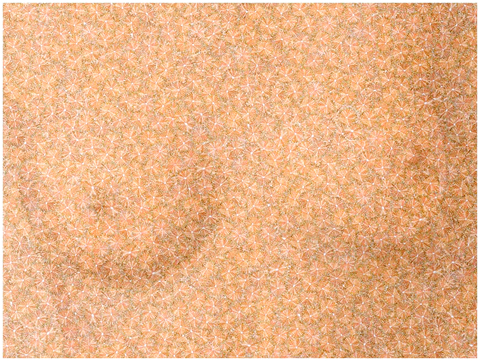
PHOTO COURTESY OF NGC
“This profoundly important issue has been right in front of my nose all these years, all the time I was a lawyer spending money like crazy. It was something like the experience that an alcoholic would have, waking up and realizing that ‘I am an alcoholic.’ I had been doing it all these years, but had not been willing to admit it, even to myself.”
The photographer attributes the success of his work at a time when artists of all types are banging the environmental drum, to his unwillingness to preach. “I think one of the most important ones (reasons for the appeal of his art), is that I try to make my work self-reflective. There is a lot of preaching going on in the environmental movement where people think that it is everybody else who has to be educated. ... I am in no position to wag my finger at anybody. I probably consume more than the average American in my work about consumerism. ... Using the alcoholic metaphor, I am an alcoholic who has woken up to my own alcoholism and now I am sitting around the table with my family, and I realize we are all alcoholics. I’m not saying anyone is bad, I just think this is how things are and we should all talk about it. I think people pick up on that.”
This led to Jordan’s Intolerable Beauty series shot between 2003 and 2005. Jordan specializes in giant prints, often measuring over 2m across, to draw attention to the vast amount of waste produced by the modern world.
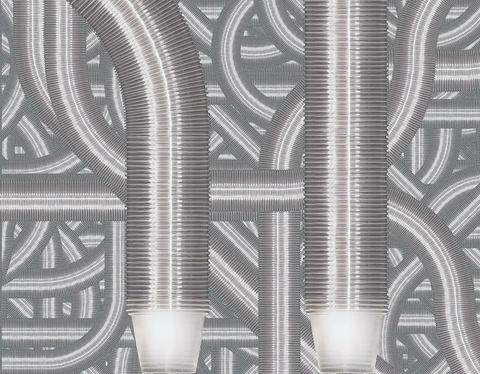
PHOTO COURTESY OF NGC
In his Running the Numbers series, which is the focus of the exhibition, Jordan said he intentionally minimized the use of color and composition. “What happened with Intolerable Beauty was that all anybody ever talked about was how beautiful the pictures were. I was using color and beauty as a tool, but that was as far as people seemed to get ... . ”
Running the Numbers has a minimalist quality, each image composed of a single consumer item. Plastic Cups, 2008 depicts one million plastic cups stacked together, the number of cups supposedly used by airline flights in the US every six hours. Plastic Bottles, 2007 is composed of 2 million bottles arranged in a kind of impressionist seascape; the number of bottles represents the figure used in the US every five minutes.
For the numbers to matter, “for us to make the change that we all know we need to make, we have to feel something,” Jordan said. “If the only way that we can relate to these mass phenomena is through numbers, then we can’t feel anything about it. Our minds aren’t wired to be able to experience these statistics here. If it’s 20 million, or 200 million or 20 billion ... those are all just huge numbers that go in one ear and out the other.”
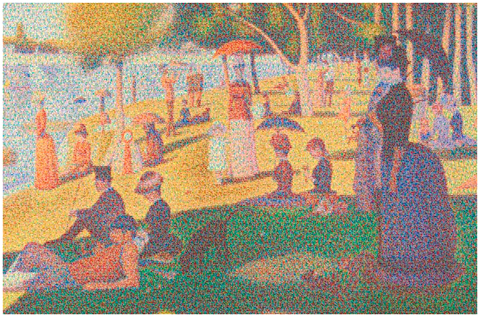
PHOTO COURTESY OF NGC
In trying to give expression to these numbers,” Jordan said. “I only used one plastic cup (to create Plastic Cups, 2008), the rest is digital manipulation.”
Disposable cups, cigarette packets, paper bags, are all part of his subject matter, and so effective has this visual representation of numbers proved that he has been approached to produce Running the Numbers, a sub-series on subjects such as Africa and the world’s oceans.
Despite producing work with a clear moral purpose, Jordan is wary of being labeled as an activist.
Speaking of his experience at the G8 Summit riots in Seattle in 1999, Jordan said: “There was this one group who really struck me. They had these signs and they were screaming ‘down with corporations.’ They where marching around saying this and they were wearing Nike, and Levis, and Gap. I don’t know if I’d call it hypocrisy, but there was a one-dimensionality about it, there was no self-reflection in that kind of activism, and I don’t want to be an activist like that.”
For your information:
Running the Numbers is on display at the National Taiwan Democracy Memorial Hall (台灣民主紀念館) until April 27

Last week the government announced that by year’s end Taiwan will have the highest density of anti-ship missiles in the world. Its inventory could exceed 1,400, or enough for the opening two hours of an invasion from the People’s Republic of China (PRC). Snark aside, it sounds impressive. But an important piece is missing. Lost in all the “dialogues” and “debates” and “discussions” whose sole purpose is simply to dawdle and delay is what the Chinese Nationalist Party (KMT) alternative special defense budget proposal means for the defense of Taiwan. It is a betrayal of both Taiwan and the US. IT’S
March 16 to March 22 Hidden for decades behind junk-filled metal shacks, trees and overgrowth, a small domed structure bearing a Buddhist swastika resurfaced last June in a Taichung alley. It was soon identified as a remnant of the 122-year-old Gokokuzan Taichuu-ji (Taichung Temple, 護國山台中寺), which was thought to have been demolished in the 1980s. In addition, a stone stele dedicated to monk Hoshu Ono, who served as abbot from 1914 to 1930, was discovered in the detritus. The temple was established in 1903 as the local center for the Soto school

Paul Thomas Anderson’s “One Battle After Another” was crowned best picture at the 98th Academy Awards, handing Hollywood’s top honor to a comic, multi-generational American saga of political resistance. The ceremony Sunday, which also saw Michael B. Jordan win best actor and “Sinners” cinematographer Autumn Durald Arkapaw make Oscar history as the first female director of photography to win the award, was a long-in-coming coronation for Anderson, a San Fernando Valley native who made his first short at age 18 and has been one of America’s most lionized filmmakers for decades. Before Sunday, Anderson had never won an Oscar. But “One Battle

In Kaohsiung’s Indigenous People’s Park (原住民主題公園), the dance group Push Hands is training. All its members are from Taiwan’s indigenous community, but their vibe is closer to that of a modern, urban hip-hop posse. MIXING CULTURES “The name Push Hands comes from the idea of pushing away tradition to expand our culture,” says Ljakuon (洪濬嚴), the 44-year-old founder and main teacher of the dance group. This is what makes Push Hands unique: while retaining their Aboriginal roots, and even reconnecting with them, they are adamant about doing something modern. Ljakuon started the group 20 years ago, initially with the sole intention of doing hip-hop dancing.


 RSS
RSS