


Jhumpa Lahiri’s characters tend to be immigrants from India and their US-reared children, exiles who straddle two countries, two cultures, and belong to neither: too used to freedom to accept the rituals and conventions of home, and yet too steeped in tradition to embrace American mores fully.
These Indian-born parents want the American Dream for their children — name-brand schools, a prestigious job, a roomy house in the suburbs — but they are cautious about the pitfalls of life in this alien land, and isolated by their difficulties with language and customs. Their children too are often emotional outsiders: having grown up translating the mysteries of the US for their relatives, they are fluent navigators of both Bengali and American culture but completely at home in neither; they always experience themselves as standing slightly apart, given more to melancholy observation than wholehearted participation.
As she did in her Pulitzer Prize-winning collection of stories Interpreter of Maladies (1999) and her dazzling 2003 novel The Namesake, Lahiri writes about these people in Unaccustomed Earth with an intimate knowledge of their conflicted hearts, using her lapidary eye for detail to conjure their daily lives with extraordinary precision: the faint taste of coconut in the Nice cookies that a man associates with his dead wife; the Wonder Bread sandwiches, tinted green with curry, that a Bengali mother makes for her embarrassed daughter to take to school.

A Chekhovian sense of loss blows through these new stories: a reminder of Lahiri’s appreciation of the wages of time and mortality and her understanding too of the missed connections that plague her husbands and wives, parents and children, lovers and friends.
Many of the characters in these stories seem to be in relationships that are filled with silences and black holes. In some cases this is the result of an arranged marriage that’s never worked out; in others it is simply a case of people failing to communicate or failing to reach out, in time, for what they want.
In Only Goodness Sudha, who is working on her second master’s degree at the London School of Economics, wonders at the bizarre “lack of emotion” in her parents’ marriage, which was “neither happy nor unhappy” and seemingly devoid of both bitterness and ardor, but she finds her own marriage to an Englishman foundering upon her failure to tell him a family secret.
In Hell-Heaven the narrator recounts the story of her parents’ chilly marriage and her mother’s passionate, unrequited love for a fellow Bengali and family friend, who gave her mother “the only pure happiness she ever felt.”
And in A Choice of Accommodations Amit realizes that the “most profound thing” in his life — the birth of his daughters — has already happened, that the rest of his life will be only “a continuation of the things” he already knows. Increasingly he will come to regard solitude — a run in the park, a ride by himself on the subway — as “what one relished most, the only thing that, even in fleeting, diminished doses, kept one sane.”
As for Ruma, the heroine of the title story, she realizes during a visit from her widowed father that they rarely talk about matters of real importance; they do not speak about her mother or her brother, they do not discuss her pregnancy or her marriage, or her father’s new relationship with a woman he met on vacation.
This has been their history as long as she can remember: “Somehow, she feared that any difference of opinion would chip away at the already frail bond that existed between them.” Her marriage, Ruma realizes, is stilted too: she is increasingly aware that she and her husband, Adam, are “separate people leading separate lives,” and that part of her is actually relieved when Adam leaves on one of his many business trips.
Like many children of immigrants Lahiri’s characters are acutely aware of their parents’ expectations; that they get into an Ivy League school, go to med school or grad school, marry someone from a good Bengali family. Deftly explicating the emotional arithmetic of her characters’ families, Lahiri shows how some of these children learn to sidestep, even defy their parents’ wishes. But she also shows how haunted they remain by the burden of their families’ dreams and their awareness of their role in the generational process of Americanization.
Their parents often seem so exhausted just coping with the difficulties of surviving in a strange new world that talk about self-fulfillment or depression or happiness seems utterly irrelevant to them; they are strangely pragmatic and unsentimental — about their marriages, their work, the hardships of daily life.
These characters’ US-born children are, at once, more romantic about the possibilities of finding genuine love and rewarding careers and more cynical too about the trajectories of most people’s lives. Often cast in the role of facilitator or fixer, they are accustomed to serving as their parents’ go-betweens and to easing their younger siblings’ way into full-fledged American lives.
The last three overlapping tales in this volume tell a single story about a Bengali-American girl and a Bengali-American boy, whose crisscrossing lives make up a poignant ballad of love and loss and death. Hema and Kaushik get to know each other as teenagers, when Kaushik’s family comes to stay with Hema’s parents while they house-hunt in the Boston suburbs.
Hema secretly nurses a crush on Kaushik, but he is oblivious to her schoolgirl antics and preoccupied with his mother’s deteriorating health. His grief over her death and his rage at his father’s hasty remarriage will propel him into a career as a photojournalist, who spends most of his time traveling to war zones in distant parts of the globe.
Hema, meanwhile, becomes a professor, a Latin scholar, who after a long, unhappy love affair impulsively decides to opt for a traditional arranged marriage; though she is conscious of the “deadness” of this proposed partnership, she tries to convince herself that the relationship will endow her life with a sense of certainty and direction. Then, against all odds, Hema and Kaushik run into each other in Rome — on the eve of Hema’s departure for her wedding — and embark on an intense, passionate affair. And yet it is an affair that concludes not with a fairy-tale happy ending but with an operatic denouement that speaks of missed opportunities and avoidable grief.
In the hands of a less talented writer it’s an ending that might have seemed melodramatic or contrived, but as rendered by Lahiri it possesses the elegiac and haunting power of tragedy — a testament to her emotional wisdom and consummate artistry as a writer.
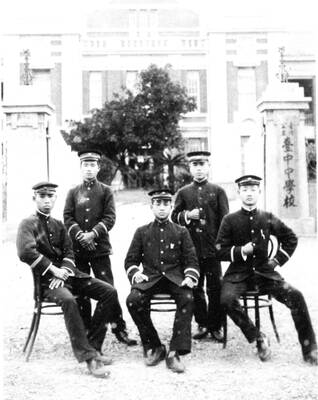
April 28 to May 4 During the Japanese colonial era, a city’s “first” high school typically served Japanese students, while Taiwanese attended the “second” high school. Only in Taichung was this reversed. That’s because when Taichung First High School opened its doors on May 1, 1915 to serve Taiwanese students who were previously barred from secondary education, it was the only high school in town. Former principal Hideo Azukisawa threatened to quit when the government in 1922 attempted to transfer the “first” designation to a new local high school for Japanese students, leading to this unusual situation. Prior to the Taichung First

The Ministry of Education last month proposed a nationwide ban on mobile devices in schools, aiming to curb concerns over student phone addiction. Under the revised regulation, which will take effect in August, teachers and schools will be required to collect mobile devices — including phones, laptops and wearables devices — for safekeeping during school hours, unless they are being used for educational purposes. For Chang Fong-ching (張鳳琴), the ban will have a positive impact. “It’s a good move,” says the professor in the department of

On April 17, Chinese Nationalist Party (KMT) Chairman Eric Chu (朱立倫) launched a bold campaign to revive and revitalize the KMT base by calling for an impromptu rally at the Taipei prosecutor’s offices to protest recent arrests of KMT recall campaigners over allegations of forgery and fraud involving signatures of dead voters. The protest had no time to apply for permits and was illegal, but that played into the sense of opposition grievance at alleged weaponization of the judiciary by the Democratic Progressive Party (DPP) to “annihilate” the opposition parties. Blamed for faltering recall campaigns and faced with a KMT chair

Article 2 of the Additional Articles of the Constitution of the Republic of China (中華民國憲法增修條文) stipulates that upon a vote of no confidence in the premier, the president can dissolve the legislature within 10 days. If the legislature is dissolved, a new legislative election must be held within 60 days, and the legislators’ terms will then be reckoned from that election. Two weeks ago Taipei Mayor Chiang Wan-an (蔣萬安) of the Chinese Nationalist Party (KMT) proposed that the legislature hold a vote of no confidence in the premier and dare the president to dissolve the legislature. The legislature is currently controlled


 RSS
RSS