


The Barker Ranch was the last redoubt of the gaggle of hippies, hitchhikers and lost souls that called itself the Family and followed the twisted beliefs of the convicted pimp, sex offender and would-be musician Charles Manson.
It was to this lonely outpost in the California desert that the group of 26 came after committing the gruesome Sharon Tate and LaBianca murders, and it was here, on Aug. 12, 1969, that Manson was arrested hiding under a bathroom basin.
The story of how Manson came to form his sex and drug-fuelled cult, and turned his followers' adulation into blood lust, has become the stuff of criminological legend, marking the low point of the 60s revolution. Members of the Family were prosecuted for nine murders, the most famous victim being Tate, the pregnant wife of the film director Roman Polanski, but rumors have consistently claimed that the true death toll was much higher.
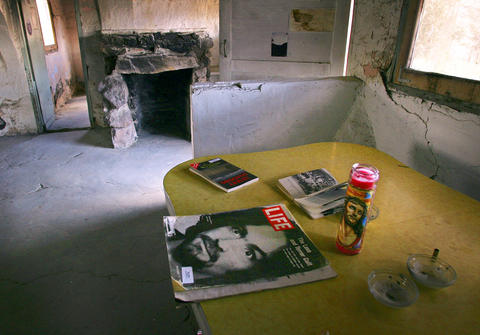
PHOTO: AP
Now a group of interested individuals - including Tate's younger sister, Debra, a local police detective, and forensics experts - have begun searching the desert around the ranch and believe they have found evidence of two, perhaps three, human graves that may be linked to the Manson Family.
The local sheriff's office in Inyo County, about 322km from Los Angeles, is expected to decide next week whether to order an official dig of the potential grave sites to follow up on the amateur sleuthing. The sheriff is weighing up the cost and police time that would be involved against the public interest in bringing closure to one of America's most notorious criminal sprees.
The team of investigators made use of technology that was unavailable in 1969 to identify what they believe are sites where human remains are buried. Sergeant Paul Dostie, a local police officer working off-duty, used his sniffer dog that has been trained to detect the smell of bodies, and researchers from a laboratory in Tennessee used ground probing equipment and radar to detect signs of refilled holes in the ground.
Debra Tate, who has dedicated her life since her sister's murder to preventing any of the jailed Family members being released, is insistent that the excavation should take place. She told an LA television station: "If there's a chance that we can send some children home, then we need to do that."
There has long been conjecture that Manson may have been responsible for more murders than those ascribed to him and the four members of the Family who he got to do his bloody bidding. An informant who associated with Manson in jail has said the cult leader once confessed that he had killed 35, though such bragging from a recognized psychopath and fantasist must be treated with a degree of skepticism.
Susan Atkins, one of the Manson devotees who was involved in the murders and like him is serving a life sentence, was also said to have bragged to her cell mate soon after she was arrested that there were "three people out in the desert that they done in."
Tales have swirled around Death Valley, where the Barker ranch is located, that Manson and his main accomplice, Tex Watson, took a woman who was proving to be awkward within the group for a walk away from the building into the desert, returning an hour later without her. Dostie said the first site that received the attention of his sniffer dog fits the description of the direction in which they had been walking.
An abandoned haversack was found at the ranch, leading to speculation that its owner may also be a victim.
In nearby Bishop police have reopened the case of Fillippo Tennerelli, who was thought to have committed suicide in a motel room in 1969 but is said to have been a victim of the Family.
Police are taking seriously the findings of the amateur investigators, though they have pointed out that loose ground resembling a burial site can be created by animals, and that even if there are human remains present they could be those of a prospector or rancher from long ago.
"At this point we're looking at whatever shreds of evidence we can gather," police chief Kathleen Sheehan told the Associated Press. "There's no statute of limitations on murder."

Taiwan’s English education system is being pulled apart by three opposing forces. Bilingual Nation 2030 pulls students toward English and global communication. Artificial Intelligence (AI) readiness pulls them toward digital judgment, verification and AI-mediated work. But Taiwan’s old exam culture pulls them back toward memorization, grammar drills, timed reading and correct answers. If the education system keeps using old exams to define success, it risks producing graduates who are neither genuinely bilingual nor genuinely AI-ready, but trained for tasks machines can already perform. The first force is Bilingual Nation 2030. Launched in 2018, the policy aimed to “help Taiwan’s workforce connect

It seems every few days one bumps into one of those “real man” comments in which Taiwan is urged to “face reality” or similar, and “make a deal,” with the speaker implying that soon it will be too late. “Deal” advocates always present themselves as having a superior grip on reality, and the manly ability to make the “hard choice.” Their testosterone-laden language often echoes that of Taiwan sellout advocates. Note that such commentary always specifies a process (“make a deal, work with, make progress”), never the end state of what occupation by a violent authoritarian colonialist state will entail. In

“Taiwan’s Opposition Leader Comes to US With a Message Straight Out of Beijing” read a May 31 headline in the Wall Street Journal. Top US administration officials and members of Congress almost certainly read the WSJ, and if there was a bullet point takeaway that people in Washington should absorb ahead of Chinese Nationalist Party (KMT) Chair Cheng Li-wun’s (鄭麗文) arrival in DC on June 9, that headline is it. The last few columns have discussed this very topic, and the timing is not coincidental. While those top officials likely do not read the Taipei Times, judging by the number

As someone who normally steers clear of books with “transcendence” or “metaphysics” in their subtitles, this reviewer — a casual observer of local belief systems since the 1990s — found Fabian Graham’s Money God Temples in Taiwan a challenging read. Those who’ve only dipped their toes into temple culture will likely need to parse several sections with special care if they’re to keep up with the author, a British ethnographic researcher whose previous books have investigated religious practices among ethnic Chinese in Southeast Asia. This scholarly volume examines a facet of Taiwan’s religious landscape that didn’t exist a century ago, and


 RSS
RSS