

The Taipei International Cycle Show rides into town today and features many of the world's top brand names in cycling. Dubbed Asia's largest bicycle industry fair and the world's third-largest bike show, it features a staggering variety of tires, seats, frames, lights, breaks, derailleur, light electric vehicles (LEVs) and bicycles.
Organized under the auspices of the Taiwan External Trade Development Council (TAITRA, 中華民國對外貿易發展協會) in conjunction with the Taiwan Bicycle Exporters' Association (台灣區自行車公會), the exhibition coincides with the grand opening of the Taipei World Trade Center Nangang Exhibition Hall (台北世界貿易中心南港展覽館), where it will be held. The show is open to the public on Saturday and Sunday.
According to the organizers, 763 exhibitors will show off their products in 2,842 booths - a 24 percent increase over last year's show. About 50,000 people are expected to visit the exhibition hall over the next three days.
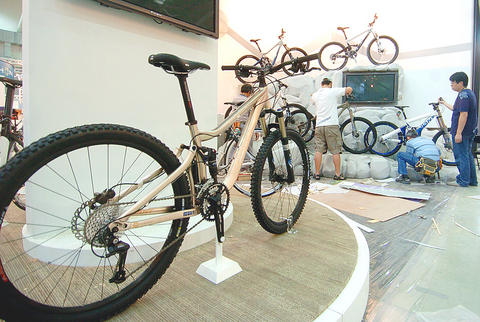
PHOTO: CHANG CHIA-MING, TAIPEI TIMES
The trade show, however, isn't just about bicycles and cycling accouterments. Winners of the annual Innovative Bicycle, Parts and Accessories Competition and International Bicycle Design Competition will be announced today and consumers will be able to view the latest creations by the world's top designers.
The International Bicycle Trend Forum is a forum that brings together industry experts from Taiwan, Europe, the US and Japan to discuss the effects that changing social and environmental trends have on the bicycle industry.
A discussion will examine the uses of LEVs and an exhibition will showcase new designs. Attendees will have the opportunity to test out several of the latest models.
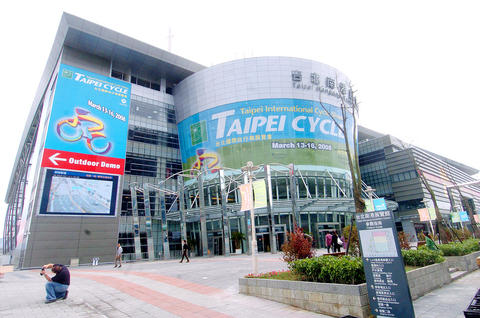
PHOTO: CHANG CHIA-MING, TAIPEITIMES
A Biking Acrobatic Show will feature extreme BMX stunts.
Foreign exhibitors attending the expo hail from all over the world: the US, Italy, Japan, Hong Kong, France, Germany, Belgium, Switzerland, the Netherlands and the UK. Exhibitors include Giant, Merida, Ideal, Kenda, Sram, Maxxis, Shimano, Topeak, Fulcrum, Hayes, Campagnolo, Continental, Colnago and DT Swiss.
The Nuclear Safety Commission (NSC, 核安會) on Sept. 24 approved the re-operation plan that Taiwan Power Co (Taipower, 台電) filed in March for the Ma-anshan Nuclear Power Plant in Pingtung County, after three rounds of review and 589 comments. Taipower now has to carry out the work in the plan and its own inspections on ageing, radiation and seismic resistance, then report back to the commission for review and on-site checks. Minister of Economic Affairs Kung Ming-hsin (龔明鑫) has named 2028 as the earliest restart. The NSC has given no date. THE DEBATE No challenge has been identified as to whether Ma-anshan
Oct. 12 to Oct. 18 After 11 years in prison on Green Island, Yen Shih-hung (顏世鴻) was finally due for release when a camp guard asked him for NT$20,000 to help pay his bride price. Yen refused. The next day, officials deemed that he had “failed to improve his thinking” and ordered him to undergo further political reeducation on Siaoliouciou (小琉球), where prisoners were also subjected to forced labor. He spent another 19 months there before regaining his freedom in January 1964. Yen’s punishment stemmed from his joining the Taiwan Provincial Student Affairs Committee

Cognitive warfare, says the Ministry of National Defense (MND), is the People’s Republic of China’s (PRC) use of “political, economic, cultural, military and legal means, with the intent to divide internal unity and undermine social stability” in Taiwan. Last week offered several examples. PRC media in October last year reported that the Chongqing Municipal Public Security Bureau had opened an investigation into Democratic Progressive Party (DPP) Legislator Puma Shen (沈伯洋), the DPP’s mayoral candidate for Taipei in next month’s election, for “Taiwan independence” activities. This was a cognitive warfare ploy, designed to unsettle the targeted person and to establish the idea
In pandemic preparedness work, scientists like to focus on the technical challenges: identifying pathogens, diagnosing infections, understanding their effects and developing vaccines and treatments. Each step promises progress through human innovation, investment and planning. The WHO, for example, brings experts together to identify and prioritize emerging disease threats and collect the evidence needed to prepare for them. But preparedness depends on more than scientific innovation. As the past week has shown, politics is the elephant in the room in all of this. No one could have predicted we would be talking about pneumonic plague, and that the death of a single


 RSS
RSS