


After viewing a four-minute ad online, seeing the brochure, reading reviews and interviewing the Taiwan spokesperson for the show, what will happen when Shen Yun Chinese Spectacular (神韻晚會) opens in Tainan City tonight is still something of a mystery.
The performance could be a celebration of Chinese culture and the best show you've ever seen, or it could be Falun Gong propaganda with torture scenes you wouldn't want your children to watch. It seems to depend on who you ask and who's doing the asking.
One thing is certain: The Chinese Communist Party (CCP) is putting a lot of effort into keeping young and old alike from seeing the production - and in South Korea and Singapore, the party's tactics are working.
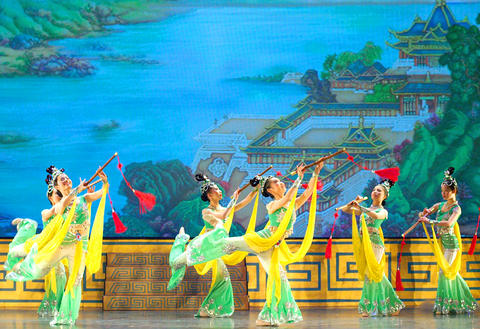
PHOTO: COURTESY OF DIVINE PERFORMING ARTS
The Divine Performing Arts' Spectacular - scheduled to show at 22 venues in five cities throughout Taiwan and more than 60 cities worldwide - features some 70 dancers, musicians and singers. After three shows in Tainan, the gala will visit Kaohsiung, Taichung, Taipei and Chiayi.
Winifred Tung (童文薰), spokesperson for the New York-based company in Taiwan, says the performance "will transport the audience into an incredible, ancient land; the land of the true China."
A glance at the brochure makes it apparent why Divine Performing Arts' "true China" doesn't sit well with the CCP. The Taiwan Falun Dafa Institute (台灣法輪大法學會), a local branch of a perennial thorn in Beijing's side, is one of the show's sponsors.
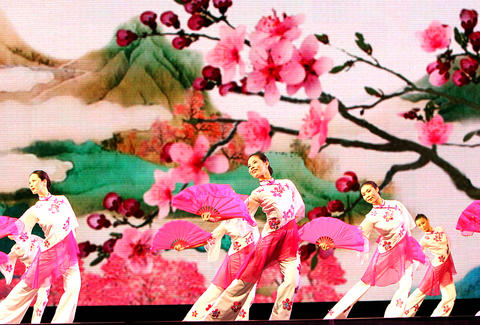
PHOTO: COURTESY OF DIVINE PERFORMING ARTS
Falun Dafa, or Falun Gong, is a spiritual practice based around meditation and breathing exercises with a motto of "truthfulness, compassion, forbearance." Some compare its teachings to Buddhism or Taoism; others equate it with cultish groups like the Scientologists.
The CCP added Falun Gong to its blacklist - along with activists, journalists and drug dealers - after a crowd of 10,000 practitioners surprised authorities with a peaceful sit-in at the Communist Party headquarters in 1999. Since then, followers in China have mysteriously disappeared, fallen out of windows and given their organs up for transplant. Most of the world says they're persecuted; the CCP says adherents hurt themselves and coerce others into doing the same.
The Spectacular Web site says that last year's tour sold 200,000 tickets and the New York-based company expects a total audience of 650,000 this year. That number may drop if Beijing gets its way.
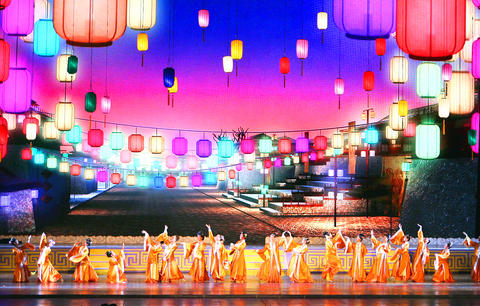
PHOTO: COURTESY OF DIVINE PERFORMING ARTS
"The Chinese Communist Party is very afraid of this troupe's performances," Tung says. "When they find out we've booked a stadium somewhere, they contact the government and try to get it stopped."
The company sold 6,000 tickets for three shows scheduled earlier this week in Pusan, South Korea, before its Korean outlet caved in to pressure from the Chinese embassy and pulled out at the last minute. And there have been problems elsewhere: Taiwan has the CCP and pushovers in Singapore to thank for the addition of a second performance in Chiayi.
But the sponsor is not the only aspect of the show that upsets Beijing. According to an online article in the Epoch Times - "an independent voice" and "proud sponsor" of Spectacular not mentioned in the Taiwan brochure - the performance includes acts "depicting the persecution against Falun Gong members that has been carried out by the regime." (Epoch is the Falun Gong's US newspaper.)
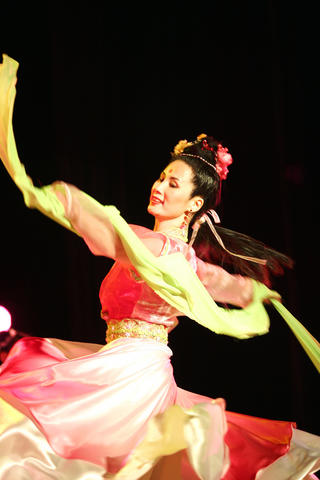
PHOTO: COURTESY OF DIVINE PERFORMING ARTS
Tung downplays this aspect of the performance, saying that of 20 acts, only two have to do with Falun Gong.
But a New York Times review of the company's Chinese New Year Splendor at Radio City Music Hall earlier this month said the show was peppered with references to the practice, highlighting a torture scene it said drove audience members from the theater.
"It's a little too political, too religious, especially the dance showing some girls getting tortured in the prisons. That's too much for Chinese New Year, especially with our children," a Chinese-American viewer told the paper.
Days after the New York Times review appeared, Epoch posted a blizzard of articles condemning the piece, its author and the paper with headlines like "The New York Times parrots Communist Party line" and "Transportation company CEO: I didn't give a shit about what it (the New York Times) said."
One article quoted a New York psychologist who had heard about the New York Times article, but hadn't read it: "Everything I saw was positive. I don't know what they saw or why they were disappointed. … I'm going to go to the library, look that article up and tell the writer what I think."
Tung says she's not sure if the prison act will be part of the show in Taiwan.
"But a similar one was performed in Taiwan in 2007. No Taiwan audiences said that 'it's political' or said that they were bothered," she says.
And, as far as Epoch is concerned, neither did the 1,000 audience members it interviewed after a Feb. 9 show in New York - quite a feat of reportage, as there were 5,000 in total. The response "was overly positive," which judging from the praise lavished on the show in the paper's articles, might be an understatement.
For example: "Ms Valentina Alexis, a former ballerina with the Moscow ballet company, said, 'I am shocked, I am just completely shocked - but shocked in a fabulous way. It amazed me. I think it's the best show that I ever saw - the best.

On a harsh winter afternoon last month, 2,000 protesters marched and chanted slogans such as “CCP out” and “Korea for Koreans” in Seoul’s popular Gangnam District. Participants — mostly students — wore caps printed with the Chinese characters for “exterminate communism” (滅共) and held banners reading “Heaven will destroy the Chinese Communist Party” (天滅中共). During the march, Park Jun-young, the leader of the protest organizer “Free University,” a conservative youth movement, who was on a hunger strike, collapsed after delivering a speech in sub-zero temperatures and was later hospitalized. Several protesters shaved their heads at the end of the demonstration. A
Google unveiled an artificial intelligence tool Wednesday that its scientists said would help unravel the mysteries of the human genome — and could one day lead to new treatments for diseases. The deep learning model AlphaGenome was hailed by outside researchers as a “breakthrough” that would let scientists study and even simulate the roots of difficult-to-treat genetic diseases. While the first complete map of the human genome in 2003 “gave us the book of life, reading it remained a challenge,” Pushmeet Kohli, vice president of research at Google DeepMind, told journalists. “We have the text,” he said, which is a sequence of
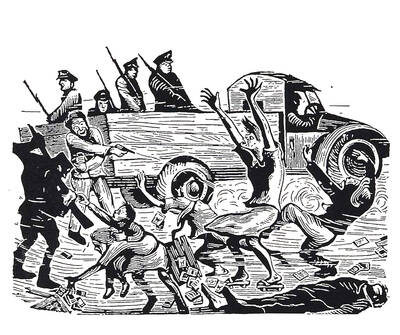
In August of 1949 American journalist Darrell Berrigan toured occupied Formosa and on Aug. 13 published “Should We Grab Formosa?” in the Saturday Evening Post. Berrigan, cataloguing the numerous horrors of corruption and looting the occupying Republic of China (ROC) was inflicting on the locals, advocated outright annexation of Taiwan by the US. He contended the islanders would welcome that. Berrigan also observed that the islanders were planning another revolt, and wrote of their “island nationalism.” The US position on Taiwan was well known there, and islanders, he said, had told him of US official statements that Taiwan had not
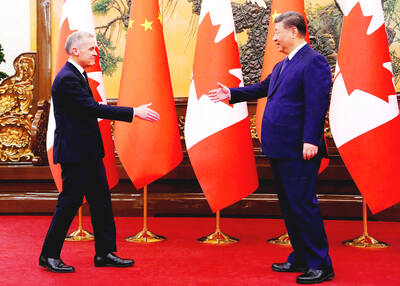
Britain’s Keir Starmer is the latest Western leader to thaw trade ties with China in a shift analysts say is driven by US tariff pressure and unease over US President Donald Trump’s volatile policy playbook. The prime minister’s Beijing visit this week to promote “pragmatic” co-operation comes on the heels of advances from the leaders of Canada, Ireland, France and Finland. Most were making the trip for the first time in years to refresh their partnership with the world’s second-largest economy. “There is a veritable race among European heads of government to meet with (Chinese leader) Xi Jinping (習近平),” said Hosuk Lee-Makiyama, director


 RSS
RSS