


In the summer of 1984, Burt Shavitz, a beekeeper in Maine, picked up Roxanne Quimby, a 33-year-old single mother down on her luck, as she hitchhiked to the post office in Dexter, Maine. More than a dozen years Quimby's senior, the guy locals called "the bee-man" sold honey in pickle jars from the back of his pickup truck. To Quimby, he seemed to be living an idyllic life in the wilderness (including making his home inside a small turkey coop).
She offered to help Shavitz tend to his beehives. The two became lovers and eventually birthed Burt's Bees, a niche company famous for beeswax lip balm, lotions, soaps and shampoos, as well as for its homespun packaging and feel-good, eco-friendly marketing. The bearded man whose image is used to peddle the products is modeled after Shavitz.
Today, the couple's quirky enterprise is owned by the Clorox Co, a consumer products giant best known for making bleach, which bought it for US$913 million in November. Clorox plans to turn Burt's Bees into a mainstream American brand sold in big-box stores like Wal-Mart. Along the way, Clorox executives say, they plan to learn from unusual business practices at Burt's Bees - many centered on environmental sustainability. Clorox, the company promises, is going green.
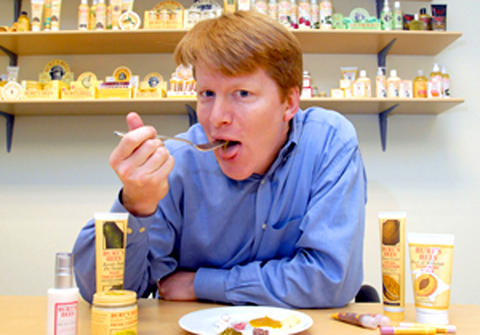
PHOTO: NY TIMES NEWS SERVICE
But not even Clorox can sanitize the details of a fallout between Shavitz and Quimby that began in the late 1990s - when Quimby managed to buy out the bee-man for a low, six-figure sum. She has been paid more than $300 million for her stake in Burt's Bees, and she spends her time traveling, refurbishing fancy homes in Florida and preserving large tracts of land in Maine. Burt himself, now 72, makes his home again in the converted turkey coop - expanded but without running water or electricity - but with $4 million or so to his name.
As unlikely as their journeys have been, Quimby and Shavitz are pioneers in an entrepreneurial movement that has lately won the affection of corporate behemoths.
Clorox was willing to pay almost US$1 billion for Burt's Bees because big companies see big opportunities in the market for green products. From 2000 to 2007, Burt's Bees' annual revenue soared to US$164 million from US$23 million. Analysts say there is far more growth to be had by it and its competitors as consumers keep gravitating toward products that promise organic and environmental benefits.

PHOTO: NY TIMES NEWS SERVICE
In the last couple of years, L'Oreal paid US$1.4 billion for the Body Shop, and Colgate-Palmolive bought 84 percent of Tom's of Maine, which makes natural toothpaste and deodorant, for US$100 million. Clorox is also creating eco-friendly product lines of its own.
Many corporate leaders have sold their shareholders on green initiatives by pointing out that they help cut costs - an argument that is more persuasive now, while energy costs are sky high. But as companies rush to put out more and more "natural," "organic" or "green" products, consumers and advocacy groups are increasingly questioning the meaning of these labels.
Clorox, for one, will face plenty of skepticism. Environmentalists have long said that bleach is harmful when drained into city sewers. The disinfectant has become a stand-in for jokes about chemicals and the environment, and a new round seems to have begun this fall when the company acquired Burt's Bees.
"Who likes Burt's Bees now that it's been bought by Clorox?" Alison Stewart, a host on National Public Radio, said in November. "You know, just slap some bleach on your lips, it'll all be good."
Clorox executives have been fighting what they call "misinformation" about bleach for years. The company says that 95 percent to 98 percent of its bleach breaks into salt and water and that the remaining byproduct is safe for sewer systems. And Clorox sells many products that have nothing to do with bleach - including Brita water filters, Glad trash bags and Hidden Valley salad dressings.
Still, after Clorox agreed to buy Burt's Bees last fall, scores of customers called Burt's Bees and accused the company of selling out. John Replogle, the chief executive of Burt's Bees, says he personally responded to customers who left their phone numbers.
"Don't judge Clorox as much by where they've been as much as where they intend to go," Replogle says he told them.
For her part, Quimby is at peace with the Clorox deal. "I feel the fact that I was able to sell the company accelerated the process of land conservation in terms of what I could do," she says. "So if there is any negative karma, I'm neutral."
When the pair incorporated as a company - in 1989 or 1991, no one can quite remember when - Shavitz owned one-third and Quimby owned two-thirds, she says. The famous Burt's Bees lip balm was born in 1991, and that item, a combination of beeswax and sweet almond oil, helped the company find a niche in personal care products.
Shavitz was still active in the company in 1993, when they moved its base to North Carolina. Sales had reached US$3 million a year, and they wanted to find a state with lower taxes and more workers to keep their business growing, Quimby says.
During this time, the couple had a falling-out, their romance became strained, and Shavitz decided to return to Maine. It is unclear exactly when he moved back permanently; Quimby said it was in 1993, but in a written response to questions, Shavitz implied that it was later.
What is clear, is that Shavitz lost out on a huge payday. In 1999, Quimby bought out his one-third share in Burt's Bees by buying him a house in Maine. Much grander than a turkey coop, the home cost US$130,000, Quimby says. She now calls that figure "embarrassing" considering how much she made from the company.
Shavitz did not respond when asked if he hired advisers to determine whether he had been paid a fair valuation for his stake. He sold the house in Maine a few months after Quimby bought it for him because, she says, he missed his turkey coop. (He has since enlarged it to about 3.5m by 6m.)
By 2000, Burt's Bees was pulling in US$23 million in revenue, according to the company. Quimby said she had always intended to sell the company and had received offers for quite some time before she put it up for auction in 2003. That year, AEA Investors, a private equity firm in New York, paid Quimby US$141.6 million for an 80 percent stake in Burt's Bees. If Shavitz had held onto the stake he traded to Quimby for US$130,000, it would have been worth about $59 million.
At the time of that deal, Shavitz demanded more money and Quimby said she agreed to pay him US$4 million. Burt's Bees also pays Shavitz an undisclosed amount each year for using his name and image on its products. Through a Burt's Bees spokeswoman, Shavitz declined to comment on any payments he had received or the reasons for his fallout with Quimby. When asked if he and Quimby were still friends, Shavitz said, "Sure."
"What happened between us in our personal relationship in the past is history," he said in a statement. "The magic of living life for me is, and always has been, the magic of living on the land, not in the magic of money."
The task of defending Clorox's purchase of Burt's Bees has fallen on Replogle's shoulders. He says that in six months, he will post a blog on the Burt's Bees site about whether he thinks Clorox is making enough progress on its green initiatives. He says Burt's Bees' 380 employees have an opportunity to influence the direction of Clorox, a company that generated US$4.8 billion in sales last year and employs 7,800 people.
Burt's Bees maintains its founders' green philosophies. Employees' bonuses are based in part on how well the company meets energy conservation goals, and there are prime parking spaces for staff members who drive hybrid cars or carpool. It buys offsets for 100 percent of its carbon emissions and is working toward a goal of sending no trash to landfills by 2020.
Replogle calls his current job a "mission" and says he is trying to reinvent business with an idea he calls "the Greater Good," based on the founders' ideals. The premise is that if companies are socially responsible, profit will follow. Burt's Bees not only prioritizes the natural origin of its ingredients but also emphasizes animal rights, responsible trade, employee benefits and the environment.
Like most natural-products companies, Burt's Bees has the luxury of charging enough for its goods to pay for such causes. A 4.3g tube of Burt's Bees basic lip balm, for example, costs US$3. The same-size tube of ChapStick, which uses synthetic ingredients, costs US$1.69.
Burt's Bees is not perfect, Replogle acknowledges. The company obtains all of its beeswax from hives in Ethiopia, so shipping the ingredient across the Atlantic adds to carbon emissions.

Taiwan’s English education system is being pulled apart by three opposing forces. Bilingual Nation 2030 pulls students toward English and global communication. Artificial Intelligence (AI) readiness pulls them toward digital judgment, verification and AI-mediated work. But Taiwan’s old exam culture pulls them back toward memorization, grammar drills, timed reading and correct answers. If the education system keeps using old exams to define success, it risks producing graduates who are neither genuinely bilingual nor genuinely AI-ready, but trained for tasks machines can already perform. The first force is Bilingual Nation 2030. Launched in 2018, the policy aimed to “help Taiwan’s workforce connect

It seems every few days one bumps into one of those “real man” comments in which Taiwan is urged to “face reality” or similar, and “make a deal,” with the speaker implying that soon it will be too late. “Deal” advocates always present themselves as having a superior grip on reality, and the manly ability to make the “hard choice.” Their testosterone-laden language often echoes that of Taiwan sellout advocates. Note that such commentary always specifies a process (“make a deal, work with, make progress”), never the end state of what occupation by a violent authoritarian colonialist state will entail. In

“Taiwan’s Opposition Leader Comes to US With a Message Straight Out of Beijing” read a May 31 headline in the Wall Street Journal. Top US administration officials and members of Congress almost certainly read the WSJ, and if there was a bullet point takeaway that people in Washington should absorb ahead of Chinese Nationalist Party (KMT) Chair Cheng Li-wun’s (鄭麗文) arrival in DC on June 9, that headline is it. The last few columns have discussed this very topic, and the timing is not coincidental. While those top officials likely do not read the Taipei Times, judging by the number

As someone who normally steers clear of books with “transcendence” or “metaphysics” in their subtitles, this reviewer — a casual observer of local belief systems since the 1990s — found Fabian Graham’s Money God Temples in Taiwan a challenging read. Those who’ve only dipped their toes into temple culture will likely need to parse several sections with special care if they’re to keep up with the author, a British ethnographic researcher whose previous books have investigated religious practices among ethnic Chinese in Southeast Asia. This scholarly volume examines a facet of Taiwan’s religious landscape that didn’t exist a century ago, and


 RSS
RSS