


My husband, at 74, is the baby of his bridge group, which includes a woman who is 85 and a man who is 89. This challenging game demands an excellent memory (for bids, cards played, rules and so on) and an ability to think strategically and read subtle psychological cues. Never having had a head for cards, I continue to be amazed by the mental agility of these septuagenarians and octogenarians.
The brain, like every other part of the body, changes with age, and those changes can impede clear thinking and memory. Yet many older people seem to remain sharp as a tack well into their 80s and beyond. Although their pace may have slowed, they continue to work, travel, attend plays and concerts, play cards and board games, study foreign languages, design buildings, work with computers, write books, do puzzles, knit or perform other mentally challenging tasks that can befuddle people much younger.
But when these sharp old folks die, autopsy studies often reveal extensive brain abnormalities like those in patients with Alzheimer's. Nikolaos Scarmeas and Yaakov Stern at Columbia-Presbyterian Medical Center recall that in 1988, a study of "cognitively normal elderly women" showed that they had "advanced Alzheimer's disease pathology in their brains at death." Later studies indicated that up to two-thirds of people with autopsy findings of Alzheimer's disease were cognitively intact when they died.
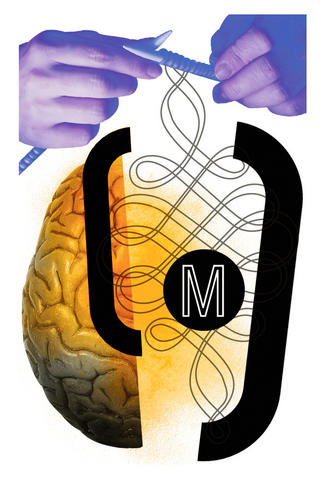
ILLUSTRATION: NY TIMES NEWS SERVICE
"Something must account for the disjunction between the degree of brain damage and its outcome," the Columbia scientists deduced. And that something, they and others suggest, is "cognitive reserve."
MENTAL EXERCISE
Cognitive reserve, in this theory, refers to the brain's ability to develop and maintain extra neurons and connections between them via axons and dendrites. Later in life, these connections may help compensate for the rise in dementia-related brain pathology that accompanies normal aging.
As Cathryn Jakobson Ramin relates in her new book, Carved in Sand: When Attention Fails and Memory Fades in Midlife, the brains of animals exposed to greater physical and mental stimulation appear to have a greater number of healthy nerve cells and connections between them. Scientists theorize that this excess of working neurons and interconnections compensates for damaged ones to ward off dementia.
Observing this, Stern, a neuropsychologist, and others set out to determine how people can develop cognitive reserve. They have learned thus far that there is no "quick fix" for the aging brain, and little evidence that any one supplement or program or piece of equipment can protect or enhance brain function - despite advertisements for products like ginkgo biloba to the contrary.
Nonetheless, well-designed studies suggest several ways to improve the brain's viability. Though best to start early to build up cognitive reserve, there is evidence that this account can be replenished even late in life.
Cognitive reserve is greater in people who complete higher levels of education. The more intellectual challenges to the brain early in life, the more neurons and connections the brain is likely to develop and perhaps maintain into later years. Several studies of normal aging have found that higher levels of educational attainment were associated with slower cognitive and functional decline.
Scarmeas and Stern suggest that cognitive reserve probably reflects an interconnection between genetic intelligence and education, since more intelligent people are likely to complete higher levels of education.
But brain stimulation does not have to stop with the diploma. Better-educated people may go on to choose more intellectually demanding occupations and pursue brain-stimulating hobbies, resulting in a form of lifelong learning. In researching her book, Ramin said she found that novelty was crucial to providing stimulation for the aging brain.
"If you're doing the same thing over and over again, without introducing new mental challenges, it won't be beneficial," she said in an interview. Thus, as with muscles, it's "use it or lose it." The brain requires continued stresses to maintain or enhance its strength.
So if you knit, challenge yourself with more than simply stitched scarves. Try a complicated pattern or garment. Listening to opera is lovely, but learning the libretto (available in most libraries) stimulates more neurons. In my 60s I took up knitting and crocheting and am now learning Spanish. My husband is a fanatical puzzle-doer who recently added Sudoku to the crosswords and double-crostics he carries around with him.
In 2001, Scarmeas published a long-term study of cognitively healthy elderly New Yorkers. On average, those who pursued the most leisure activities of an intellectual or social nature had a 38 percent lower risk of developing dementia. The more activities, the lower the risk.
Long-term studies in other countries, including Sweden and China, have also found that continued social interactions helped protect against dementia. The more extensive an older person's social network, the better the brain is likely to work, the research suggests. Especially helpful are productive or mentally stimulating activities pursued with other people, like community gardening, taking classes, volunteering or participating in a play-reading group.
PHYSICAL ACTIVITY
Perhaps the most direct route to a fit mind is through a fit body. As Sandra Aamodt, editor of Nature Neuroscience, and Sam Wang, a neuroscientist at Princeton University, recently stated on the New York Times' Op-Ed page, physical exercise "improves what scientists call 'executive function,' the set of abilities that allows you to select behavior that's appropriate to the situation, inhibit inappropriate behavior and focus on the job at hand in spite of distractions. Executive function includes basic functions like processing speed, response speed and working memory, the type used to remember a house number while walking from the car to a party."
Although executive function typically declines with advancing years, "elderly people who have been athletic all their lives have much better executive function than sedentary people of the same age," Aamodt and Wang reported.
And not just because cognitively healthy people tend to be more active. When inactive people in their 70s get more exercise, executive function improves, an analysis of 18 studies showed. Just walking fast for 30 to 60 minutes several times a week can help. And compared with those who are sedentary, people who exercise regularly in midlife are one-third as likely to develop Alzheimer's in their 70s. Even those who start exercising in their 60s cut their risk of dementia in half.
Exercise may help by improving blood flow (and hence oxygen and nutrients) to the brain, reducing the risk of ministrokes and clogged blood vessels, and stimulating growth factors that promote the formation of new neurons and neuronal connections.

The canonical shot of an East Asian city is a night skyline studded with towering apartment and office buildings, bright with neon and plastic signage, a landscape of energy and modernity. Another classic image is the same city seen from above, in which identical apartment towers march across the city, spilling out over nearby geography, like stylized soldiers colonizing new territory in a board game. Densely populated dynamic conurbations of money, technological innovation and convenience, it is hard to see the cities of East Asia as what they truly are: necropolises. Why is this? The East Asian development model, with

June 16 to June 22 The following flyer appeared on the streets of Hsinchu on June 12, 1895: “Taipei has already fallen to the Japanese barbarians, who have brought great misery to our land and people. We heard that the Japanese occupiers will tax our gardens, our houses, our bodies, and even our chickens, dogs, cows and pigs. They wear their hair wild, carve their teeth, tattoo their foreheads, wear strange clothes and speak a strange language. How can we be ruled by such people?” Posted by civilian militia leader Wu Tang-hsing (吳湯興), it was a call to arms to retake

Desperate dads meet in car parks to exchange packets; exhausted parents slip it into their kids’ drinks; families wait months for prescriptions buy it “off label.” But is it worth the risk? “The first time I gave him a gummy, I thought, ‘Oh my God, have I killed him?’ He just passed out in front of the TV. That never happens.” Jen remembers giving her son, David, six, melatonin to help him sleep. She got them from a friend, a pediatrician who gave them to her own child. “It was sort of hilarious. She had half a tub of gummies,

The wide-screen spectacle of Formula One gets a gleaming, rip-roaring workout in Joseph Kosinski’s F1, a fine-tuned machine of a movie that, in its most riveting racing scenes, approaches a kind of high-speed splendor. Kosinski, who last endeavored to put moviegoers in the seat of a fighter jet in Top Gun: Maverick, has moved to the open cockpits of Formula One with much the same affection, if not outright need, for speed. A lot of the same team is back. Jerry Bruckheimer produces. Ehren Kruger, a co-writer on Maverick, takes sole credit here. Hans Zimmer, a co-composer previously, supplies the thumping


 RSS
RSS