


The Mainland Affairs Council (MAC) on Friday night defended its decision to bar Chinese officials and tourism representatives from attending a tourism event in Taipei next month, citing the unsafe conditions for Taiwanese in China.
The Taipei International Summer Travel Expo, organized by the Taiwan Tourism Exchange Association, is to run from July 18 to 21.
China’s Taiwan Affairs Office spokeswoman Zhu Fenglian (朱鳳蓮) on Friday said that representatives from China’s travel industry were excluded from the expo.
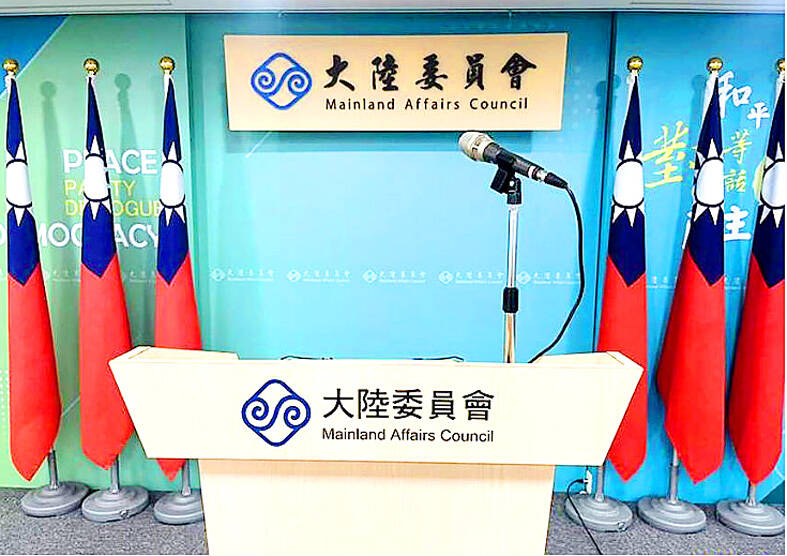
Photo: Taipei Times file photo
The Democratic Progressive Party government is obstructing cross-strait tourism exchange in a vain attempt to ignore the mainstream support for peaceful development and cooperation, she said.
The MAC said China’s 22 guidelines targeting Taiwanese who do not support Beijing’s efforts to take over the nation make China unsafe to visit.
Beijing on June 21 last year unveiled the 22 guidelines authorizing its courts to try “Taiwanese independence separatists” in absentia, with sentences including the death penalty.
The MAC said it rejected the expo organizer’s application for Chinese nationals’ participation for failing to demonstrate an essential purpose or guarantees that Taiwan would be treated with respect.
The MAC said it in February asked Beijing to resume tourism talks via appropriate channels, but its calls fell on deaf ears.
China should do more to ensure healthy exchanges across the Taiwan Strait, it said.
Separately, the Tourism Administration said that China is not a safe place for Taiwanese to visit.
The Chinese delegation had 300 officials, including the deputy heads of principal culture and tourism departments, a tourism industry insider who spoke on condition of anonymity said.
Taiwan’s refusal of Chinese officials’ attendance to an event as “soft” as a tourism expo is a sign of deteriorating relations between the two sides, they said.
The expo, first held in 2018, is no stranger to difficulties, but issues had always been solved, Taiwan Tourism Exchange Association chairwoman Janice Lai (賴瑟珍) said.
Chinese officials were unusually enthusiastic about attending the expo this year, she said, adding that the exclusion of the Chinese delegation is a source of “deep regret and frustration” for the association.
Additional reporting by CNA
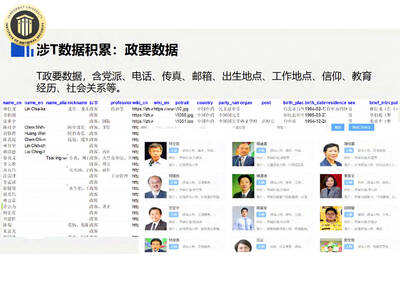
NETWORK-MAPPING PROJECT: The database contains 170 detailed files of Taiwanese politicians and about 23 million records of household registration data in Taiwan China has developed a network-mapping project targeting political figures and parties in Taiwan to monitor public opinion during elections and to craft tailored influence campaigns aimed at dividing Taiwanese society, according to documents leaked by Chinese technology firm GoLaxy (中科天璣). The documents, collected by Taipei-based Doublethink Lab, showed a database was specifically created to gather detailed information on Taiwanese political figures, including their political affiliations, job histories, birthplaces, residences, education, religion and a brief biography about them. Several notable Taiwanese politicians are in the database, including President William Lai (賴清德), former president Tsai Ing-wen (蔡英文), Minister of Foreign Affairs Lin Chia-lung (林佳龍),
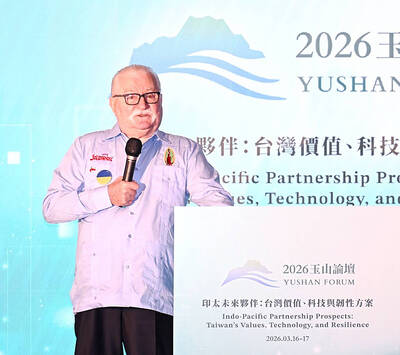
RECOGNITION: Former Fijian prime minister Mahendra Chaudhry said that Taiwan’s New Southbound Policy serves as a stabilizing force in the Indo-Pacific region Taiwan can lead the unification of the Chinese people, Nobel Peace Prize laureate and former Polish president Lech Walesa said in Taipei yesterday, adding that as the world order is changing, peaceful discussion would find good solutions, and that the use of force and coercion would always fail. Walesa made the remarks during his keynote address at a luncheon of the Yushan Forum in Taipei, titled “Indo-Pacific Partnership Prospects: Taiwan’s Values, Technology and Resilience,” organized by the Taiwan-Asia Exchange Foundation with the Ministry of Foreign Affairs. Walesa said that he had been at the forefront of a big peaceful revolution and “if
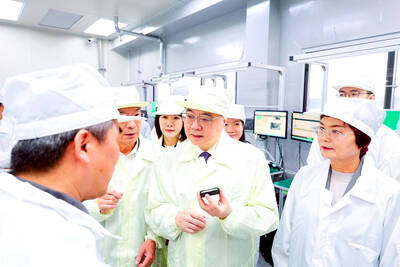
KEY INDUSTRY: The vice premier discussed a plan to create a non-red drone supply chain by next year, which has been allocated a budget of more than NT$7.2 billion The government has budgeted NT$44.2 billion (US$1.38 billion) to cultivate Taiwan’s uncrewed aerial vehicle (UAV) industry over the next five years, which would make the nation a major player in the industry’s democratic supply chain in the Asia-Pacific region, Premier Cho Jung-tai (卓榮泰) said yesterday. Cho made the remarks during a visit to the facilities of Cub Elecparts Inc (為升電裝). Democratic Progressive Party (DPP) Legislator Chen Su-yueh (陳素月) and Chinese Nationalist Party (KMT) Legislator Hsieh Yi-fong (謝依鳳) also participated in the trip. Cub Elecparts has transitioned from the automotive industry to the defense industry, which is the top priority among the nation’s
UPGRADED MISSILE: The Chungshan Institute of Science and Technology is reportedly to conduct a live-fire test of the Hsiung Feng III anti-ship missile on Thursday next week The US Army is planning to build new facilities to boost explosives production and strengthen its supply chain, a move aimed at addressing munitions shortages and supporting obligations to partners including Taiwan, Ukraine and Israel, Defense News reported. The army has issued a sources sought notice for a proposed Center of Excellence at the Blue Grass Army Depot in Kentucky, the report said. The facility would serve as a hub within the US industrial base for the production of key military explosives, including research department explosives (RDX) and high melting explosives (HMX), while also supporting research and development of next-generation materials. The proposed


 RSS
RSS