


Earlier this week, a poll nominated Natalie Portman and Hayden Christensen as having the worst "screen chemistry" in movie history for their wooden non-relationship in Star Wars: Attack of the Clones. But they have been pushed down to the silver medal position by a new non-sparking duo: Marina Hands and Jean-Louis Coulloc'h as Lady Chatterley and her gamekeeper in this French adaptation of DH Lawrence's famous novel, directed by Pascale Ferran, and actually taken from an early version of the book called John Thomas and Lady Jane.
Hands is a beautiful and stylish Lady Chatterley, showing a responsive, intelligent address to the camera, and she is also - if this doesn't seem obtuse - wonderfully clothed, with tailoring that I suspect owes more to contemporary French style than anything available to a 1920s Englishwoman, however wealthy. But her partner? Well, this isn't so much Beauty and the Beast as Beauty and the Dull Bloke.
Parkin (as he is here called) has the face and body of a plump, hibernating ruminant, and assiduously avoids disclosing any of the charisma and elemental mastery that Lawrence imagined; Coulloc'h maintains the look of a vaguely vexed ox at all times. I was reminded of Timothy Mo's description of a stone-faced political leader in his novel Brownout on Breadfruit Boulevard: an expression that was the same for sexual climax as for his father's funeral. When he and Lady Chatterley have to part, Parkin is required to show some emotion and confesses that his mother always thought he had too much of a "feminine" side. A feminine side? You could have fooled me: this gamekeeper has about as much of a feminine side as Russell Crowe. Towards the end of their leaving, he has to shed some tears, and Lady Chatterley asks, tenderly: "Is it the thought of going to Sheffield?" Well, if it's not Sheffield, it's something else, but heaven only knows what.
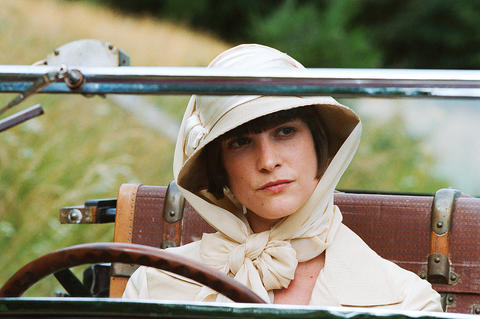
PHOTO: COURTESY OF SERENITY
The terrible thing is that Hands is excellent. There is a great scene in which she asks to see the baby chicks that Parkin is rearing; she holds one tremulous, tiny creature in the palm of her hand and at first grins with sheer delight, is then thoughtful, then dissolves in tears. The trusting little chick has triggered a remarkable succession of emotions that Hands delineates with compassion and clarity. Does the chick cause in her a yearning for a baby? Or does she identify with the chick, does she feel the profound need to place herself, caressingly, in another's hands?
The sex is awful. Ferran is addicted to coyly fading to black after about five seconds of full or partially clothed congress, and then fading back in to let us see what appear to be the lineaments of gratified desire as Lady Chatterley and her lover slump, sated. The transgressive concept of learning about sex, being introduced to its mysteries and arts, the eroticism of submitting to instruction - all this is lost in a movie full of the wrong sort of solemnity. Their relationship climaxes with running about naked in the rain; Parkin's impulsive joy at ripping off his green corduroy trousers and participating looks distinctly forced, and their subsequent rapture at garlanding each other's bodies with flowers is unearned. A great performance from Hands, but she is a priestess of love without a church.
FILM NOTES:
Lady Chatterley
DIRECTED BY: Pascale Ferran
STARRING: Marina Hands (Lady Chatterley), Jean-Louis Coulloc'h (Parkin)
LANGUAGE: French
RUNNING TIME: 168 minutes
TAIWAN RELEASE: Today

Dissident artist Ai Weiwei’s (艾未未) famous return to the People’s Republic of China (PRC) has been overshadowed by the astonishing news of the latest arrests of senior military figures for “corruption,” but it is an interesting piece of news in its own right, though more for what Ai does not understand than for what he does. Ai simply lacks the reflective understanding that the loneliness and isolation he imagines are “European” are simply the joys of life as an expat. That goes both ways: “I love Taiwan!” say many still wet-behind-the-ears expats here, not realizing what they love is being an

Every now and then, even hardcore hikers like to sleep in, leave the heavy gear at home and just enjoy a relaxed half-day stroll in the mountains: no cold, no steep uphills, no pressure to walk a certain distance in a day. In the winter, the mild climate and lower elevations of the forests in Taiwan’s far south offer a number of easy escapes like this. A prime example is the river above Mudan Reservoir (牡丹水庫): with shallow water, gentle current, abundant wildlife and a complete lack of tourists, this walk is accessible to nearly everyone but still feels quite remote.

It’s a bold filmmaking choice to have a countdown clock on the screen for most of your movie. In the best-case scenario for a movie like Mercy, in which a Los Angeles detective has to prove his innocence to an artificial intelligence judge within said time limit, it heightens the tension. Who hasn’t gotten sweaty palms in, say, a Mission: Impossible movie when the bomb is ticking down and Tom Cruise still hasn’t cleared the building? Why not just extend it for the duration? Perhaps in a better movie it might have worked. Sadly in Mercy, it’s an ever-present reminder of just
Google unveiled an artificial intelligence tool Wednesday that its scientists said would help unravel the mysteries of the human genome — and could one day lead to new treatments for diseases. The deep learning model AlphaGenome was hailed by outside researchers as a “breakthrough” that would let scientists study and even simulate the roots of difficult-to-treat genetic diseases. While the first complete map of the human genome in 2003 “gave us the book of life, reading it remained a challenge,” Pushmeet Kohli, vice president of research at Google DeepMind, told journalists. “We have the text,” he said, which is a sequence of


 RSS
RSS