


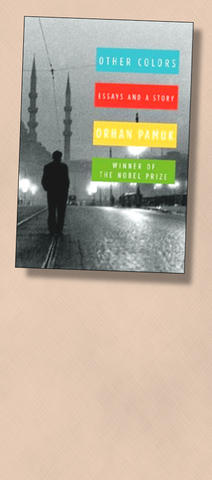
Taken together, the scattered essays and sketches that make up Other Colors can be read as a loose sort of autobiography, Orhan Pamuk writes in his preface. A stray remark here, a detail there, and something like a life emerges.
We learn that Pamuk, Turkey's most eminent novelist and winner of the Nobel Prize in Literature in 2006, dreamed of being a painter for most of his childhood and youth; studied architecture but abandoned the pursuit after three years; was once a leftist; writes very slowly; lived in New York for three years; and after the great Istanbul earthquake of 1999, constructed a shelter made of books under his desk.
That last bit sticks in the mind. It's the perfect emblem for a writer attuned to the cultural and political fault lines running underneath modern Turkey, and passionate about the novelist's power to make his own world through words. Pamuk, urbane and self-mocking, admires his little literary fort.
"Having assured myself that it was strong enough to withstand falling concrete," he writes, "I lay down there for a few earthquake drills, assuming a fetal position as instructed to protect my kidneys." Surrounded by books, he feels safe enough and decides to skip a long list of recommended precautions.
Pamuk devotes two essays to the big quake. They are among the best in a grab bag that includes wispy throwaway newspaper sketches, prefaces to a variety of classic and modern novels (including his own), his Nobel acceptance speech, several political essays and a short story. Nearly all of them end up, one way or another, addressing art, identity and cultural politics on the European perimeter.
The least successful do so directly. Pamuk, a Westernizer and a liberal, believes in a future for Turkey founded on freedom of speech and religion. His views have brought down the wrath of Turkey's authoritarian leaders, notably when he has argued against the government-enforced taboo that forbids discussion of the mass murder of Armenians and Kurds in Turkey.
As a political writer, however, he rarely advances beyond noble sentiment. Turkey should be included in the EU, he maintains, because Europe, for reasons he never really explains, would be incomplete without Turkey. Besides, Turks would feel hurt to be left out.
Pamuk returns to form every time he hits the streets of Istanbul, his native city and reservoir of images. He writes brilliantly about the hot dog, one of the street foods, along with doner kebabs and the pizza-like treat known as lahmacun, that seduced him and his brother, in defiance of their mother's strict orders. It tasted good - topped with tomato sauce, tomatoes, pickles and mustard - but it also functioned as a potent symbol.
"To leave behind Islamic tradition, whose ideas about food were embedded in ideas about mothers, women and sacred privacy - to embrace modern life and become a city dweller - it was necessary to be ready and willing to eat food even if you didn't know where, how or why it was made," he writes.
Likewise, the old coal-fired ferries that ply Istanbul's waters bring out Pamuk's most colorful, ruminative writing. So do barbers. Pamuk, as a boy, spent productive time in Istanbul's barber shops, feasting on a humor magazine called Vulture and keeping his ears open for a conversational style heard nowhere else, a kind of male gossip elicited, with great subtlety, by the barber himself.
In My Father's Suitcase, his Nobel lecture, Pamuk writes that as a child and as a young writer, he felt as if he lived far from the center. That has changed.
"For me the center of the world is Istanbul," he writes. "This is not just because I have lived there all my life, but because for the last 33 years I have been narrating its streets, its bridges, its people, its dogs, its houses, its mosques, its fountains, its strange heroes, its shops, its famous characters, its dark spots, its days and its nights, making them part of me, embracing them all."
The Istanbul essays in Other Colors - which amplify his 2005 memoir, Istanbul: Memories and the City - draw their strength from the same sources as his fiction, and their comedy, too, notably the little gem on watching the film Cleopatra in the 1960s.
At the same time, Pamuk instantly picks up the frequency of writers who feel themselves to be on the periphery, like Mario Vargas Llosa, or Dostoyevsky, the subject of three essays in this collection. The cultural predicament of Dostoyevsky is Pamuk's own, and he zeroes right in on it. The true subject of Notes From Underground, he writes, is "the jealousy, anger and pride of a man who cannot make himself into a European."
Pamuk understands cultural isolation more deeply than most writers, perhaps, because he regards reading as a profoundly isolating experience. The writers he most admires speak to him with frightening intimacy.
"I felt as if Dostoyevsky were whispering arcane things about life and humanity, things no one knew, for my ears only," he writes. Almost in passing he offers a probing, quite personal analysis of degradation as a perverse pleasure in the world of Dostoyevsky's novels.
The linked sequence of essays about New York counts as a bonus. Having been mugged, Pamuk spends a day with the police. He ponders the mysteries of cinnamon rolls, runs into a long-lost Turkish friend in a subway station and finally figures out why New Yorkers hate smoking so much.
"They were not running away from the cancer that smoking might cause, but from the smoker," he concludes. "I would only gradually come to understand that my cigarette to them represented a lack of willpower and of culture, a disordered life, indifference and (America's worst nightmare) failure."
When let loose, Pamuk drops observations like this with deceptive ease. An expert reader of Istanbul's multilayered text, he must have found New York's embedded meanings child's play to extract. It's such a small town, after all, by comparison.

As mega K-pop group BTS returns to the stage after a hiatus of more than three years, one major market is conspicuously missing from its 12-month world tour: China. The omission of one of the group’s biggest fan bases comes as no surprise. In fact, just the opposite would have been huge news. China has blocked most South Korean entertainment since 2016 under an unofficial ban that also restricts movies and the country’s popular TV dramas. For some Chinese, that means flying to Seoul to see their favorite groups perform — as many were expected to do for three shows opening
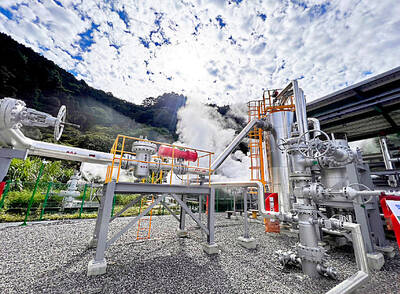
Taiwan’s semiconductor industry consumes electricity at rates that would strain most national grids. Taiwan Semiconductor Manufacturing Co (TSMC) alone accounted for more than 9 percent, or 2,590 megawatts (MW), of the nation’s power demand last year. The factories that produce chips for the world’s phones and servers run around the clock. They cannot tolerate blackouts. Yet Taiwan imports 97 percent of its energy, with liquefied natural gas reserves measured in days. Underground, Taiwan has options. Studies from National Taiwan University estimate recoverable geothermal resources at more than 33,000 MW. Current installed capacity stands below 10 MW. OBSTACLES Despite Taiwan’s significant geothermal potential, the
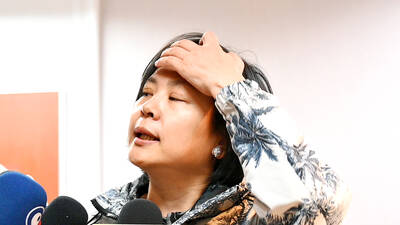
The entire Li Zhenxiu (李貞秀) saga has been an ugly, complicated mess. Born in China’s Hunan Province, she moved to work in Shenzhen, where she met her future Taiwanese husband. Most accounts have her arriving in Taiwan and marrying somewhere between 1993 and 1999. She built a successful career in Taiwan in the tech industry before founding her own company. She also served in high-ranking positions on various environmentally-focused tech associations. She says she was inspired by the founding of the Taiwan People’s Party (TPP) in 2019 by Ko Wen-je (柯文哲), and began volunteering for the party soon after. Ko
Chinese Nationalist Party (KMT) Chair Cheng Li-wun (鄭麗文) returned from her trip to meet People’s Republic of China (PRC) dictator Xi Jinping (習近平) bearing “a gift” for the people of Taiwan: 10 measures the PRC proposed to “facilitate the peaceful development of cross-strait relations.” “China on Sunday unveiled 10 new incentive measures for Taiwan,” wrote Reuters, wrongly. The PRC’s longstanding habit with Taiwan relations is to repackage already extant or once-existing policies and declare that they are “new.” The list forwarded by Cheng reflects that practice. NEW MEASURES? Note the first item: establishing regular communication mechanisms between the Chinese Communist Party


 RSS
RSS