


On top of Danby Slide, a slick, 18m-long chute of the Mill River in Danby, Vermont, Samantha Gill eased down to sit in a rush of water. Her hands were splayed back. Elbows locked. A roar of current tugged at her toes.
"OK, here it goes," she said.
The river took hold, and Gill was descending, no stopping now. The ride skirted a rib of exposed stone, then bumped left, diving steep to a drop, plunging Gill 1m into a bubbling pool below.
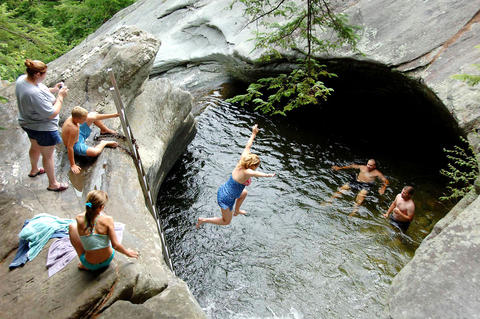
PHOTO: NY TIMES NEWS SERVICE
She came up smiling, slicking her hair back.
"An old pro," said Dave Hajdasz, a fellow slider standing on the bank of the stream.
It was a Sunday afternoon, muggy and hot by Vermont standards, and Gill was out on an adventure. "I swim here and do these slides," she said, motioning upstream toward a gorge of falling water.
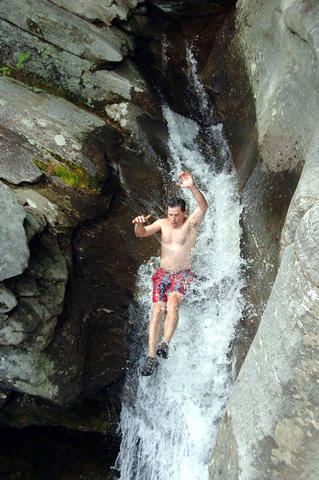
PHOTO: NY TIMES NEWS SERVICE
Natural water slides - essentially whitewater chutes navigable on your rear end - flank rivers and streams in places like Vermont, where tumbling water and time have worn smooth paths over stone. Rides like the Danby Slide, an unmarked locals' play spot just west from Route 7 in a gorge above its namesake town, provide a slippery fast slope, slicked with algae and smooth enough to be safe, allowing humans to slide like otters off a riverbank.
"You feel like a kid again doing this," said Hajdasz, a 45-year-old financial planner from Meriden, Connecticut. "I can do it all day long."
In late July, under a faultless blue sky, I joined Hajdasz to tour some water-slide sites around the state. As a contributor to www.swimmingholes.info, Hajdasz was in Vermont for the weekend, taking notes and photographs for the site. "I'm the regional correspondent," he said, dripping wet and smiling after a dip.
Natural water slides, found in most states, range from 3m-long child-friendly chutes to harrowing steep descents that launch sliders from the lip of a waterfall. Shallow water and slick stone are defining traits. Water levels dictate a slide's speed and seriousness; heavy rain or springtime flooding can create dangerous conditions.
New England, Vermont and New Hampshire boast dozens of slides in the White and Green Mountains, where old hills with bedrock-bottom creeks can create perfect sliding. Maine can claim at least eight slide sites, including the mellow Ledges Slide at Baxter State Park in the northern part of the state, and the more precipitous Cataracts Falls, a 9m plunge near Andover in western Maine.
Pennsylvania's Ohiopyle State Park, southeast of Pittsburgh, has two slides on the Youghiogheny River. "Sit in the creek bed and ride the water," the park's Web site advises. An observation deck overlooks a 9m-long flume.
Outside the US, sliders zip with river currents off drops from Nigeria to Fiji. Samoa, Australia, Israel, Nigeria, New Zealand and Belize have highlighted slides on www.naturalwaterslides.com, a site that catalogs water slides around the globe.
Most water slides are do-it-yourself adventures, often a side activity to a day swimming in a creek. Whitewater rafters might slide a stream as an ancillary activity. Slide locations are rarely marked, and only a handful of guide companies lead trips to water slides.
Robert Netzer, a 34-year-old engineering manager from Bloomington, Minnesota, had never heard of a natural water slide before traveling to New Zealand last winter. "Our guide held us over the falls by our ankles, then let go," he said, describing a head-first plunge canyoneering near Queenstown.
The New Zealand guide company, XII Mile Delta Canyoning (www.xiimile.co.nz), incorporates multiple water slides into its daylong river-exploration trips. "That plunge was a highlight of the day," Netzer said.
On the New Haven River in Vermont, a clear stream coming out of the Green Mountains near Bristol, I took my virgin plunge in a narrow chute above a pool. It was 11am, and two other sliders were frolicking upstream. The water was cold and utterly clear. The slide, a slot running horizontal to the river's main flow, tugged on my feet as I sat down. "Lean back," someone yelled.
I held my breath and straightened my arms. The water took hold, and I was free, a fish rocketing downriver, skipping off smooth stone, then dropping into a pool.
Circle Current, the local name for this whitewater stretch of the New Haven River, includes several narrow slides through its protruding bedrock slabs, one 12m long.
Elisa Adams, a 48-year-old chiropractor from Concord, Massachusetts, hesitated atop the lower slide. "Water's cold," she said.
But she slid anyway, shooting underwater on her back, disappearing under the froth, then re-emerging to plunk into the pool below.
Her daughter, Ariana, 18, was up next. "I've seen these slides before but have never done it," she said a moment before sliding off.
At Danby Slide, our next stop, a half-dozen swimmers were upstream of the main chute, warming up on a little slide. Hajdasz dipped a foot in the mountain water. "About 16°C," he said.
Always eager to swim, Hajdasz went first. "Whoo-hoo," he yelled on the way by.
Gill, a student from nearby Bennington College, slid second.
Soon, a line was forming at the top of Danby Slide. Its 18m length, combined with an algae-slick surface and a launching into a pool below, make the slide one of the best in the state.
I rode it three times, sitting bolt upright, letting my body literally go with the flow. The ride accelerates as it goes down, getting steeper. Then it launches from a lip over a cascade into deep water.
Miaya and Marissa Trombino - sisters, eight and nine, respectively - came down with a scream. Miaya piggybacked Marissa, both plugging their noses midair before the splash. They dog-paddled to the pool's edge.
"That was fun," said Marissa.
"That was so fun," mimicked Miaya.
A man barreled down Danby Slide on an inner tube. Three people slid past as a train.
"Busy day," said Hajdasz, tromping up to slide again. "I want one more ride."
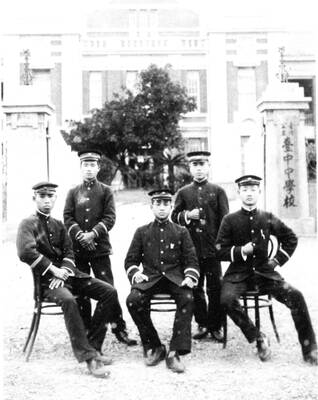
April 28 to May 4 During the Japanese colonial era, a city’s “first” high school typically served Japanese students, while Taiwanese attended the “second” high school. Only in Taichung was this reversed. That’s because when Taichung First High School opened its doors on May 1, 1915 to serve Taiwanese students who were previously barred from secondary education, it was the only high school in town. Former principal Hideo Azukisawa threatened to quit when the government in 1922 attempted to transfer the “first” designation to a new local high school for Japanese students, leading to this unusual situation. Prior to the Taichung First

The Ministry of Education last month proposed a nationwide ban on mobile devices in schools, aiming to curb concerns over student phone addiction. Under the revised regulation, which will take effect in August, teachers and schools will be required to collect mobile devices — including phones, laptops and wearables devices — for safekeeping during school hours, unless they are being used for educational purposes. For Chang Fong-ching (張鳳琴), the ban will have a positive impact. “It’s a good move,” says the professor in the department of

On April 17, Chinese Nationalist Party (KMT) Chairman Eric Chu (朱立倫) launched a bold campaign to revive and revitalize the KMT base by calling for an impromptu rally at the Taipei prosecutor’s offices to protest recent arrests of KMT recall campaigners over allegations of forgery and fraud involving signatures of dead voters. The protest had no time to apply for permits and was illegal, but that played into the sense of opposition grievance at alleged weaponization of the judiciary by the Democratic Progressive Party (DPP) to “annihilate” the opposition parties. Blamed for faltering recall campaigns and faced with a KMT chair

Article 2 of the Additional Articles of the Constitution of the Republic of China (中華民國憲法增修條文) stipulates that upon a vote of no confidence in the premier, the president can dissolve the legislature within 10 days. If the legislature is dissolved, a new legislative election must be held within 60 days, and the legislators’ terms will then be reckoned from that election. Two weeks ago Taipei Mayor Chiang Wan-an (蔣萬安) of the Chinese Nationalist Party (KMT) proposed that the legislature hold a vote of no confidence in the premier and dare the president to dissolve the legislature. The legislature is currently controlled


 RSS
RSS