


Steve McQueen praised Taiwan at the Venice Biennale for its development of a contemporary aesthetic, said curator Hongjohn Lin (林宏璋) at a press conference yesterday beamed from Italy to Taipei.
Lin said the Turner Prize-winning artist was impressed with works in the Taiwan Pavilion, at the Palazzo delle Prigioni, because of their up-to-date techniques and ideas.
Speaking on a Skype conference call, Hong said yesterday was the first press preview of the show Atopia and the public opening would be Sunday.
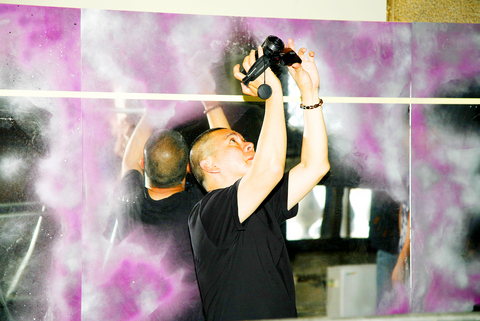
PHOTOS: COURTESY OF TFAM
"Since the exhibition has not officially opened I cannot say much more about the reaction to it," Lin replied to a question from the Taipei Times in Taiwan. "But the feeling is good, it's very special."
Atopia, features work from the auteur Tsai Ming-liang (蔡明亮), photographer Lee Kuo-min (李國民), video director Tang Huang-chen (湯皇珍), bricoleur Huang Shih-chieh (黃世傑) and comic-book artist VIVA.
Taking turns to speak at the world's most high-profile contemporary art exhibition, which runs every two years, the artists commented on the installation of their works and impressions so far of the festival.
In a virtual guided tour of the Taiwan Pavilion, Lin said getting everything ready in time and overcoming technical problems had been challenging.
He said it had been a learning process for himself and the five-featured artists, none of whom have previously exhibited at Venice.
Tsai concurred, adding it was a novel experience for him to enter a movie at an art exhibition rather than a competition, such as the Cannes Film Festival.
"This is a different kind of filmmaking to the Hollywood style," he said of It's a Dream, which has been transferred to DVD from 35mm. "You have to be more patient to appreciate it and this suits the character of my work."
Speaking of the other artists, Tsai said all the works were different and had a unique style. "Even so I think that together they are harmonious and the atmosphere is great."
Lee echoed this view and spoke of his series of intensely localized photos, You Only Die Twice, that were presented as transparencies.
Lee said what they represented (people's lives as shown by their rooms) was not as important as the feelings they projected or evoked.
In contrast, Tang's videos I Go Traveling V/A Postcard with Scenery are more personal to the artist. Initially the videos appear to be holiday snaps or videos but the way they are presented makes the viewer reflect on 21st century communication and nostalgia.
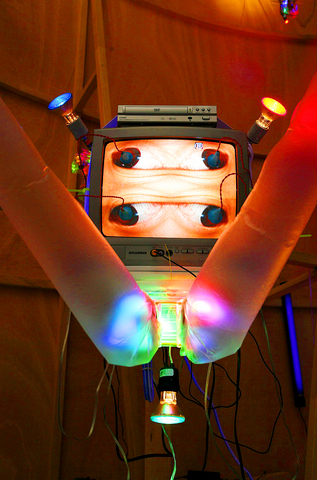
Possibly the most arresting work is Huang's EVX-07, which features large-scale, cannibalized objects that light up, blow up and are also interactive.
From the virtual video tour of the exhibition Huang's neon-lit creations seemed to create a weird world of common objects seen in an unusual light.
Finally, the comic book artist VIVA's look at the life of Taiwanese otaku, or computer/technology nerds, was imaginatively presented. The audience can view the works, but also pull them down, roll them up and take a four-panel manga cartoon home.
This was the first live video conference call that Taipei Fine Arts Museum has held and it seemed to complement the modern aesthetic that Steve McQueen recognized as being a strength in Taiwan's entry.
There were glitches, slow-motion digitized images and the occasional absence of clarity, but overall it worked and virtually brought the Venice Biennale home.

On a harsh winter afternoon last month, 2,000 protesters marched and chanted slogans such as “CCP out” and “Korea for Koreans” in Seoul’s popular Gangnam District. Participants — mostly students — wore caps printed with the Chinese characters for “exterminate communism” (滅共) and held banners reading “Heaven will destroy the Chinese Communist Party” (天滅中共). During the march, Park Jun-young, the leader of the protest organizer “Free University,” a conservative youth movement, who was on a hunger strike, collapsed after delivering a speech in sub-zero temperatures and was later hospitalized. Several protesters shaved their heads at the end of the demonstration. A
Google unveiled an artificial intelligence tool Wednesday that its scientists said would help unravel the mysteries of the human genome — and could one day lead to new treatments for diseases. The deep learning model AlphaGenome was hailed by outside researchers as a “breakthrough” that would let scientists study and even simulate the roots of difficult-to-treat genetic diseases. While the first complete map of the human genome in 2003 “gave us the book of life, reading it remained a challenge,” Pushmeet Kohli, vice president of research at Google DeepMind, told journalists. “We have the text,” he said, which is a sequence of
In August of 1949 American journalist Darrell Berrigan toured occupied Formosa and on Aug. 13 published “Should We Grab Formosa?” in the Saturday Evening Post. Berrigan, cataloguing the numerous horrors of corruption and looting the occupying Republic of China (ROC) was inflicting on the locals, advocated outright annexation of Taiwan by the US. He contended the islanders would welcome that. Berrigan also observed that the islanders were planning another revolt, and wrote of their “island nationalism.” The US position on Taiwan was well known there, and islanders, he said, had told him of US official statements that Taiwan had not
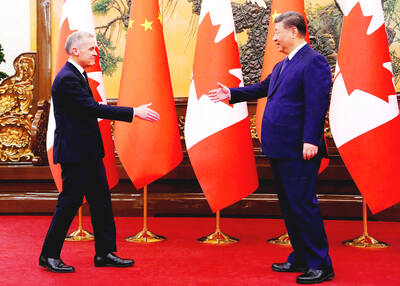
Britain’s Keir Starmer is the latest Western leader to thaw trade ties with China in a shift analysts say is driven by US tariff pressure and unease over US President Donald Trump’s volatile policy playbook. The prime minister’s Beijing visit this week to promote “pragmatic” co-operation comes on the heels of advances from the leaders of Canada, Ireland, France and Finland. Most were making the trip for the first time in years to refresh their partnership with the world’s second-largest economy. “There is a veritable race among European heads of government to meet with (Chinese leader) Xi Jinping (習近平),” said Hosuk Lee-Makiyama, director


 RSS
RSS