


If Britons already believe that their island is intolerably crowded today, they might well want to brace themselves -- because the country is going to become much, much more densely populated over the course of this century as millions of people flee the uninhabitable desert that ma inland Europe is doomed to turn into.
Such at least is James Lovelock's fear. The esteemed — if controversial — environmentalist and futurologist (he prefers to be called a planetary physician) also believes that by the middle of this century, the America-sized chunk of floating ice that currently covers the Arctic will melt. As a result, the current habitat of polar bears will eventually be the place where we, or our probably very fed-up descendants, live out their pitiful existences. "Most life will move up to the Arctic basin because only it and a few islands will remain habitable," says Lovelock, who is most famous for coming up with the so-called Gaia hypothesis — the idea that the Earth functions as some kind of living super-organism.
Lovelock is now seriously concerned about said super-organism. Humanity's vast output of carbon dioxide over the past two centuries has prompted the deserts to spread towards the poles at an alarming rate, he says. "The Sahara is heading north. So where's the food going to come from? Not from the European mainland. Even here things are changing: there are in Britain now scorpions and snails hitherto only seen in the Mediterranean. Recently I saw hawk moths. Something terrible is happening." On the plus side, hawk moths are very pretty, I suggest. "That's not really the point," says Lovelock.
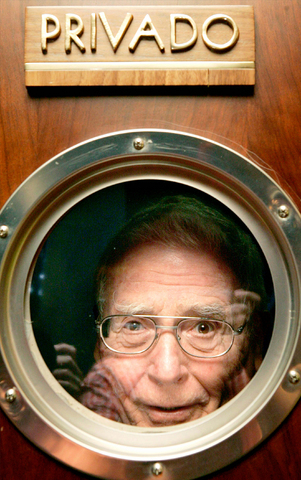
PHOTO: EPA
"I think people forget that the whole world is going to be affected," he goes on. "Climate change will affect China and the US." Indeed, Lovelock envisages that the Chinese people will press to live in a newly lush Siberia before the century is out. "No wonder Putin is arming like mad. In fact, Putin is one of the more far-sighted of global leaders." In the US, even now, distinguished academics are contemplating moving north, Lovelock says. "I gave a talk at Stanford [the Californian Ivy League university] a few months ago. Professors, including Nobel prize winners, were coming up to me asking where in Canada they should buy real estate because they believed me when I said much of the US will be uninhabitable."
Are they right to think that way? "Absolutely ... we should be scared stiff. If you speak to any senior climatologists, the summer of 2003 [in which thousands of Europeans, many of them elderly, perished in the heat] will be the norm by 2050. Old people might have air conditioning, but that won't help the plants which we need to regulate temperatures. It will become a desert climate."
But what of Britain? Is this green and sometimes pleasant land doomed to become desert too? Lovelock thinks not. "We'll be a bloody lifeboat for Europe. It will be their right to come here too." Why? "Because we're all members of the European community." Good point, but one tends to forget such footling matters as the rights that go with EU membership when one is staring global catastrophe in the face.
Lovelock reckons that the British Isles will be among the few island oases in a world given over to desert, scrub and oceans devoid of life.
Lovelock may sound extreme to some, but although he is regarded as a sort of dotty uncle figure by some scientists, and his Gaia hypothesis has been criticized by the likes of Richard Dawkins, others hold him in high regard. His fans include biologist Lewis Wolpert, green thinker Jonathan Porrit, geo-grapher Jared Diamond, and philosopher John Gray. The environmentalist Fred Pearce once said Lovelock was to science what Gandhi was to politics; Prospect magazine included him in its list of the world's top 100 intellectuals.
Why, you might well ask, will the British Isles be spared the desert fate predicted for much of continental Europe? Because global warming will be, in our blissful case, cancelled out by a fall in temperature caused by the failure of the Gulf Stream. The suggestion comes from Lovelock's latest book The Revenge of Gaia: Why the Earth Is Fighting Back and How We Can Still Save Humanity.
If, as Lovelock forecasts, the Arctic ice melts as a consequence of global warming, the Gulf Stream — the flow that moves warm water towards northern Europe from the Caribbean — will cease. This possibility has long been the subject of science fiction, with writers imagining the return of an ice age to the British Isles and the east coast of North America. Lovelock now thinks that possibility is less likely because any such cooling effect will be cancelled out by global warming.
I walk out with Lovelock into the unseasonably mild air, for a turn around Kensington Gardens in west London, where crocuses press their charms weeks too soon.
As we stroll, the 87-year-old scientist says: "Not only is the world turning and fearfully, but everything is happening very quickly." He points out that carbon dioxide emissions warm the planet and in so doing destroy some of the regulatory systems — such as the reflective powers of the poles' icy wastes — that have kept the earth cool despite the increasing heat of the sun.
"Things are changing all the time, but because we live in towns we don't see it. We modulate the temperature. We don't want to notice the big disturbing picture, we want to see the next episode of the soap opera. There are children," he says ruefully, shaking his head, "who live in cities and have never seen the Milky Way."
Where did we go wrong? "If we were hunter-gatherers and this was a bigger planet we would be all right. But we're not: we're farmers and that's what's screwed us up. There are just too many of us living the way we do. Our wrongdoing has been to take energy hundreds of times faster than it is made naturally available."
How can we reduce human population to more sustainable levels? "We can't solve the problem. There's no human way of cutting numbers. You can empower women and persuade them to have fewer children but we don't have the time for that."
His diagnosis may be grim, but Lovelock's prognosis is much more bleak. He suggests that the current population of six billion humans will be cut to a more ecologically sustainable half — to one billion people. "How will this mass cull happen? "It'll be worse than Hitler — Gaia's going to do it," says Lovelock. He writes about this chillingly at the outset of The Revenge of Gaia, where he considers the December 2004 tsunami. "That awful event starkly revealed the power of the earth to kill. The planet we live on has merely to shrug to take some fraction of a million people to their deaths. But that is nothing compared with what may soon happen; we are now so abusing the Earth that it may rise and move back to the hot state it was in 55 million years ago, and if it does, most of us, and our descendants, will die."
Lovelock first came up with the idea of Gaia 40 years ago to try to account for his view that the planet's chemistry, climate and veneer of life worked together as a self-sustaining organism. It was widely ridiculed by scientists. "One even called it an evil religion," he says with a giggle, "but they later admitted not having read my books."
He maintains that no academic scientist would have been able to come up with such a radical idea as Gaia. "I hate academia. Most of the scientists who work there are not free men any more and they can't speak out. That's no way to do science." He believes the increasing specialization of university science departments has made academic scientists unlikely to have the overview necessary to envisage the Earth as a self-regulating organic system.
As we walk, Lovelock talks about Gaia. "She's an old lady who has lived for three and a half billion years but she only has half a billion to one billion to go," he says. "She's a bit like me — near the end of her life. I'm pretty unlikely to live beyond 100. She will die the same way as me." How? "Your ability to resist perturbations gets less as you get older."
Looking at the dead red landscape of Mars, as he did during his years as an independent scientist, gave him a premonition of what Earth might become like if global warming continues. "Vast tracts of it will become like Mars — uninhabitable for humans." His suggestion is that all we can do is minimize humanity's impact on Gaia. "We have got into this mess by burning carbon. We shouldn't have burned things in the atmosphere to get energy. We shouldn't have burned forests to drive out animals as a cheap way of hunting, because Gaia demands that the forests are kept in order to regulate her temperature and health."
I suggest to Lovelock there are many skeptics about global warming. For instance, Michael Crichton, in his novel State of Fear, suggested that global warming was a fiction, while Mother Teresa said in 1988 that the fate of the planet was not humanity's concern, adding: "God will take care of the Earth." Recently Newsweek columnist George F Will wrote that the central tenets of the global warming thesis are all unproven, and that the benefits of trying to reverse it will far exceed the costs. "Maybe they're right," says Lovelock, sarcastically.
He goes on: "There are several things we can and should do to make the situation better, but they will only be like dialysis machines are for a kidney patient. It's not going to cure you." His suggestions for ameliorating global warming are intriguing. Among them are massive terrestrial or space-mounted sunshades to cool ourselves back to pre-industrial temperatures. He also supports the idea of the artificial production of clouds across large areas of the sky in order to reduce the input of solar radiation. His book also calls for sailing ships and even giant sailing airships for sustainable long-distance travel.
Lovelock, who is pro nuclear power, derides renewable energy, such as wind power. "It's gesture stuff. I'm not anti-wind turbines. You need five- to 10-megawatt ones on oil platforms in the sea because the wind is more reliable at sea. Planting thousands of them in the country-side is not going to solve the problem." Nor does he like biofuels. Indeed, he is suspicious of any policy that results in more land being used in cultivation. "Gaia needs at least a third of the land for self-regulation."
Before we part, I ask Lovelock, who lives in Cornwall, if he is utterly gloomy about the future. "No! Humans have gone through seven major climactic changes in the million years we've been around. Even those changes — ice ages — were ones we adjusted to. Admittedly, those adjustments usually took place over thousands of years, and ours will involve an adjustment in little more than two centuries, but we are flexible as a species." He draws a parallel with his wartime experiences in London: "I was here for much of the war and when it happened it wasn't as bad as we had thought it would be. If people are honest, they rather enjoyed it. It could well be similar in the next few decades. Life will become a little more interesting than it was before."
If one asks Taiwanese why house prices are so high or why the nation is so built up or why certain policies cannot be carried out, one common answer is that “Taiwan is too small.” This is actually true, though not in the way people think. The National Property Administration (NPA), responsible for tracking and managing the government’s real estate assets, maintains statistics on how much land the government owns. As of the end of last year, land for official use constituted 293,655 hectares, for public use 1,732,513 hectares, for non-public use 216,972 hectares and for state enterprises 34 hectares, yielding

The small platform at Duoliang Train Station in Taitung County’s Taimali Township (太麻里) served villagers from 1992 to 2006, but was eventually shut down due to lack of use. Just 10 years later, the abandoned train station had become widely known as the most beautiful station in Taiwan, and visitors were so frequent that the village had to start restricting traffic. Nowadays, Duoliang Village (多良) is known as a bit of a tourist trap, with a mandatory, albeit modest, admission fee of NT$10 giving access to a crowded lane of vendors with a mediocre view of the ocean and the trains

Traditionally, indigenous people in Taiwan’s mountains practice swidden cultivation, or “slash and burn” agriculture, a practice common in human history. According to a 2016 research article in the International Journal of Environmental Sustainability, among the Atayal people, this began with a search for suitable forested slopeland. The trees are burnt for fertilizer and the land cleared of stones. The stones and wood are then piled up to make fences, while both dead and standing trees are retained on the plot. The fences are used to grow climbing crops like squash and beans. The plot itself supports farming for three years.

President William Lai (賴清德) on Nov. 25 last year announced in a Washington Post op-ed that “my government will introduce a historic US$40 billion supplementary defense budget, an investment that underscores our commitment to defending Taiwan’s democracy.” Lai promised “significant new arms acquisitions from the United States” and to “invest in cutting-edge technologies and expand Taiwan’s defense industrial base,” to “bolster deterrence by inserting greater costs and uncertainties into Beijing’s decision-making on the use of force.” Announcing it in the Washington Post was a strategic gamble, both geopolitically and domestically, with Taiwan’s international credibility at stake. But Lai’s message was exactly


 RSS
RSS