

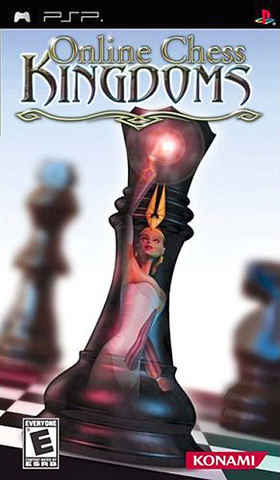
Online Chess Kingdoms
Konami
Sony PSP
Chess players don't have much to choose from on today's portable gaming systems. Konami fixes that with the release of Online Chess Kingdoms for the PSP, a fanciful take on one of the world's oldest games.
Those who crave a quick match can choose from five unique sets — Order, Chaos, Magic, Reason and Spirit — duking it out against the CPU or online on a variety of interesting 3-D boards. Taking an opponent's piece triggers a battle animation, which, while initially interesting, can get tiresome. Fortunately, the animations and battle sounds can be turned off.
Chess purists can choose more traditional pieces and play on a 2-D board similar to versions used in chess publications. Four skill levels will prove challenging to all players except the most advanced. Those who have studied chess will face a wily opponent that does not "stick to the book" in openings. Oddly, there is no clock or in-game chess tutorial, which, combined with the fantasy world pieces and boards, would have been a good way to introduce the game of kings to a child. A story mode expands upon the fantasy world setting by pitting the five fantasy armies against one another on a map divided into a grid. Move an army into an enemy square, and you'll have to win a game of chess to conquer it. Online play brings a world of opponents to the table.
Untold Legends: Dark Kingdom
Sony Online Entertainment
PlayStation 3
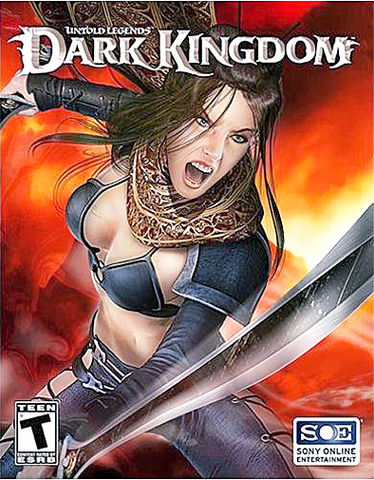
The latest in the Untold Legends series makes no attempt to be anything more than a visually upgraded version of its hack-and-slash predecessors. By setting the bar so low, it succeeds. But given the hardware and the game's price tag, it could (and should) have been much more. Those familiar with the "role-playing lite" genre will feel right at home playing hero in this oft-told tale. The king of a mystical land has fallen prey to evil, and it's up to your character to slaughter a few thousand evil creatures to set things aright.
Players can choose one of three vanilla character classes — Mage, Warrior and the nimble Scout. Despite outward appearances, the three are similar enough that, once you learn the simple combat and spell-casting scheme, the same button combos work equally well for each. Combat is fluid, and the controls feel responsive, but battles tend to be a letdown. Loot drops are plentiful and include upgrades to weapons, armor and spells, but there are better game options out there. The graphics are merely passable.
At times, characters can get stuck on objects such as boulders. The biggest drawback, other than the repetitive game play, is camera control. Assigned to the right analog stick, it is too easy to accidentally zoom in and out. Once zoomed out, objects such as trees block the player's view of his character. Co-op and online multiplayer adds real value to those who will share the journey with friends — up to four players can join the slaughter at once.
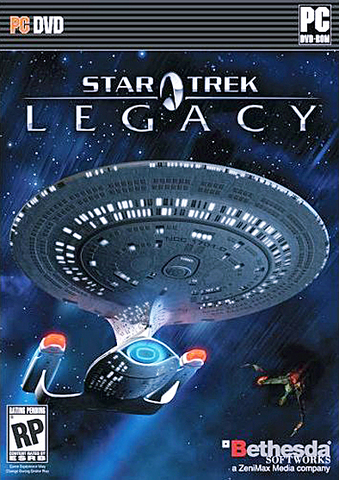
Star Trek: Legacy
Bethesda Softworks
PC, Xbox 360
"Space, the final frontier. These are the voyages of the starship Enterprise?" The words can send chills up the spines of Trekkies throughout the solar system. With each Star Trek game release, these same Trekkies hold their breath and hope the majesty of Gene Roddenberry's classic science fiction TV show can somehow be recaptured.
Exhale Star Trek fans. This is not it.
Legacy is certainly an ambitious saga that spans all five TV series (Star Trek, The Next Generation, Deep Space Nine, Voyager and Enterprise). As expected, the story behind the game's career mode is good and involves the expected Vulcans, Romulans, Klingons and Borg. Voice acting, featuring series stars such as Scott Bakula and William Shatner, also evokes good times. But this Trek is plagued by a universe of problems.
The graphics look outdated; giant space stations explode in large chunks as though cut apart by giant space scissors rather than photon torpedoes. Sometimes phasers fire but can't be seen. The controls are frustrating on the PC because they were designed for a game controller, not a keyboard and mouse. Thus, there are times in the PC version, such as when allocating energy to different ship systems, when controls do not work reliably.
Players are assigned a fleet of ships, which creates even more problems. There is no "follow me" command. In fact, there is no way to assign fleet-wide commands other than to attack. The player has to micromanage each ship because the other captains are too stupid to order repairs. Battles are too long, and the targeting system has glitches. Missions are pretty long, too — up to 45 minutes. Fail a mission, and you are forced to start again from the beginning because there is no Save option.
As Spock would say, the missions are illogical. In one mission, medical ships need a military escort as they fly from planet to planet curing an outbreak of disease.
When a dozen Romulan ships attack, you would expect the medical ships to pause long enough for the warships to clear the way. Instead, they charge ahead to their doom. Multiplayer does not work unless a patch is downloaded and applied. Star Trek is a great franchise, but this is a flawed game.
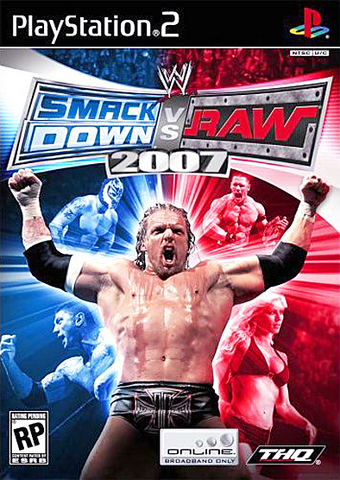
WWE SmackSown vs. Raw 2007
THQ
Xbox 360, Xbox, Sony PSP, PlayStation 2
This SmackDown update rolls out a few new tricks for its World Wrestling Entertainment stable of stars.
The first noticeable change — other than improved graphics on the series' 360 debut — is the control scheme, which forgoes face buttons in favor of the right analog stick to initiate grapple moves. Once knocked out of the ring, the newfound ability to smack opponents with folding chairs or bash their heads into stairs or tables becomes obvious, too. The ability to fight amid the audience definitely ramps up the immersion factor.
Players enter the "squared circle" as one of dozens of male or female characters, including legends the Rock, Stone Cold or Hulk Hogan. A custom grappler also can be created for a deep Season Mode featuring more than 40 different original story lines. An expanded General Manager Mode allows the creation of a personal stable of bruisers. Wrestlers and arenas look good, but sometimes the animations hiccup. Load times are atrocious, and tag team matches require five interminable waits — four for each wrestler's introduction and one for the actual match.
The artificial intelligence appears buggy at times, with opponents standing immobile waiting for some serious hurt or repeatedly taking an unavoidable beatdown. But the game is at its best when it's mano a mano. Up to four players can beat on one another at the same time in multiplayer. Online play via Xbox Live also provides a bevy of options.

A decade ago, Taiwanese television had an image problem. When representatives of Taiwan’s Public Television Service (PTS) traveled to Singapore to meet Netflix, they brought two dramas: A Touch of Green (一把青, 2015), a sweeping story of war, displacement and military families, and Wake Up (麻醉風暴, 2015), a tightly constructed medical thriller. They were not simply trying to sell programs. They were trying to change an idea of Taiwan. International perceptions of Taiwanese television, PTS executives recalled in interviews conducted for my joint research with Chairman Hu Yuan-hui (胡元輝), were still strongly associated with the idol dramas that had enjoyed enormous regional popularity

No matter where one sits on the political spectrum and who one blames for the ongoing struggles between the executive and legislative branches or the latest food scandal, there has been noticeable frustration with the way democratic institutions are functioning. Attempts to circumvent political opposition and institutional checks can begin a slide toward authoritarianism, even when presented as short-term solutions to gridlock. While that might solve problems in the short term, it inevitably evolves into a system that serves the rulers and the powerfully connected at the expense of the rights of regular folks. One interesting lens to examine the

Another doleful set of demographic announcements this month from the National Development Council (NDC), with the number of young people shriveling as the proportion of old people grows. “Taiwan’s 18-year-olds, the typical age for entering college, will fall below 200,000 for the first time in the 2027 academic year to 195,309, down from 200,406 in 2026,” this paper reported citing NDC sources. Meanwhile, the administration of President William Lai (賴清德) announced a goal of training at least 500,000 AI professionals by 2040. Although this could include foreign recruits and retraining those already in the workforce, the math is stark: Ministry of
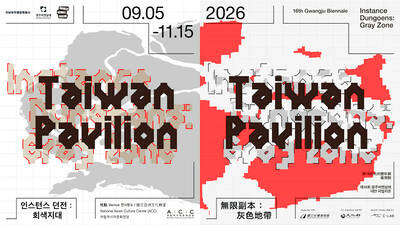
The name “Taiwan” is to appear at South Korea’s Gwangju Biennale when it opens on Saturday, after months of objections from Taiwanese artists and government agencies over an attempted name change. China Pavilion personnel halted installation and left the venue on Friday, after China’s Ambassador to South Korea Dai Bing (戴兵) objected to the restoration of the “Taiwan Pavilion” name. As of Monday, the Chinese side was reportedly preparing to withdraw, although its formal withdrawal had not been completed. The pavilion dispute began on June 10, when the ministry and participating artists said organizers had changed “Taiwan Pavilion” to “NTMoFA Pavilion,” referring


 RSS
RSS