


The administrators at the International Academy of Film and Television in Cebu, Philippines describe the next big wave in travel as "edu-tourism." They hold that vacationers are no longer satisfied with just sitting on the beach sipping margaritas, and want to do something educational to engage with their host country in a meaningful way. The Philippines has a range of schools that give you just that, offering fun, education and everything in between.
The Philippines doesn't normally jump to mind as an English immersion environment. But although Filipino English has its own distinct accent, English is one of the two national languages and is spoken universally. For students of English without the budget to fly half way around the world to the UK or US for an immersion environment, the Philippines is a cheaper and more convenient option. And you can work towards your IELTS certification while sitting by the pool or learning how to scuba dive.
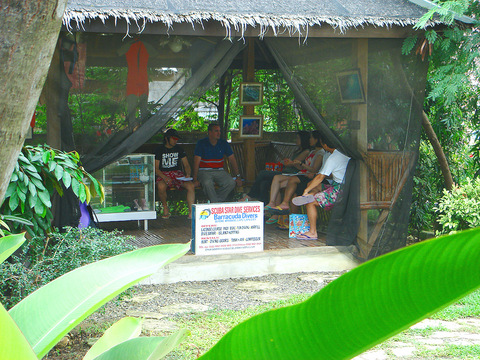
Many of the institutions are more than just schools, blurring the lines between education, business and even vacation. The American Language Teaching Academy (ALTA) is located near the beach outside Cebu City, and bills itself as a "language resort." It is an accredited school offering the standard range of TOEFL and IELTS certifications. However you won't find students hunkered over their books in the library at midnight studying for finals, but rather in the bar. ALTA opened an adjunct Cebu Garden Resort on the same compound just a few months ago, and indeed it's hard to tell where the school ends and the resort begins. President Larry Tarquinio emphasizes a relaxed family-style approach, and says many students find the program helpful because the laid-back atmosphere helps them get over shyness about speaking. He also gets the resort guests to pitch in to the educational environment, encouraging students to come down to the bar after classes and loosen up with a couple of beers to practice their English with foreigners staying at the resort.
PHOTOS: MARC LANGER, TAIPEI TIMES
ALTA offers 15-day "learning vacation" packages, but students certainly aren't bound by specific programs. They can come whenever they want and stay as long as they please — there is nothing so un-hip as semesters. In fact, students can study pretty much whatever suits their interest. The resort chef will teach them cooking, or they can learn how to make earrings and necklaces. The school was originally funded by money Tarquino made in the jewelry manufacturing business, and there is a sizeable jewelry factory in the middle of the campus if students are interested. Whatever students can dream up to study, Tarquino will find someone on staff to teach it to them.
And with only around 30 students at the school at a time, students get plenty of one-on-one instruction. Classes are informal, shoes are optional and when the weather's nice classes move outside to the scuba shack.
Closer in to Cebu is the International Academy of Film and Television (IAFT), a compound of large square buildings with a slick black lobby complete with flat-screen TVs and leather couches. It is also an amalgamation of different things, with a dedicated English training center connected to the film school, which is attached to a professional movie studio. Students might come to practice their English and end up directors. Last year there were seven graduates from its one-year filmmaking program, and four of them now work for the studio. The teaching staff has many Hollywood veterans, and if you hang around in the lobby long enough, you just might see a star.
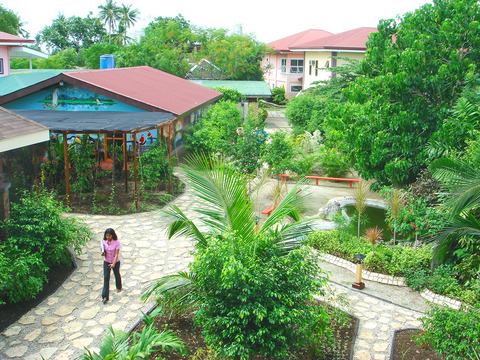
It's certainly a more corporate-style environment. Bigfoot Entertainment, the company that owns the school and studio, seems to have its hand in everything. It has a fashion channel, Bigfoot Coffee is served out of a cafe in the lobby, and there are even a few ostriches in a pen outside that one of the company bigwigs bought on a whim for a movie and never used.
The language school in the main building is run by Cleverlearn English Language Institute, an affiliate of Bigfoot. It has multiple locations in the Philippines and throughout Asia. As with the rest of the school, everything in the language center is shiny and new, with long rows of glassed-in booths for one-on-one and group instruction. It certainly lacks the family feel of ALTA, and the square, concrete buildings seem incongruous with a waterfront property on a tropical island. But it is a more traditional educational environment for students not interested in charting their own course at ALTA.
But Bigfoot emphasizes fun too. It also has two-week "learning vacations" where visitors can study English and also try their hand at various aspects of the film industry. The school is willing to be flexible and let students do mixtures of ESL and film activities to break up the hours of language drilling.
Southwestern University in downtown Cebu offers the most traditional collegiate fare. It has a very well respected medical program to go along with the standard bachelors and masters degrees. And it is also the only school of the three with Taiwanese students currently studying there.
Having its campus spread out through the city costs Southwestern most of its holiday vacation feel, but it makes up for it with a real college atmosphere. Whereas ALTA and Bigfoot tend to follow the resort tradition of making themselves independent enclaves in the surrounding community, Southwestern is much more integrated into Cebu. Students should be ready to take care of themselves. Though the university has an office to help students find apartments in Cebu, it doesn't guarantee university housing. Southwestern has programs to help students acclimate, but it doesn't hold your hand like all-inclusive resorts do. Of the three, this would probably be the best option for serious students truly intent on hitting the books.
Students would certainly need a sense of adventure and a lot of flexibility to thrive in the Filipino ESL schools. Cebu is regarded as the safest major city in the Philippines, but parts of it can seem a bit gritty and chaotic compared to downtown Taipei. Still, all three schools emphasized that the common Taiwanese conception of the Philippines as a dangerous place is out of proportion.
The industry is just burgeoning and schools are eager to make accommodations to entice students. They are especially happy to have Taiwanese students, who are still very underrepresented. The schedules and courses laid out in brochures are often more guidelines for you to adjust to your preferences than set agendas.
There aren't any western-style grassy promenades and ivy-covered buildings, but there is solid instruction to be had at a fraction of the price. If you want to study English at the University of Southern California Language Academy, you have to fork over US$125 just to apply, and a six-week program will run to US$2,200. Four weeks at Cleverlearn is a mere US$490, and that's with the vacation thrown in.

Last week the government announced that by year’s end Taiwan will have the highest density of anti-ship missiles in the world. Its inventory could exceed 1,400, or enough for the opening two hours of an invasion from the People’s Republic of China (PRC). Snark aside, it sounds impressive. But an important piece is missing. Lost in all the “dialogues” and “debates” and “discussions” whose sole purpose is simply to dawdle and delay is what the Chinese Nationalist Party (KMT) alternative special defense budget proposal means for the defense of Taiwan. It is a betrayal of both Taiwan and the US. IT’S

Paul Thomas Anderson’s “One Battle After Another” was crowned best picture at the 98th Academy Awards, handing Hollywood’s top honor to a comic, multi-generational American saga of political resistance. The ceremony Sunday, which also saw Michael B. Jordan win best actor and “Sinners” cinematographer Autumn Durald Arkapaw make Oscar history as the first female director of photography to win the award, was a long-in-coming coronation for Anderson, a San Fernando Valley native who made his first short at age 18 and has been one of America’s most lionized filmmakers for decades. Before Sunday, Anderson had never won an Oscar. But “One Battle

In Kaohsiung’s Indigenous People’s Park (原住民主題公園), the dance group Push Hands is training. All its members are from Taiwan’s indigenous community, but their vibe is closer to that of a modern, urban hip-hop posse. MIXING CULTURES “The name Push Hands comes from the idea of pushing away tradition to expand our culture,” says Ljakuon (洪濬嚴), the 44-year-old founder and main teacher of the dance group. This is what makes Push Hands unique: while retaining their Aboriginal roots, and even reconnecting with them, they are adamant about doing something modern. Ljakuon started the group 20 years ago, initially with the sole intention of doing hip-hop dancing.

You would never believe Yancheng District (鹽埕) used to be a salt field. Today, it is a bustling, artsy, Kowloon-ish “old town” of Kaohsiung — full of neon lights, small shops, scooters and street food. Two hundred years ago, before Japanese occupiers developed a shipping powerhouse around it, Yancheng was a flat triangle where seawater was captured and dried to collect salt. This is what local art galleries are revealing during the first edition of the Yancheng Arts Festival. Shen Yu-rung (沈裕融), the main curator, says: “We chose the connection with salt as a theme. The ocean is still very near, just a


 RSS
RSS