


Dragons have been around for so long that some people have a hard time coping with the fact that they do not exist. "I got some very strange e-mails from people who thought they were alive and kept in zoos and used for military purposes," said Peter Hogarth, chairman of the biology department at the University of York in England, describing the response to his work as a "dragonology" consultant on the 2004 Animal Planet television special Dragons: A Fantasy Made Real.
Given the expectations, the filmmakers behind Eragon knew they had to step carefully when it came to reinventing this particular legend.
"It was always a daunting task from the get-go," Glen McIntosh, the animation director who led the Eragon special effects team at Industrial Light and Magic, said in a recent telephone interview from his office in San Francisco.
"There are so many dragon movies, from Ray Harryhausen to Dragonslayer and Dragonheart, up to recent Harry Potter films, and they all adhere to the classic myth of a dragon as a creature that is elemental."
Early in the process McIntosh and his team set some ground rules for bringing to life Saphira, the blue dragon who bonds with her human companion, Eragon.
"The goal was always to reference nature first — take the attributes of an animal that is regal, like a lion," explained McIntosh, who knew he had to strive for the kind of verisimilitude that made the scene on the ledge between the actress Naomi Watts and the computer-generated ape in last year's King Kong a showstopper. That meant favoring real animal behavior and adding only a sprinkling of anthropomorphic interpretation on top.
When Saphira is "in the air, we looked at eagles and how they soar," McIntosh said. "She's a creature of fantasy, but we had to assign her with attributes people have seen on other animals, so we went looking at everything from puppies to wildebeest."
Such range was necessary because, he explained, the audience sees Saphira from birth through adolescence to maturity, a far cry from other dragon movies, in which the creature is seen mostly as an adult antagonist, not a companion.
The most difficult challenge was not to make the dragon breathe fire but to make it speak. Remembering the brogue of Sean Connery spewing from the creature's mouth in Dragonheart, they knew they had to do better.
"In the book, and in the movie, there's this telepathic, symbiotic relationship," McIntosh explained of the fearsome, elegant Saphira and her human co-star, a teenage boy played by Edward Speleers. "You'll hear her voice, but we had to convey that in her facial movements, in her eyes."
Having worked on Jurassic Park 3 as lead character animator in 2001 — a lifetime away in special effects terms — McIntosh said he was confident that Eragon would strike even sophisticated viewers as something more than a recycling of computer algorithms that created real or imagined monsters of the past.
"As far as the world of visual effects that came out in 1993, we had just scratched the surface," he said, referring to the first Jurassic Park film. "And now we've been able to see this evolution, whether it's Gollum and King Kong and now Davy Jones," the half-man, half-crustacean co-star of the most recent Pirates of the Caribbean installment.
Stefen Fangmeier, Eragon's director, said the key to making a new kind of dragon epic was to take the mythology of the beast seriously. "Really the dragon movie had become kind of a figure that was a little bit ridiculous," Fangmeier said by phone from his home in the canyons north of Los Angeles. "The dragon films that were out there are ones that weren't necessarily that successful. I tried to look at, 'Why aren't they?"' On the one hand, he said, were movies like Dragonheart. "On the other side was Reign of Fire, with nasty reptilian creatures who didn't have intelligence. They were reduced to giant alligators. We needed to be right in the middle."
Fangmeier said the 22-year-old author of the Eragon novel, Christopher Paolini, had already given Saphira enough lore and mystery to sustain her as a character. He focused instead on one aspect: the business of dragon flight. To that end the filmmaking team spent a lot of time debating the degree to which Saphira's wings should or should not resemble the standard bat wing. Eventually they added some feathers, though not so many as to tip the creature toward the canine-looking dragon Atreyu from the 1984 fantasy movie The NeverEnding Story.
Hogarth said he was certain that people would continue to believe in dragons, whatever the level of realism brought to bear in Eragon."
"In young people it's sort of understandable," he mused. "What surprises me is the middle-aged civil engineer wanting to come across the Loch Ness monster."
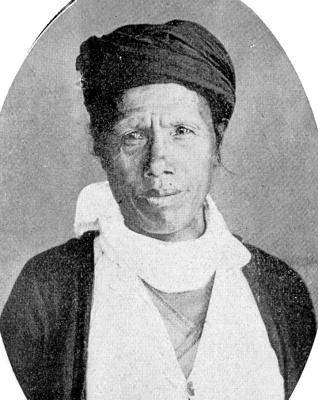
May 11 to May 17 Traversing the southern slopes of the Yushan Range in 1931, Japanese naturalist Tadao Kano knew he was approaching the last swath of Taiwan still beyond colonial control. The “vast, unknown territory,” protected by the “fierce” Bunun headman Dahu Ali, was “filled with an utterly endless jungle that choked the mountains and valleys,” Kano wrote. He noted how the group had “refused to submit to the measures of our authorities and entrenched themselves deep in these mountains … living a free existence spent chasing deer in the morning and seeking serow in the evening,” even describing them as

Yesterday, the Democratic Progressive Party (DPP) nominated legislator Puma Shen (沈伯洋) as their Taipei mayoral candidate, the Chinese Nationalist Party (KMT) put their stamp of approval on Wei Ping-cheng (魏平政) as their candidate for Changhua County commissioner and former legislator Tsai Pi-ru (蔡壁如) of the Taiwan People’s Party (TPP) has begun the process to also run in Changhua, though she has not yet been formally nominated. All three news items are bizarre. The DPP has struggled with settling on a Taipei nominee. The only candidate who declared interest was Enoch Wu (吳怡農), but the party seemed determined to nominate anyone

In a sudden move last week, opposition lawmakers of the Chinese Nationalist Party (KMT) and Taiwan People’s Party (TPP) passed a NT$780 billion special defense budget as a preemptive measure to stop either Chinese leader Xi Jinping (習近平) or US President Donald Trump from blocking US arms sales to Taiwan at their summit in Beijing, said KMT heavyweight Jaw Shaw-kong (趙少康), speaking to the Taipei Foreign Correspondents Club on Wednesday night in Taipei. The 76-year-old Jaw, a political talk show host who ran as the KMT’s vice presidential candidate in 2024, says that he personally brokered the deal to resolve
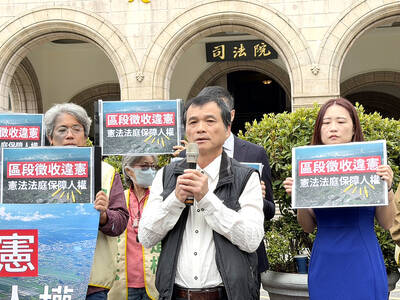
What government project has expropriated the most land in Taiwan? According to local media reports, it is the Taoyuan Aerotropolis, eating 2,500 hectares of land in its first phase, with more to come. Forty thousand people are expected to be displaced by the project. Naturally that enormous land grab is generating powerful pushback. Last week Chen Chien-ho (陳健和), a local resident of Jhuwei Borough (竹圍) in Taoyuan City’s Dayuan District (大園) filed a petition for constitutional review of the project after losing his case at the Taipei Administrative Court. The Administrative Court found in favor of nine other local landowners, but


 RSS
RSS