


In the aftermath of Hurricane Katrina, Bush administration officials said they had been caught by surprise when they were told on Tuesday, Aug. 30, that a levee had broken, allowing floodwaters to engulf New Orleans. But congressional investigators have now learned that an eyewitness account of the flooding from a federal emergency official reached the Homeland Security Department's headquarters starting at 9:27pm the day before, and the White House itself at midnight.
The Federal Emergency Management Agency (FEMA) official, Marty Bahamonde, first heard of a major levee breach Monday morning. By late Monday afternoon, Bahamonde had hitched a ride on a Coast Guard helicopter over the breach at the 17th Street Canal to confirm the extensive flooding. He then telephoned his report to FEMA headquarters in Washington, which notified the Homeland Security Department.
"FYI from FEMA," said an e-mail message from the agency's public affairs staff describing the helicopter flight, sent Monday night at 9:27 to the chief of staff of US Homeland Security Secretary Michael Chertoff and recently unearthed by investigators. Conditions, the message said, "are far more serious than media reports are currently reflecting. Finding extensive flooding and more stranded people than they had thought -- also a number of fires."
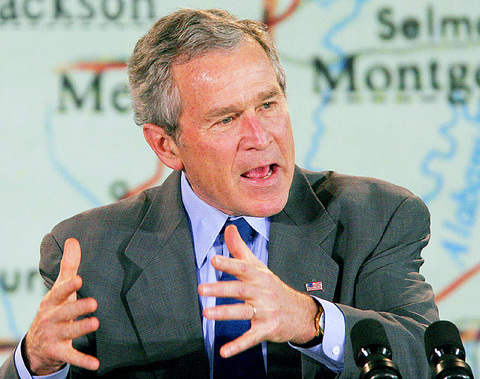
PHOTO: EPA
Michael Brown, who was the director of FEMA until he resigned under pressure on Sept. 12, said in a telephone interview Thursday that he personally notified the White House of this news that night, though he declined to identify the official he spoke to.
White House officials have confirmed to congressional investigators that the message arrived there at midnight, and Trent Duffy, the White House spokesman, acknowledged as much in an interview this week, though he said it was surrounded with conflicting reports.
But somehow, this alert did not seem to register. Even the next morning, US President George W. Bush, on vacation in Texas, was feeling relieved that New Orleans had "dodged the bullet," he later recalled. Chertoff, similarly confident, flew off Tuesday to Atlanta for a briefing on avian flu. With power out from the high winds and movement limited, even news reporters in the city remained unaware of the full extent of the levee breaches until Tuesday.
The federal government had let out a sigh of relief, when in fact it should have been sounding an "all hands on deck," alarm, the investigators have found.
This chain of events, along with dozens of other critical flashpoints in the Hurricane Katrina saga, has for the first time been laid out in detail following five months of work by two congressional committees that have assembled nearly 800,000 pages of documents, testimony and interviews from more than 250 witnesses. Investigators now have the documentation to pinpoint some of the fundamental errors and oversights that combined to produce what is universally agreed to be a flawed government response to the worst natural disaster in modern US history.
Brown, the former FEMA director, was scheduled to testify before the US Senate Homeland Security and Governmental Affairs Committee. He was expected to confirm that he notified the White House on that Monday, the day the hurricane hit, that the levee had given way, the city was flooding and his crews were overwhelmed.
"There is no question in my mind, that at the highest levels of the White House they understood how grave the situation was," Brown said in the interview. The problem, he said, was the handicapping of FEMA when it was turned into a division of the Homeland Security Department in 2003.
"The real story is with this new structure," he said. "Why weren't more things done or what prevented or delayed Mike Brown from being able to do what he would have done and did do in any other disaster?"
Although Bahamonde said in October that he had notified Brown that Monday, it was not known until recently what Brown or Homeland Security did with that information, or when the White House was informed.
Litany of errors
It has been known since the earliest days of the storm that all levels of government -- from the White House to the Department of Homeland Security to the Louisiana Capitol to New Orleans City Hall -- were unprepared, uncommunicative and phlegmatic in protecting Gulf Coast residents from the floodwaters and their aftermath. But an examination of the latest evi-dence by The New York Times shines a new light on the key players involved in the important turning points -- what they said, what they did, what they did not do, all of which will soon be written up in the committees' investigative reports.
Among the findings that emerge in the mass of documents and testimony:
* Federal officials knew long before the storm showed up on the radar that 100,000 people in New Orleans had no way to escape a major hurricane on their own and that the city had finished only 10 percent of a plan for how to evacuate its largely poor, black population.
* Chertoff failed to name a principal federal official to oversee the response before the hurricane arrived, an omission that a top Pentagon official acknowledged to investi-gators complicated the coordination of the
response.
* The Louisiana transportation secretary, Johnny Bradberry, who had legal responsibility for the emergency evacuation of thousands of people in nursing homes and hospitals, admitted bluntly to investigators that "we put no plans in place to do any of this."
* Mayor Ray Nagin of New Orleans at first directed his staff to prepare a mandatory evacuation of his city on Saturday, two days before the storm hit, but he testified that he had not done so that day while he and other city officials struggled to decide if they should exempt hospitals and hotels from the order.
* The New Orleans Police Department unit assigned to the rescue effort, despite many years' worth of flood warnings and requests for money, had just three small boats and no food, water or fuel to supply its emergency workers.
* Investigators could find no evidence that food and water supplies were formally ordered for the Convention Center, where more than 10,000 evacuees had assembled, until days after the city had decided to open it as a backup emergency shelter. FEMA had planned to have 360,000 ready-to-eat meals delivered to the city and 15 trucks of water in advance of the storm. But only 40,000 meals and five of the trucks of water had arrived.
Representative Thomas Davis, Republican, Virginia, chairman of the special House committee investigating the hurricane response, said the only level of government that performed well was the National Weather Service, which correctly predicted the force of the storm. But no one heeded the message, he said.
"The president is still at his ranch, the vice president is still fly-fishing in Wyoming, the president's chief of staff is in Maine," Davis said. "In retrospect, don't you think it would have been better to pull together? They should have had better leadership. It is disengagement."
One of the greatest mysteries for both the House and Senate committees has been why it took so long, even after Bahamonde filed his urgent report on the Monday the storm hit, for federal officials to appreciate that the levee had broken and that New Orleans was flooding.
As his helicopter approached the site, Bahamonde testified in October, there was no mistaking what had happened: large sections of the levee had fallen over, leaving the section of the city on the collapsed side entirely submerged, but the neighborhood just on the other side relatively dry. He snapped a picture of the scene with a small camera he had.
"The situation is only going to get worse," he said. He warned Brown, then the FEMA director, whom he called at about 8pm Monday Eastern time to report on his helicopter tour.
"Thank you," he said Brown replied. "I am now going to call the White House."
Partial disclosure
Citing restrictions placed on him by his lawyers, Brown declined to tell House investigators during testimony if he had actually made that call. White House aides have urged admin-istration officials not to discuss any conver-
sations with the president or his top advisors and declined to release e-mail messages sent among Bush's senior advisors.
But investigators have found the e-mail message referring to Bahamonde's helicopter survey that was sent to John Wood, chief of staff to Chertoff, the homeland security secretary, at 9:27pm. They have also found a summary of Bahamonde's observations that was issued at 10:30pm and an 11:05pm e-mail message to Michael Jackson, the deputy secretary of Homeland Security. Each message describes in detail the extensive flooding that was taking place in New Orleans after the levee collapse.
Given this chain of events, investigators have repeatedly questioned why Bush and Chertoff stated in the days after the storm that the levee break did not happen until Tuesday, as they made an effort to explain why they initially thought the storm had passed without the catastrophe that some had feared.
"The hurricane started to depart the area on Monday, and then Tuesday morning the levee broke and the water started to flood into New Orleans," Chertoff said on CBS's Face the Nation, Sunday, Sept. 4, the weekend after the hurricane hit.
In their defense, Chertoff and White House officials have said that they were referring to official confirmation that the levee had broken, which they say they received Tuesday morning from the Army Corps of Engineers. They also say there were conflicting reports all day Monday about whether a breach had occurred and noted that they were not alone in failing to recognize the growing catastrophe.
Duffy, the White House spokesman, said it would not have made much difference even if the White House had realized the significance of the midnight report. "Like it or not, you cannot fix a levee overnight, or in an hour, or even six hours," he said.
But Senator Susan Collins, Republican, Maine, the chairwoman of the Senate Committee on Homeland Security and Governmental Affairs, said it was obvious to her in retrospect that Chertoff, perhaps in deference to Brown's authority, was not paying close enough attention to the events in New Orleans and that the federal response to the disaster may have been slowed as a result. "Secretary Chertoff was too disengaged from the process," Collins said in an interview.
Compounding the problem, even once Chertoff learned of the levee break on Tuesday, he could not reach Brown, his top emergency response official, for an entire day because Brown was on helicopter tours of the damage.
The day before the hurricane made landfall, the Homeland Security department issued a report predicting that it could lead to a breach in the levees that could submerge New Orleans for months and leave 100,000 people stranded. Yet despite these warnings, state, federal and local officials acknowledged to investigators that there was no coordinated effort before the storm arrived to evacuate nursing homes and hospitals or others in this urban population without cars.
Bradberry, the state transportation secretary, told an investigator that he had focused on improving the highway evacuation plan for the general public with cars and had not attended to his responsibility to remove people from hospitals and nursing homes. The state even turned down an offer for patient evacuation assistance from the federal government.
In fact, the city at that moment was desperately in need of help. And this failure would have deadly consequences. Only 21 of the about 60 nursing homes were cleared of residents before the storm struck. Dozens of lives were lost in hospitals and nursing homes.
Part of the reason the city was unable to help itself, investigators said, is that it never purchased the basic equipment needed to respond to the long-predicted catastrophe. The fire department had asked for inflatable boats and generators, as well as an emergency food supply, but none were provided, a department official told staff investigators.
The investigators also determined that the US Transportation Department had not been asked until Wednesday to provide buses to evacuate the Superdome and Convention Center, meaning that evacuees sat in these overcrowded shelters of last resort for perhaps two more days longer than necessary.
Brown acknowledged to investigators that he wished, in retrospect, that he had moved much earlier to turn over major aspects of the response effort to the US Department of Defense. It was not until Tuesday, he said, that he asked the military to take over the delivery and distribution of water, food and ice. "In hindsight I should have done it right then," Brown told the House, referring to the Sunday before the storm hit.

Taiwan’s English education system is being pulled apart by three opposing forces. Bilingual Nation 2030 pulls students toward English and global communication. Artificial Intelligence (AI) readiness pulls them toward digital judgment, verification and AI-mediated work. But Taiwan’s old exam culture pulls them back toward memorization, grammar drills, timed reading and correct answers. If the education system keeps using old exams to define success, it risks producing graduates who are neither genuinely bilingual nor genuinely AI-ready, but trained for tasks machines can already perform. The first force is Bilingual Nation 2030. Launched in 2018, the policy aimed to “help Taiwan’s workforce connect

“Taiwan’s Opposition Leader Comes to US With a Message Straight Out of Beijing” read a May 31 headline in the Wall Street Journal. Top US administration officials and members of Congress almost certainly read the WSJ, and if there was a bullet point takeaway that people in Washington should absorb ahead of Chinese Nationalist Party (KMT) Chair Cheng Li-wun’s (鄭麗文) arrival in DC on June 9, that headline is it. The last few columns have discussed this very topic, and the timing is not coincidental. While those top officials likely do not read the Taipei Times, judging by the number

With weighty, anxiety-inducing geopolitical topics dominating the headlines, checking in on the wild and weird state of local politics can take some of the edge off. This November’s elections will determine who will be in charge of fixing potholes in your neighborhood, not the potholes in Taiwan’s complicated geopolitical space. Recently, after an online interview with a Taipei-based journalist, I commented that Taipei journalists never go further than the MRT can take them. He laughed and agreed. Naturally, the Taipei mayoral race is eating up much of the press attention. TAIPEI CITY Democratic Progressive Party (DPP) candidate Puma Shen (沈伯洋) has

As someone who normally steers clear of books with “transcendence” or “metaphysics” in their subtitles, this reviewer — a casual observer of local belief systems since the 1990s — found Fabian Graham’s Money God Temples in Taiwan a challenging read. Those who’ve only dipped their toes into temple culture will likely need to parse several sections with special care if they’re to keep up with the author, a British ethnographic researcher whose previous books have investigated religious practices among ethnic Chinese in Southeast Asia. This scholarly volume examines a facet of Taiwan’s religious landscape that didn’t exist a century ago, and


 RSS
RSS