


Locked away in deep freeze in the Philippines, the farm heritage of Iraq and Afghanistan awaits the arrival of a political spring in the bruised nations so that rice fields will once again carpet the battlefields.
Holding the seeds of more than 108,000 varieties of the key grain is a squat, quake-proof laboratory at the International Rice Research Institute (IRRI) complex south of Manila, their last refuge from war, floods, drought and pestilence.
Priceless native crop varieties are among the unmourned casualties every time human conflict or natural disasters ravage the Earth, says Ruaraidh Sackville Hamilton, a British evolutionary biologist and custodian of the institute's gene bank set up in 1977.
Iraq, at the heart of the so-called "Fertile Crescent" where rice has been grown for at least two millennia, would be no different, he adds.
"After the end of a war you will find none of the varieties of any kind still in use and that includes the modern high-yielding varieties and traditional varieties," Sackville Hamilton says during a tour of the facility.
The seeds, gathered by the institute's scientists throughout the world or sent in by cooperative governments, are held in trust for humanity inside floor-to-ceiling trays of foil packets at the climate-controlled facility.
Some seeds are stored at temperatures of minus 19 degrees Celsius, designed to make them last for 100 years, while the active collection, used for global exchange to breeders as well as government entities that seek them, are kept at -2 degrees Celsius.
Duplicate packets are stored in a similar facility inside the Fort Collins military base in the US.
"Whenever there's a civil conflict -- Iraq, Afghanistan, Rwanda, Cambodia, East Timor -- the rural population is displaced and they don't go through their annual cropping cycles," institute spokesman Duncan Macintosh says.
"Farmers have to keep seeds year after year to grow the crops. If they're off fighting wars, they don't get to do that," he adds.
The `Green Revolution'
After the institute helped spark the "Green Revolution" that boosted yields in the 1970s, its gene bank came to Cambodia's rescue in 1988, a decade after the bloody 1970s rule of the Khmer Rouge that practically wiped out the agricultural nation's rice varieties.
"After their civil war we were able to restore to them all the major varieties of rice that originally came from Cambodia that we conserved in this gene bank," Sackville Hamilton said.
Sister agencies from the World Bank-funded Consultative Group on International Agricultural Research also helped rebuild agriculture, among others, in Rwanda after the genocide, Angola after the civil war, Peru after the 1997 El Nino drought, and Honduras and Nicaragua after a deadly 1998 hurricane.
"We can do the same for Iraq and Afghanistan as soon as the mechanism to get these varieties back into those countries [are in place]. We have some [rice varieties] safely conserved here. We can send them back," Sackville Hamilton said.
Macintosh says that with the post-war security situation still unsettled in Iraq, the US, Australia, and the Aleppo, Syria-based International Center for Agricultural Research in the Dry Areas (ICARDA) are focusing their efforts on rebuilding Iraq's gene banks for wheat, barley, and other crops.
"We have been making plans with ICARDA to do the same with rice. We began that last year and we haven't got to sending anything back yet, but as soon as we get these plans we can send them," Sackville Hamilton said.
While wheat is the primary cereal in Iraq, rice is also grown in some areas while Afghans are big rice eaters, he added.
But he says sending the rice seeds back "depends on a combination of getting the appropriate infrastructure there to make it worth doing."
"Until they get something to keep it there, there's no point in getting it there. We can get it there at any time. We'll wait for a way of doing it so that we have an impact," Macintosh adds.
Dealing with tsunamis
The gene bank also proved invaluable following the deadly Indian Ocean tsunamis that struck rice-growing areas in Asia in December last year. The giant waves dumped salt water on paddies up to several kilometers inland.
One of the first things Malaysia, Sri Lanka and India did was to contact the institute as "they needed to find rice varieties that would tolerate salty conditions," Macintosh says.
The three countries later learned that they actually have some varieties back home that grew well in salty areas, and the institute ended up sending advice instead of seeds.
Rice grows in a variety of areas, and each type has its own unique way of adapting to drought, floods, and disease as well as resistance to cold, heat, acid soils, salt soils and other conditions, Macintosh says.
"So for example a country would have a problem with drought and we would send drought-tolerant varieties to them," he says.
Sackville Hamilton said the gene bank has gained added significance after the rice genome was decoded and as biotechnology companies race to patent newly developed varieties of rice, the staple food of nearly half of humanity including many of the world's poorest.
He cited a case when India, a key contributor to the rice gene bank, requested a variety that was native to China, which is protective of its indigenous varieties. The UN's Food and Agriculture Organization resolved the issue for the two countries and institute.
India obtained the sought variety from the institute free of charge after the government signed a document that prevented New Delhi from taking a patent to it.
India could then grow it commercially or use it for its own breeding programs to produce higher-yielding varieties, Sackville Hamilton says.
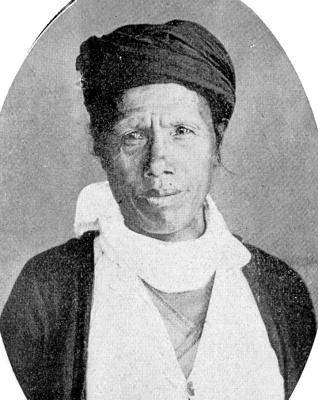
May 11 to May 17 Traversing the southern slopes of the Yushan Range in 1931, Japanese naturalist Tadao Kano knew he was approaching the last swath of Taiwan still beyond colonial control. The “vast, unknown territory,” protected by the “fierce” Bunun headman Dahu Ali, was “filled with an utterly endless jungle that choked the mountains and valleys,” Kano wrote. He noted how the group had “refused to submit to the measures of our authorities and entrenched themselves deep in these mountains … living a free existence spent chasing deer in the morning and seeking serow in the evening,” even describing them as

Yesterday, the Democratic Progressive Party (DPP) nominated legislator Puma Shen (沈伯洋) as their Taipei mayoral candidate, the Chinese Nationalist Party (KMT) put their stamp of approval on Wei Ping-cheng (魏平政) as their candidate for Changhua County commissioner and former legislator Tsai Pi-ru (蔡壁如) of the Taiwan People’s Party (TPP) has begun the process to also run in Changhua, though she has not yet been formally nominated. All three news items are bizarre. The DPP has struggled with settling on a Taipei nominee. The only candidate who declared interest was Enoch Wu (吳怡農), but the party seemed determined to nominate anyone

In a sudden move last week, opposition lawmakers of the Chinese Nationalist Party (KMT) and Taiwan People’s Party (TPP) passed a NT$780 billion special defense budget as a preemptive measure to stop either Chinese leader Xi Jinping (習近平) or US President Donald Trump from blocking US arms sales to Taiwan at their summit in Beijing, said KMT heavyweight Jaw Shaw-kong (趙少康), speaking to the Taipei Foreign Correspondents Club on Wednesday night in Taipei. The 76-year-old Jaw, a political talk show host who ran as the KMT’s vice presidential candidate in 2024, says that he personally brokered the deal to resolve
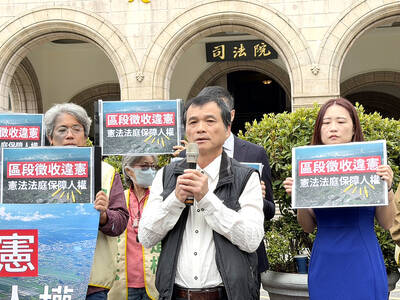
What government project has expropriated the most land in Taiwan? According to local media reports, it is the Taoyuan Aerotropolis, eating 2,500 hectares of land in its first phase, with more to come. Forty thousand people are expected to be displaced by the project. Naturally that enormous land grab is generating powerful pushback. Last week Chen Chien-ho (陳健和), a local resident of Jhuwei Borough (竹圍) in Taoyuan City’s Dayuan District (大園) filed a petition for constitutional review of the project after losing his case at the Taipei Administrative Court. The Administrative Court found in favor of nine other local landowners, but


 RSS
RSS