

It is believed that Taiwan's tea-drinking culture started in Taichung and Chun-shui Tang is a popular place for people to hang out and drink tea, or take a simple meal or snack at the same time.
The tea house has come up with quite a few cool inventions in the past such as foam black tea and pearl cream tea, that were first introduced to the Taiwan public, in 1983 and 1987 respectively. The pearl cream tea mixed by Chun-shui Tang is still considered unbeatable, however, and Chun-shui Tang is now operating as a chain store, having spread to the major cities and based itself in Taichung.
The tea house located by International Street near the Tunghai University campus is unique because it is in a street lined with artefact shops, boutique stores and gourmet restaurants. It is a one-way street and is usually packed with people during the weekends, and in the evenings on most weekdays when the university faculty and students come to patronize their favorite restaurants.
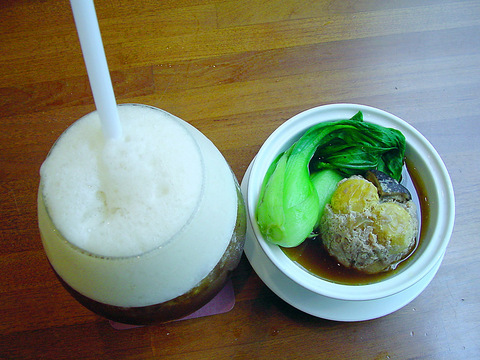
PHOTO: DEREK LEE, TAIPEI TIMES
Most of the tables in the tea house are arranged to lean against a large beautifully-shaped glass window through which sunlight filters through fine bamboo curtains. Little potted plants and elegant flower arrangements at every turn are pleasing to the eyes and create a good mood. The second-floor interior and teak-wood furniture of the place gives visiting guests the idea of a traditional Taiwanese tea house, yet with a modern and clever twist.
Best of all the food served with the teas is generally good, with a refined taste. The square-shaped brown sugar teacake introduced last year proved to be a knock-out for its smooth taste. It is a bit sweet at first bite. Yet, with a sip of the tea, the taste in your mouth turns and make the tea flavor much more fragrant.
If you care for a simple repast, the set meal of ground-pork with pickle is probably the best bet. The dish is served in a chinaware bowl with steamed meatballs mixed with thick sliced black mushrooms and egg yolk. Green vegetables are served on the side. The soup goes well with the white rice. The side dish of daikon pickles is neither hot nor salty.
Furthermore, your side order of tea -- either oolong, jasmine or another kind, with ice or hot -- always comes with extra-large cups or a teapot and will add to the satisfaction of the meal. -- Derek Lee

During the Martial Law era, newspapers and magazines were strictly controlled by the government. But from 1985 to 1990 — a period that straddled the lifting of martial law in 1987 — a free monthly expat magazine emerged as one of the first published and edited by foreigners. It was also perhaps the first to express a uniquely local expatriate voice. Taiwan Grapevine’s articles were irreverent, politically incorrect and plagued by typos. Neither editors nor writers were named in the magazine, and those bylines that appeared were obvious pseudonyms like Archibald Hellbender. Yet the magazine achieved nationwide distribution. And while

Bloomberg reported earlier this week that the People’s Republic of China (PRC) “has developed hypersonic glide vehicles that can launch air-to-air weapons, an advancement meant to threaten high-value targets such as command-and-control aircraft thousands of miles away.” Military Watch magazine reported in 2024 on one of the designs: “the vehicle is designed with payload options that include electronic warfare and reconnaissance suites, as well as bombs and both supersonic and subsonic drones that detach from the vehicle during flight,” while noting that the PRC is a world leader in such technologies. The threat from the PRC is not only increasing,
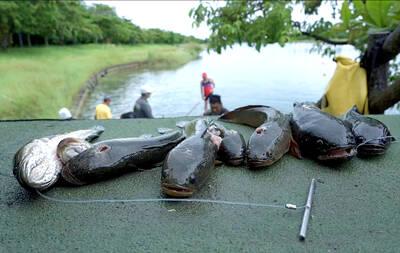
Taiwan’s rivers are significantly cleaner today than they were a few decades ago. The country’s rapid industrialization left many waterways polluted by untreated factory discharge, domestic sewage and runoff from livestock operations. Since the 1990s, expansion of municipal sewerage infrastructure and stricter enforcement of environmental standards have turned the situation around. However, freshwater ecosystems now face a very different threat — one that’s far less obvious to people living nearby. “Southern Taiwan — Tainan, Kaohsiung and Pingtung — is facing a particularly critical crisis regarding freshwater biological invasions,” says Lin Yen-ting (林晏廷), an assistant professor in the Master’s Program in Biodiversity

Wait. President Volodymyr Zelenskyy, Ukraine’s war chief, holding a puppy? Yes, and it’s no accident. In a collision of dog lovers, sports and ongoing war with Russia, the Ukrainian president was seen on video Tuesday as never before — cuddling and cooing over a floppy, 3-month-old American pit bull terrier, handed to him by US former boxer Terence Crawford. The cute and fluffy scene in Zelenskyy’s office in Kyiv was the latest volley in a deadly serious battle of visuals that runs in parallel to Ukraine’s fight against Russia’s brutal four-year invasion. Crawford, a longtime supporter of Ukraine and a devotee of the


 RSS
RSS