


Traveling by train may no longer be the quickest way to reach destinations of rest and relaxation, but for thousands of holidaymakers it remains one of the most preferred ways to get to resorts and tourist hotspots throughout Taiwan.
Nearly all of the nation's leading seaside resort towns can be reached via one of the two major coastal rail arteries, and visitors can explore scenic mountain areas by traveling one of four narrow-gauge routes that wind into the lofty northern and central mountain ranges.
Trains enable tourists to sit back, relax and enjoy a smorgasbord of spectacular vistas of Taiwan's lush, verdant countryside, breathtaking mountains and tranquil coastlines.
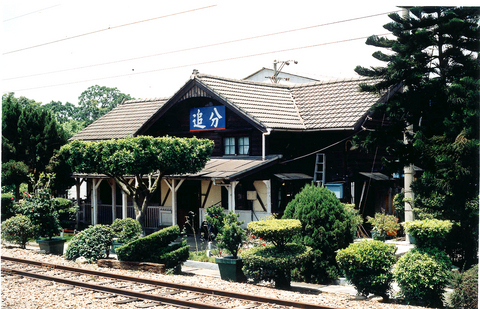
PHOTO COURTESY OF TAIWAN RAILWAY ADMINISTRATION
The nation's sole rail operator is the Taiwan Railway Administration (TRA,
Taiwan has three standard-gauge major trunk lines -- West Coast Line, Southern Link Line and the East Coast Line -- and four narrow-gauge railways -- Pingxi Line, Neiwan Line, Jiji Line and the Alishan Line.
Every year the TRA carries an average of 480,000 passengers per day. And while safety factors and price considerations are some reasons so many people choose to travel by rail in Taiwan, another factor is the historical significance of the network.
Taiwan's rail network dates back almost 120 years, and until the completion of the Sun Yat-sen Freeway in 1977, it was the quickest and most direct route from north to south.
Taiwan's railway system was born in 1887, after the governor of Taiwan and founding father of Taiwan's railway, Liu Ming-chuan (
The route was completed 1891, and while its inception led to the closure of several of Taipei's once-thriving ports, it proved hugely lucrative. Before Taiwan was ceded to Japan in 1895, work had already begun on Taiwan's second rail link, the 78.1km line that ran from Taipei to Hsinchu. Although work was completed in 1888, Liu is still credited with linking Taiwan's then-busiest cities.
During the years of Japanese occupation, the colonial authorities continued to develop the nation's rail network, and by 1945 it covered roughly 750km.
But rail development in Taiwan ground to a halt from 1945 until the 1970s, when the TRA began to electrify existing tracks, add double tracks and build additional routes along the east coast. The longest of these was the 162.2km Hualien-to-Taitung route, which was built from 1978 to 1982. Full electrification of Taiwan's west-coast rail network was completed in 1979.
For many of the nation's multitude of train buffs and "train spotters," one of the most popular reasons to travel by train is that is gives them the opportunity to see some of Taiwan's oldest and most historic stations. The architecture of many dates from the early years of Japanese colonial rule, and the rustic surroundings and remote hamlets make for a marked and pleasing contrast to the concrete, bunker-like modern stations that have sprung up in recent years.
Many of the classical station structures have now been demolished and are gradually being replaced by ugly, featureless concrete monstrosities, but there are still over a dozen striking wooden stations in operation and open to the public. Sadly, it is predicted within the next five years the picturesque wooden stations from the pre-World War II period will all have either been torn down or been converted into museums.
Some of the most picturesque of the remaining Japanese colonial-style stations include Shengshing (
Before setting out to explore Taiwan by rail, passengers should first consider the speed and comfort with which they intend to travel. The TRA operates three classes of long-distance rail service and one type of electric commuter train.
The fastest and most comfortable of the long-distance classes is the ziqiang (
A slower and slightly less comfortable choice of train is the juguang class (
The slowest and least comfortable of Taiwan's trains is the fuxing (
TRA operations run 24 hours day, but there are no sleeping compartments on any of the trains. Not all trains cater to passengers with disabilities, and for those who rely wheelchairs, it is best to check TRA's schedule for information regarding wheelchair accessibility before purchasing a ticket.
A pleasant alternative to station hopping on regular trains is to purchase a ticket on one of the nation's special Tourist Trains (
The special carriages, with their oversized airplane-business-class-like seating, large windows and dining cars where everything from coffee to regionalized lunchboxes can be purchased, proved such a hit with local tourists that TRA and EZ Travel added more routes; there are now five Tourist Trains operating daily.
The Hotspring Princess (
Along with offering travelers the chance to relax in over-sized seating comfort, the windows on these trains are twice as large as those of regular carriages. And in contrast to the rather dowdy uniforms worn by regular TRA staffers, Tourist Train staff wear traditional Aboriginal costumes or colorful sarongs, depending on the route.
While traveling on any one of the Tourist Trains certainly has its benefits, they are certainly not the quickest way to ride the rails. Although operated by Taiwan Railways, the Tourist Trains are not priority traffic and do, on occasion, grind to a halt at some small rural train station in order to allow regular express-locomotive-driven commuter traffic to pass.
Tickets for the Tourist Trains can be booked via EZ Travel's Web site or at one of three tour companies operating out of Taipei Railway Station. Individual tickets for travel on these trains can also be purchased directly from Taiwan Railways' ticketing offices. Hotel accommodation and any additional travel costs to and from tourist spots are not included, however.
Package tours on the Tourist Trains range from NT$2,300 to NT$25,000, depending on the route and the length of stay in any one hotel/resort. The number of Tourist Train carriages is limited, and trains can only accommodate between 120 to 175 people in tourist comfort. On weekdays this makes little difference to availability of tickets, but if you plan to travel weekends, it is advisable to book seats at least two weeks in advance.
For Taiwan Railways info, log on to www.railway.gov.tw/index_ok.htm. The site has up-to-date schedules and timetables in both English and Chinese.
Tickets and train timetables can also be checked in both Chinese and English at train2.twtraffic.com.tw/TaiTrain/time.html.
For EZ-Travel Tourist Train packages, log on to eztravel.com.tw/package1/taiwan_train.htm. This site is only available in Chinese.


The US war on Iran has illuminated the deep interdependence of Asia on flows of oil and related items as raw materials that become the basis of modern human civilization. Australians and New Zealanders had a wake up call. The crisis also emphasizes how the Philippines is a swatch of islands linked by jet fuel. These revelations have deep implications for an invasion of Taiwan. Much of the commentary on the Taiwan scenario has looked at the disruptions to world trade, which will be in the trillions. However, the Iran war offers additional specific lessons for a Taiwan scenario. An insightful

The problem with Marx’s famous remark that history repeats itself, first as tragedy, the second time as farce, is that the first time is usually farce as well. This week Chinese Nationalist Party (KMT) Chair Cheng Li-wun (鄭麗文) made a pilgrimage to the People’s Republic of China (PRC) “to confer, converse and otherwise hob-nob” with Chinese Communist Party (CCP) officials. The visit was an instant international media hit, with major media reporting almost entirely shorn of context. “Taiwan’s main opposition leader landed in China Tuesday for a rare visit aimed at cross-strait ‘peace’”, crowed Agence-France Presse (AFP) from Shanghai. Rare!

April 6 to April 13 Few expected a Japanese manga adaptation featuring four tall, long-haired heartthrobs and a plucky heroine to transform Taiwan’s television industry. But Meteor Garden (流星花園) took the nation by storm after premiering on April 12, 2001, single-handedly creating the “idol drama” (偶像劇) craze that captivated young viewers across Asia. The show was so successful that Japan produced its own remake in 2005, followed by South Korea, China and Thailand. Other channels quickly followed suit, with more than 50 such shows appearing over the following two years. Departing from the melodramatic

Sunflower movement superstar Lin Fei-fan (林飛帆) once quipped that the Democratic Progressive Party (DPP) could nominate a watermelon to run for Tainan mayor and win. Conversely, the DPP could run a living saint for mayor in Taipei and still lose. In 2022, the DPP ran with the closest thing to a living saint they could find: former Minister of Health and Welfare Chen Shih-chung (陳時中). During the pandemic, his polling was astronomically high, with the approval of his performance reaching as high as 91 percent in one TVBS poll. He was such a phenomenon that people printed out pop-up cartoon


 RSS
RSS