


The subtitle of this book is Finding George Orwell in a Burmese Teashop. It looks, and is, characteristic of the large number of Asia-located travel books currently coming out from the UK publishers John Murray.
These can be defined respectably written, honestly conceived and decently researched travel records. The authors are often young, and you can imagine them approaching their prospective publisher with a clear-cut project and an educational background to suggest they will probably carry it out efficiently by the agreed deadline. What they won't be, however, is great stylists or writers with a really good idea.
The premise of this book is to revisit the places in Burma that George Orwell lived in for the five years that he was an officer in the UK's Imperial Police Force there. It was his first job, and he undertook it before he entertained any ideas of becoming a professional writer. But afterwards he did write a novel about colonial life in the country, Burmese Days, published in 1934.
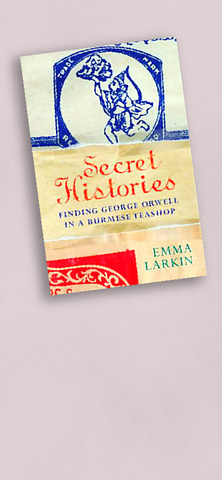
Emma Larkin's book is easy to read and untroubling to the heart or mind. She travels to Rangoon, Mandalay, Moulmeim, Katha and elsewhere.
There she tries to find the buildings Orwell worked or lived in, and in addition talks to huddled groups of Burmese in teashops about Orwell, books in general, and quite often the dire political situation in the country today.
She tells us about such things as the reception of Orwell's various works in the Britain and Burma of the day and interesting historical events unconnected to Orwell that occurred in the places she visits. Any writer will see the problem she faces and the technique she uses to overcome it. Books are long things, and as often as not writers have to look around for various ways to fill them.
This doesn't in itself mean that this is an uninteresting book. It may rather often opt for the cliched phrase -- "lush paddy fields", "a spectacular sunset", "a dog-eared copy," "bustling markets" -- but the general tone is intelligent and humane. It's just important sometimes to make certain distinctions. This is not, then, a book written by someone with a burning mission, an unusual personality or a genuninely witty and engaging style. It isn't, in other words, Paul Theroux's The Great Railway Bazaar, Michael Heller's Despatches, Jan Morris's Hong Kong or Michel Huelbecq's Platform, all of which treat Asia in ways that show their authors to be, in their very different ways, outstanding writers and quite exceptional people.
There is something a touch routine, in other words, about Secret Histories. The author will probably be furious at me for saying this, and I don't want to minimize the book's virtues. But there were times when I simply wished it was more outrageous, more personal or more opinionated. Burma is a shocking place, but this book didn't shock me. Its references to the fate of democracy activists and many ordinary people, both in the catastrophe of 1988 and afterwards, made me sad, but they didn't make me angry.
Many Burmese whispered their political anxieties to Emma Larkin, as well as explaining such things as how they got to know what was going on in spite of news blackouts. She tells how she managed to travel without raising suspicions she was planning to write a book about the country (surely no very hard task). But she never breaks down and cries. She never berates Orwell, his critics or anyone else. Instead she and an informant go into a hotel and are brought two "extraordinarily frothy cappuccinos," alongside the "expatriate housewives" and Burmese and foreign businessmen.
Don't get me wrong -- Emma Larkin does her groundwork, stays in cubicle-sized rooms, sits on hot buses and tries to rent a bicycle or go into an old building when the authorities are less than eager that she should do so. And there is all the material most people are going to need or want on Orwell and the Burma of his day. These things aren't the problem.
The problem, rather, is that the whole enterprise is more than a touch predictable. If anyone proposed such a scheme to you, you would just know for certain in advance that there would be stories of colonial stuffiness, modern restrictions and actual repression, historical snippets and people coming up to the author in the half-light and asking her to tell the world about their plight. Anyone who knows Burma, in addition, will know all about the teahouses, the strange mix of Westernness and Easternness in educated Burmese, the street puppet plays, the pagodas and the terrible record of the junta. What's missing, however, is something else. What this book doesn't have is fire in the soul.
I feel I'm being unkind. What, then, are the book's strengths?
Mainly, it's conveniently laid-out and reliable. Orwell based Burmese Days on the northern town on Katha. He sketched a town plan of the place and followed it closely, so much so that his London publisher thought it was too close to reality and might therefore be libellous. As a result it was first published in the US, and only a year later, with many details altered, in the UK. Emma Larkin tells us all this, considers the tennis club where so much of the novel's action is located, and gives us the historical information about a move to admit token Burmese to such places. She does the same for the other towns Orwell lived in, interspersing records of her chats with locals and more thorough-going interviews with well-placed and well-informed people. She describes the scenery and the traveling conditions. This book, in other words, is above all else supremely competent. You can, you feel, always trust the author -- as far, that is, as she goes.
But the sad fact is that intemperence, bias, anger and people losing their cool generally make for far better books than calm, measured accounts of not-all-that-dangerous travel. Emma Kirby is thus as far as it's possible to imagine anyone being from a writer such as Hunter S. Thompson. And that leaves me with an unavoidable thought: how very, very much I'd rather have read a book about Burma, any book about Burma, by THAT particular writer! A title such as Secret Histories would have set him off in directions undreamt of by Emma Kirby.
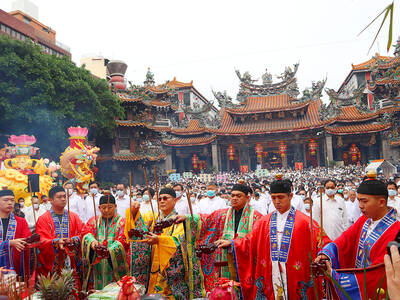
Recently the Chinese Nationalist Party (KMT) and its Mini-Me partner in the legislature, the Taiwan People’s Party (TPP), have been arguing that construction of chip fabs in the US by Taiwan Semiconductor Manufacturing Co (TSMC, 台積電) is little more than stripping Taiwan of its assets. For example, KMT Legislative Caucus First Deputy Secretary-General Lin Pei-hsiang (林沛祥) in January said that “This is not ‘reciprocal cooperation’ ... but a substantial hollowing out of our country.” Similarly, former TPP Chair Ko Wen-je (柯文哲) contended it constitutes “selling Taiwan out to the United States.” The two pro-China parties are proposing a bill that

Institutions signalling a fresh beginning and new spirit often adopt new slogans, symbols and marketing materials, and the Chinese Nationalist Party (KMT) is no exception. Cheng Li-wun (鄭麗文), soon after taking office as KMT chair, released a new slogan that plays on the party’s acronym: “Kind Mindfulness Team.” The party recently released a graphic prominently featuring the red, white and blue of the flag with a Chinese slogan “establishing peace, blessings and fortune marching forth” (締造和平,幸福前行). One part of the graphic also features two hands in blue and white grasping olive branches in a stylized shape of Taiwan. Bonus points for
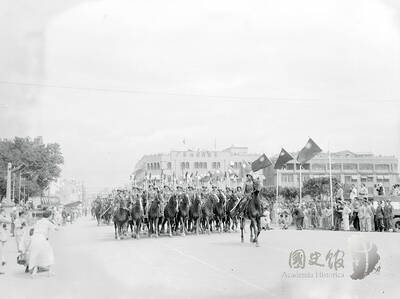
March 9 to March 15 “This land produced no horses,” Qing Dynasty envoy Yu Yung-ho (郁永河) observed when he visited Taiwan in 1697. He didn’t mean that there were no horses at all; it was just difficult to transport them across the sea and raise them in the hot and humid climate. “Although 10,000 soldiers were stationed here, the camps had fewer than 1,000 horses,” Yu added. Starting from the Dutch in the 1600s, each foreign regime brought horses to Taiwan. But they remained rare animals, typically only owned by the government or
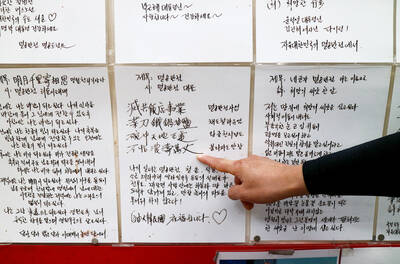
“M yeolgong jajangmyeon (anti-communism zhajiangmian, 滅共炸醬麵), let’s all shout together — myeolgong!” a chef at a Chinese restaurant in Dongtan, located about 35km south of Seoul, South Korea, calls out before serving a bowl of Korean-style zhajiangmian —black bean noodles. Diners repeat the phrase before tucking in. This political-themed restaurant, named Myeolgong Banjeom (滅共飯館, “anti-communism restaurant”), is operated by a single person and does not take reservations; therefore long queues form regularly outside, and most customers appear sympathetic to its political theme. Photos of conservative public figures hang on the walls, alongside political slogans and poems written in Chinese characters; South


 RSS
RSS