


The first week of the new year seems a quiet one for the Asian film industry, though the fever of Kung Fu Hustle (
Now confronting Kung Fu Hustle are Butterfly (
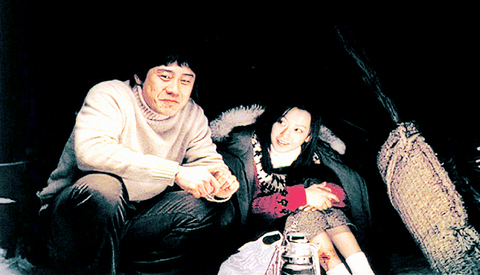
PHOTO COURTESY OF HWA JAAN FILMS
Butterfly is Hong Kong independent new blood Yan Yan Mak's (
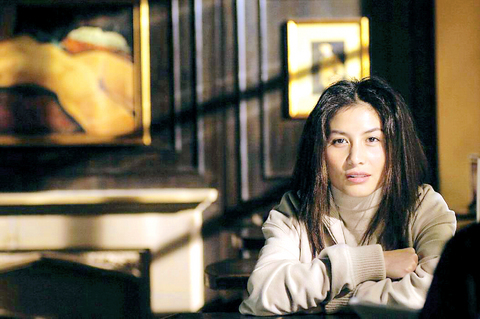
PHOTO COURTESY OF DEEPJOY INVESTMENT LTD
The film this year has toured Venice and Busan, and it received two Golden Horse nominations: Best Supporting Actress (Josie Ho,
The story follows a young married woman coming to terms with her lesbian sexuality. Roughly adapted from Taiwanese writer Chen Hsueh's (
Butterfly is a middle school teacher who has a wealthy and stable life -- a baby daughter and a loving husband. She encounters a 20-something girl, Yeh, a charming drifter with a child-like smile. Butterfly is deeply drawn to the girl and cannot calm her emotions. The narrative then cuts back to Butterfly's youth and to her high school lover Zhen. With Zhen, she spent a wild time hanging in Zhen's huge apartment, smoking, listening to Nirvana's "Smells Like Teen Spirit," playing with her 8mm film camera and making love all day when the parents were away.
It was a young passion accompanied by political passion -- the two girls are involved in students' movements and Hong Kong's support of the Tiananmen Square democratic movement of the 1980s. But the passion died quickly after the girls were caught in bed by Butterfly's mom. Butterfly left Zhen and soon had a boyfriend. Zhen devoted herself to Buddhism and became a nun.
Twenty years later, Butterfly's passion for women is evoked again while being seduced by Yeh. A struggle to find her true desire again troubles her heart. This time her husband, her daughter and her job are all dragged into the spiral of desire.
Of course, the intimate scenes of both female couples (past and present) are
crucial parts of the movie. Director Mak's use of lens is direct, raw and powerful, making audiences -- even those who cannot accept lesbian love -- look straight at the passion. Those can be the most successful parts of the film. The drawbacks of the film, however, are the slow and tedious final 20 minutes of the film, including a weak ending.
Korean romance film A Letter From Mars, comparatively, is more of a "normal" film, perhaps a too normal romance drama that is typical and predictable. It is a story about a man's persistent love for his childhood girlfriend.
Set in a humble mountain village in South Korea, young girl So-hee has a dream to go to Mars because she believes her father did not die, but is traveling on that planet. She tries to send letters to the father in Mars but of course, the letters are all returned. In order to not see the girl disappointed, So-hee's neighbor Seong-jae decides to write fake letters and deliver them to her. A love between the two begins to grow.
After growing up, Seong-jae becomes a mail man, continuing the job of delivering joy to mail recipients. But So-hee has become a businesswoman in Seoul.
The two are separated and the secret of going to Mars seems to be long buried in the snowy mountain, until one day.
Starring Kim Hee-seon, Korean top actress and model, the film may have some attraction to local fans of Korean TV drama. But as far as the movie goes, it is little more than a nicely packaged cliche; after half of the movie, the audience can already guess the melancholy ending of the story.

Taiwan’s English education system is being pulled apart by three opposing forces. Bilingual Nation 2030 pulls students toward English and global communication. Artificial Intelligence (AI) readiness pulls them toward digital judgment, verification and AI-mediated work. But Taiwan’s old exam culture pulls them back toward memorization, grammar drills, timed reading and correct answers. If the education system keeps using old exams to define success, it risks producing graduates who are neither genuinely bilingual nor genuinely AI-ready, but trained for tasks machines can already perform. The first force is Bilingual Nation 2030. Launched in 2018, the policy aimed to “help Taiwan’s workforce connect

It seems every few days one bumps into one of those “real man” comments in which Taiwan is urged to “face reality” or similar, and “make a deal,” with the speaker implying that soon it will be too late. “Deal” advocates always present themselves as having a superior grip on reality, and the manly ability to make the “hard choice.” Their testosterone-laden language often echoes that of Taiwan sellout advocates. Note that such commentary always specifies a process (“make a deal, work with, make progress”), never the end state of what occupation by a violent authoritarian colonialist state will entail. In

There are shadowy cabals plotting to sell out Taiwan to be annexed by China, by invasion if necessary. Fortunately, they are buffoons. In 2019, former Bamboo Union gangster and founder of the China Unification Promotion Party (CUPP), Chang An-le (張安樂, colorfully known as “White Wolf”), led a protest at the Legislative Yuan against comments made by then-premier Su Tseng-chang (蘇貞昌) that in the event of an attack by China, he would never surrender, but would protect the nation by fighting to the end, even if he only had a broom. Chang had party members bring a wooden casket that they
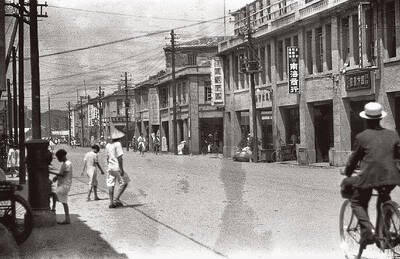
June 1 to June 7 "If all Taiwanese were as afraid of dying as you, then what would happen?” Physician Shih Chiang-nan (施江南) reportedly said this to his wife Chen Chiao-tung (陳焦桐) after she urged him to stop intervening on behalf of Taiwanese soldiers stranded overseas after serving in the Japanese Army during World War II. Shih had clashed with high-ranking officials over the issue, engaged in several heated arguments with Taiwan governor-general Chen Yi (陳儀) and allegedly shouted at general Ko Yuan-fen (柯遠芬), chief of staff of the Taiwan Garrison Command, over


 RSS
RSS