


When a former US State Department official was arrested last month on suspicion of passing secrets to Taiwan, it stirred a tempest of speculation in local media about spies and agent provocateurs, clandestine rendezvous in far-away lands and envelopes passed at posh restaurants. For a moment, Taiwan became the stuff of a Tom Clancy novel.
That official, Donald Keyser, will have his day in court this week and the US Federal Bureau of Investigations, which has thus far only charged him with failing to declare a trip he took to Taiwan last year, has held out the possibility of leveling further charges.

ILLUSTRATION: MOUNTAIN PEOPLE
Meanwhile, a Sept. 18 report in the New York Times contained a one-liner which the press has barely given a sniff, a quote from a former State Department official expressing incredulity at Keyser's arrest: "I don't know of any senior officials who are pro-Taiwan."
The article continued: "He and others said foreign service officers largely view some Taiwan officials' struggle to stay separate from China as a distraction, when the truly important relationship for the United States is China."
And so, although the Republic of China celebrates its Double Ten National Day today, its US friends won't be joining the party. Perhaps they're still hung over from China's bash 10 days go.
POLITICAL PALS
Taiwan's friendship with America has helped the nation stay afloat. But that friendship has also been subject to the whims of successive US presidents.
Harry Truman's decision in January of 1950 not to intervene against a Communist Chinese attack on Taiwan seemed at first to doom Chiang Kai-shek (
That changed starting in September of 1977, when then assistant Secretary of State for East Asian and Pacific affairs Richard Holbrooke, summoned Harvey Feldman to his office. Feldman was the US charge d'affaires in Bulgaria at the time, but was being reassigned as director of the Office of Republic of China Affairs. The job came with a caveat, Holbrooke told him his task was to devise a system whereby all US ties with Taiwan could be maintained, but in the absence of an official office. He was neither to consult nor inform anyone and ordered to report back in six weeks. Then-US president Jimmy Carter wanted to finalize a deal that was begun under the Richard Nixon administration of switching official recognition to Beijing.
Feldman spoke about his assignment at a 1998 forum sponsored by the International Interchange Foundation. The US administration, he recalled, "was [not] particularly concerned about Taiwan and its fate. When they thought about it at all, it seems they assumed that, following the switch in relations, the ROC government would have no choice but to agree to reunification on the PRC's terms. In their view, Taiwan's only significance was as an obstacle to the close relationship with Beijing which they considered a primary foreign policy interest."
After that switch was made on Jan. 1, 1979, Feldman's efforts were written into law as the Taiwan Relations Act (TRA). Twenty-five years later, it is still the foundation of relations between Taiwan and the US and a cornerstone of US policy in East Asia and the Pacific region.
"The only tie we lack with Taiwan is the diplomatic one," Feldman, who is now a senior fellow at the Heritage Foundation in Washington, told the Taipei Times. "Other than that, US relations with Taiwan's government and people are far closer than with most of the countries with which we have formal diplomatic relations."
For the US, this absence of diplomatic ties -- to exist, but not be recognized as existing -- is unique among places on the globe. The US State Department's Web site contains a list of "independent states in the world." Taiwan sits at the bottom of the list, the sole entry under the heading "other." Unlike nations the US recognizes, no "official name" is listed. Nowhere does "Republic of China" appear where it's not preceded by "People's."
In nearly 7,000 words of information on Taiwan, it never uses the terms "state" or "nation" except in mentioning former President Lee Teng-hui's "state-to-state" description of relations between Taiwan and China, and then only in quotations. Where the "background note" on China lists headings such as "government" and "party officials," the same note on Taiwan use the headings "administration" and "principal leaders."
PICKING FRIENDS
In the absence of diplomatic ties, there is little reason for anyone at the State Department to be biased towards Taiwan. Many senior administrators
began their careers when the US still recognized the ROC, though, and several of these staffers even received language training in Taiwan, Keyser among them. But pundits point out that most higher-ranking staffers are balanced in their approach to cross-strait relations and some may even lean towards Taiwan.
"There is a distinction between political appointees and the permanent bureaucracy," said Ted Galen Carpenter, a defense and foreign policy expert at the Cato Institute in Washington. "Among the latter, it would be difficult to find anyone who is especially pro-Taiwan. Among the political appointees, though, [Under Secretary of State for Arms Control and International Security] John Bolton is certainly pro-Taiwan, and to a lesser but still significant extent, so is James Kelly," the assistant secretary of state for East Asian and Pacific affairs.
Feldman, for his part, said that Kelly, along with Deputy Assistant Secretary Randall Schriver, are "quite evenly balanced. Perhaps even slightly pro-Taiwan."
Another foreign policy expert at the Cato Institute, Doug Bandow, differed. "There are few high-ranking foreign service officers who are pro-Taiwan."
But if there is a dearth of pro-Taiwan personnel at State, they each agree, it is because the US sees China as its more important relationship.
"There's no doubt that most regional analysts believe America's relationship with China is the most important one," Bandow said. "That doesn't mean that they want to see Taiwan absorbed, but they will sacrifice the interests of the latter for the former."
To be sure, many members of the current administration came into office with the opinion that America's relationship with China would be its most important in the years to come. That relationship ostensibly entailed the seeking of answers to the "Taiwan question." Then came 9-11. As Carpenter said, cross-strait relations have since "moved into second place behind the threat of radical Islamic terrorism." He added that "China's help on the North Korea issue is considered crucial. Above all, administration officials do not want Taiwan to do anything that creates a crisis in Washington's relations with Beijing."
ECHOES OF 1979
So is Taiwan's struggle to maintain its security and democracy a "distraction," as the New York Times reported? The State Department's mission is to create a more secure, democratic and prosperous world. Surely, then, democratic Taiwan should be an integral part of the US' equation in the East Asian and Pacific region.
At a time when many academics are calling for a review of the US' one-China policy, the current administration appears increasingly willing to sweep Taiwan under China's rug.
"Most US policymakers and opinion shapers consider it too dangerous for the US to mount a vigorous defense of Taiwan's democratic political prerogatives," Carpenter said.
"As for democracy," Bandow said, "the US supports it when it is convenient, but not when it isn't."
Feldman differed. "I do not regard Taiwan as a distraction," he said, adding that, while there are a number of apologists for China who might be willing to see Taiwan absorbed by China, "they know quite well that this is totally infeasible politically."
He said he has often spoken in favor of abandoning the "one-China" policy as "unrealistic" and that he'll be doing so again in a speech in New York following next month's presidential election.
The one-China policy created other headlines -- of a sort -- this past week when Koo Kwang-ming (
"While the US is telling Taiwanese to increase their arms purchases to deter a Communist takeover," the ad read, "it is also telling the same Taiwanese that they cannot have their own country ... in the name of maintaining the status quo."
US State Department spokesman, Adam Ereli, responded to Koo's ad by saying that, "There is no cause for rethinking it."
The arms purchase Koo referred to is a US$18.2 billion package over which lawmakers are currently wrangling. For the US, though, it's a straw in Taiwan's political winds.
"If the budget failed to pass, or if a decision was made not to pass the budget, it will have repercussions for the United States," said Deputy Under Secretary of Defense, Richard Lawless. "It will be regarded as a signal, if you will, as to the attitude of the legislature towards the national defense of Taiwan."
Carpenter was more succinct. "There are limits ... to the degree of risk that the US is willing -- or should be willing -- to go to defend Taiwan's de facto independence," he said. "Taiwanese need to be aware of that fact."


Taiwan’s English education system is being pulled apart by three opposing forces. Bilingual Nation 2030 pulls students toward English and global communication. Artificial Intelligence (AI) readiness pulls them toward digital judgment, verification and AI-mediated work. But Taiwan’s old exam culture pulls them back toward memorization, grammar drills, timed reading and correct answers. If the education system keeps using old exams to define success, it risks producing graduates who are neither genuinely bilingual nor genuinely AI-ready, but trained for tasks machines can already perform. The first force is Bilingual Nation 2030. Launched in 2018, the policy aimed to “help Taiwan’s workforce connect

“Taiwan’s Opposition Leader Comes to US With a Message Straight Out of Beijing” read a May 31 headline in the Wall Street Journal. Top US administration officials and members of Congress almost certainly read the WSJ, and if there was a bullet point takeaway that people in Washington should absorb ahead of Chinese Nationalist Party (KMT) Chair Cheng Li-wun’s (鄭麗文) arrival in DC on June 9, that headline is it. The last few columns have discussed this very topic, and the timing is not coincidental. While those top officials likely do not read the Taipei Times, judging by the number

With weighty, anxiety-inducing geopolitical topics dominating the headlines, checking in on the wild and weird state of local politics can take some of the edge off. This November’s elections will determine who will be in charge of fixing potholes in your neighborhood, not the potholes in Taiwan’s complicated geopolitical space. Recently, after an online interview with a Taipei-based journalist, I commented that Taipei journalists never go further than the MRT can take them. He laughed and agreed. Naturally, the Taipei mayoral race is eating up much of the press attention. TAIPEI CITY Democratic Progressive Party (DPP) candidate Puma Shen (沈伯洋) has
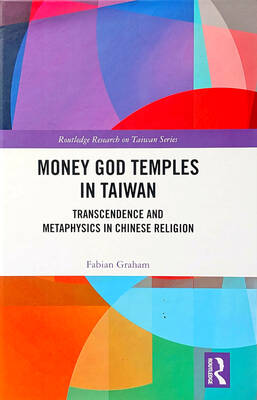
As someone who normally steers clear of books with “transcendence” or “metaphysics” in their subtitles, this reviewer — a casual observer of local belief systems since the 1990s — found Fabian Graham’s Money God Temples in Taiwan a challenging read. Those who’ve only dipped their toes into temple culture will likely need to parse several sections with special care if they’re to keep up with the author, a British ethnographic researcher whose previous books have investigated religious practices among ethnic Chinese in Southeast Asia. This scholarly volume examines a facet of Taiwan’s religious landscape that didn’t exist a century ago, and


 RSS
RSS