


A friend recently suggested having dinner at this Thai eatery in Gongguan District. It's been there 26 years -- and looks it -- but neither of us had ever eaten there before.
Afterwards we picked our teeth with satay skewers and started wondering aloud what meals either of us had eaten in Thailand that were better. I could think of only one and it had come after a sauna and massage while propped on pillows and with a view of Ko Pha Ngan in the distance. Who knew such a good Thai meal could be had in Taipei?
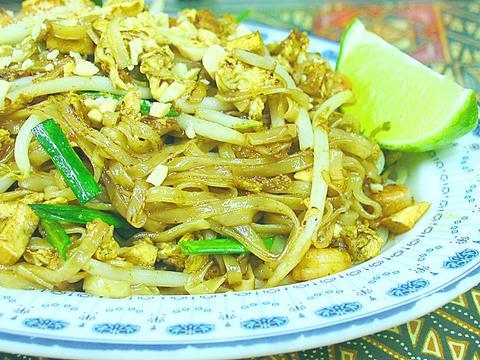
PHOTO: DAVID MOMPHARD, TAIPEI TIMES
Lots of people, apparently. Curious to know if the Taipei Times ever reviewed it, I asked a colleague if he knew of the place.
"I just had dinner there," he said. "Their pad thai is awesome."
In fact, more than a few people I checked with have frequented the place for some time. Apologies, then, to anyone whose best-kept secret this might be giving away.
It seems most of the folks familiar with this little wood-paneled wonder have not only been going there for years, they have strong ideas as to what the best dishes are.
When you sit down, you're given a clipboard that lists everything on offer. If you find it difficult to figure out what kinds of Thai dishes this list is describing in Chinese don't fret; you're also given an album filled with unpleasant photos of each of the dishes with their names scribbled beneath. Match the photos to the items on the list if you can, or just point. Keep in mind that the dishes taste far better than they look in the photographs.
Everything I've tried in my three visits has been delicious. Go with several friends and order an array of items. The dishes tantalize and your chopsticks want to leap from noodle to chicken to pork to fish. Get a Coke or a Taiwan Beer to douse the fire that's sure to engulf your taste buds.
And keep your eyes on the food. The place is decorated like a travel agency you wouldn't trust. Images of elephants, gods and the Thai king have been taped and tacked slapdash to fake wood paneling that looks recycled from a trailer park. During my most recent visit I had view of a fish tank in desperate need of a cleaning and a faded blue poster taped over a hole in the wall. "Thailand -- Amazing Shopping Paradise," it read.
But so what if you can't see Ko Pha Ngan in the distance; you can still taste Thailand in Taipei.

The Portuguese never established a presence on Taiwan, but they must have traded with the indigenous people because later traders reported that the locals referred to parts of deer using Portuguese words. What goods might the Portuguese have offered their indigenous trade partners? Among them must have been slaves, for the Portuguese dealt slaves across Asia. Though we often speak of “Portuguese” ships, imagining them as picturesque vessels manned by pointy-bearded Iberians, in Asia Portuguese shipping between local destinations was crewed by Asian seamen, with a handful of white or Eurasian officers. “Even the great carracks of 1,000-2,000 tons which plied
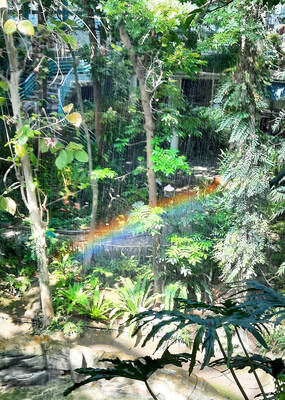
It’s only half the size of its more famous counterpart in Taipei, but the Botanical Garden of the National Museum of Nature Science (NMNS, 國立自然科學博物館植物園) is surely one of urban Taiwan’s most inviting green spaces. Covering 4.5 hectares immediately northeast of the government-run museum in Taichung’s North District (北區), the garden features more than 700 plant species, many of which are labeled in Chinese but not in English. Since its establishment in 1999, the site’s managers have done their best to replicate a number of native ecosystems, dividing the site into eight areas. The name of the Coral Atoll Zone might

On Monday morning, in quick succession, the Chinese Communist Party (CCP) and the Chinese Nationalist Party (KMT) released statements announcing “that the Central Committee of the Communist Party of China and General Secretary Xi Jinping (習近平) have invited KMT Chairwoman Cheng Li-wun (鄭麗文) to lead a delegation on a visit to the mainland” as the KMT’s press release worded it. The KMT’s press release added “Chairwoman Cheng expressed her gratitude for the invitation and has gladly accepted it.” Beijing’s official Xinhua news release described Song Tao (宋濤), head of the Taiwan Work Office of the CCP Central Committee, as
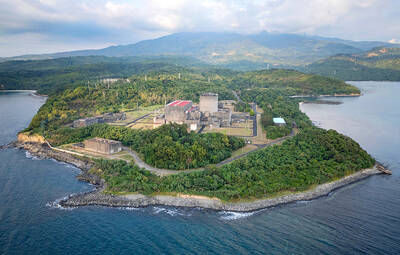
Nuclear power is getting a second look in Southeast Asia as countries prepare to meet surging energy demand as they vie for artificial intelligence-focused data centers. Several Southeast Asian nations are reviving mothballed nuclear plans and setting ambitious targets and nearly half of the region could, if they pursue those goals, have nuclear energy in the 2030s. Even countries without current plans have signaled their interest. Southeast Asia has never produced a single watt of nuclear energy, despite long-held atomic ambitions. But that may soon change as pressure mounts to reduce emissions that contribute to climate change, while meeting growing power needs. The


 RSS
RSS