


The teenage girls squint into the sun, watching the surfer expertly ride a rolling wave into the shoreline. "He's good," one says to the other. "And cute," comes the giggled response.
California? Sydney? No, this is all taking place off the generally tepid coast of Britain.

PHOTO: AFP
While not known to the layman as a surfing hotspot, Britain has seen an explosion in the sport's popularity over recent years, one aided by the increasing penchant for surfing-linked clothing among the country's youth.
It is centered around Cornwall, southwest England, and in particular Newquay, an already well-established tourist town where powerful breakers rolling in from the Atlantic now attract surfers from around the world.
Fistral Beach, where a round of the Rip Curl Boardmaster event was taking place earlier this month, is now full of surf-friendly hostels and cafes, many packed with Australians and South Africans escaping the Southern Hemisphere winter.
The industry is so big that two British universities have begun to offer undergraduate degrees in surfing business and technology.
The British Surfing Association (BSA), which regulates the sport, estimates the country now has around 250,000 regular surfers, a number which doubles during the summertime.
Such has been the demand to learn the sport that the BSA holds intensive coaching courses for those wishing to teach surfing virtually every weekend, spokeswoman Karen Walton said.
"The clothing helps enormously, with the likes of Quicksilver and Billabong getting into the high street -- before it used to only be the surf shops you could get the stuff in. Now everybody's wearing it," she said.
It is undeniable that the popular image of surfing -- often involving devil-may-care, ripple-muscled men risking their lives in huge swells to an admiring audience of young women -- has enormous power.
At the Newquay tournament, while several dozen people lined the shore to watch competitors perform, around 10 times as many were crammed into a specially-erected bar at the back of the beach, most wearing the latest surfing-style leisure gear.
"Because the surfing clothing has become mainstream, I think people can associate themselves with the sport without necessarily taking part in it," Walton conceded.
"The most annoying thing from a surfer's point of view is not that people want to be associated with the sport, but that people give the sport a bad name, because they pretend to be associated with it and then they go out and act like drunken hooligans. It does rub off on the surfers a little bit."
Despite the hangers-on, Britain is an increasingly serious surfing nation, coming 10th out of around two dozen nations at the World Surfing Games in Ecuador earlier this year.
Additionally, far from being the laid-back party animals of repute, many surfers are ardent about not only their sport but the environment in which they pursue it.
Since being formed in 1990, the Surfers Against Sewage group has won a series of notable campaigns over cleaning up Britain's beaches and coastlines. Last week, a group of male activists from the group donned high heels and wigs before carrying their surfboards to meet British environment minister Elliott Morley.
The self-styled "gender bending" surfers were hoping to highlight what they say is the harmful effect of hormone-imbalancing chemicals pumped into the water supply, which, research has found, is causing some male fish to exhibit female characteristics.
"I think we've gradually turned the surfer stereotype around," said Surfers Against Sewage campaigns director Richard Hardy.
"We campaign on all sorts of things, including safer shipping, toxic cargos and the harmful effects of everyday chemicals which get into the water through the sewage system."
As well as the activism, there is, of course, another particularly British characteristic to its surfing scene.
Despite the August heat, far from donning the baggy shorts displayed in the bar, all the surfers off Newquay were wearing wetsuits -- something listed as compulsory, whatever the season, under British Surfing Association rules.

On a harsh winter afternoon last month, 2,000 protesters marched and chanted slogans such as “CCP out” and “Korea for Koreans” in Seoul’s popular Gangnam District. Participants — mostly students — wore caps printed with the Chinese characters for “exterminate communism” (滅共) and held banners reading “Heaven will destroy the Chinese Communist Party” (天滅中共). During the march, Park Jun-young, the leader of the protest organizer “Free University,” a conservative youth movement, who was on a hunger strike, collapsed after delivering a speech in sub-zero temperatures and was later hospitalized. Several protesters shaved their heads at the end of the demonstration. A

Google unveiled an artificial intelligence tool Wednesday that its scientists said would help unravel the mysteries of the human genome — and could one day lead to new treatments for diseases. The deep learning model AlphaGenome was hailed by outside researchers as a “breakthrough” that would let scientists study and even simulate the roots of difficult-to-treat genetic diseases. While the first complete map of the human genome in 2003 “gave us the book of life, reading it remained a challenge,” Pushmeet Kohli, vice president of research at Google DeepMind, told journalists. “We have the text,” he said, which is a sequence of

In August of 1949 American journalist Darrell Berrigan toured occupied Formosa and on Aug. 13 published “Should We Grab Formosa?” in the Saturday Evening Post. Berrigan, cataloguing the numerous horrors of corruption and looting the occupying Republic of China (ROC) was inflicting on the locals, advocated outright annexation of Taiwan by the US. He contended the islanders would welcome that. Berrigan also observed that the islanders were planning another revolt, and wrote of their “island nationalism.” The US position on Taiwan was well known there, and islanders, he said, had told him of US official statements that Taiwan had not
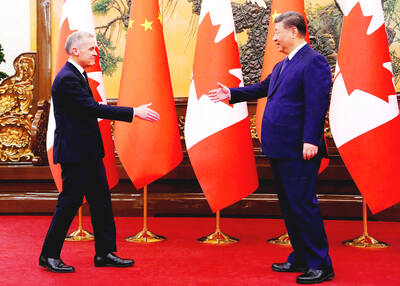
Britain’s Keir Starmer is the latest Western leader to thaw trade ties with China in a shift analysts say is driven by US tariff pressure and unease over US President Donald Trump’s volatile policy playbook. The prime minister’s Beijing visit this week to promote “pragmatic” co-operation comes on the heels of advances from the leaders of Canada, Ireland, France and Finland. Most were making the trip for the first time in years to refresh their partnership with the world’s second-largest economy. “There is a veritable race among European heads of government to meet with (Chinese leader) Xi Jinping (習近平),” said Hosuk Lee-Makiyama, director


 RSS
RSS