


On a morning in April, people in this normally placid spot in Peru's southeastern highlands burst into a Town Council meeting, grabbed their mayor, dragged him through the streets and lynched him. The killers, convinced the mayor was on the take and angry that he had neglected pledges to pave a highway and build a market for vendors, also badly beat four councilmen.
The beating death of the mayor may seem like an isolated incident in an isolated Peruvian town but it is in fact a specter haunting elected officials across Latin America. A kind of toxic impatience with democratic process has seeped into the region's political discourse, even a thirst for mob rule that has put leaders on notice.
In the last few years, six elected heads of state have been ousted in the face of violent unrest, something nearly unheard of in the previous decade. A widely noted UN survey of 19,000 Latin Americans in 18 countries in April produced a startling result: A majority would choose a dictator over an elected leader if that provided economic benefits.
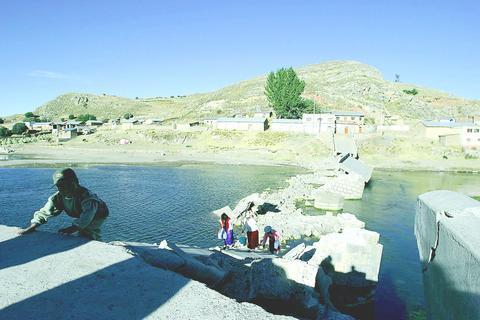
PHOTO: NY TIMES
Analysts say that the main source of the discontent is corruption and the widespread feeling that elected governments have done little or nothing to help the 220 million people in the region who still live in poverty, about 43 percent of the population.
"Latin America is paying the price for centuries of inequality and injustice, and the United States really doesn't have a clue about what is happening in the region," said Riordan Roett, director of Latin American studies at Johns Hopkins University.
"These are very, very fragile regimes," he added. "Increasingly, there's frustration and resentment. The rate of voting is going down. Blank ballots are increasing. The average Latin American would prefer a very strong government that produces a physical security and economic security, and no government has been able to do that."
These at-risk governments stretch thousands of miles from the Caribbean and Central America through the spine of the Andes to the continent's southern cone, and increasingly the problems associated with weak governments are spilling beyond Latin America itself and affecting US interests in the region.
"We're confronted with large increase in illegal migration," Roett said, "more drugs pouring into the American market to meet an insatiable demand, and the potential for regime failure that could spread in the region and bring serious threats to our security position in the hemisphere."
Among the weakest states is Guatemala, which continues to struggle with paramilitary groups, youth gangs and judicial impunity and has become a crossroads for the smuggling of people and drugs north to the US.
Several other governments are fragile at best and susceptible to popular unrest that could further weaken and even topple them. These include the interim administration of Prime Minister Gerard Latortue in Haiti, which took power after a popular revolt this year, as President Carlos Mesa in Bolivia, who took power after such a revolt last year.
Andes region most unstable
The most unpredictable and volatile region is the Andes.
In the north, Venezuela remains deeply polarized, as foes of President Hugo Chavez plot to oust him while he continues with what he has called a "peaceful revolution" that includes a radical redistribution of the nation's oil wealth. Peru, Ecuador and Bolivia, meanwhile, are all buffeted by nearly continuous protests from indigenous groups and other once-forgotten classes that are demanding to be heard.
Their struggles provide a vivid demonstration of an issue that animates strife in nearly every corner of Latin America -- the gap between the haves and have-nots of money and power that makes the region the most inequitable, and increasingly the most politically polarized, in the world.
Even in Argentina, once Latin America's most developed country, President Nestor Kirchner has warned darkly of threats against his government and his life as he struggles to root out corruption, repair democratic institutions, including the police, and lift the country out of an economic implosion in 2001 that prompted the fall of four presidents in two weeks.
The larger concern is that roiling instability is eroding the foundations of democracy itself.
In this climate, even competence has become cause for concern -- the popular impulse being to find something that works and to stick with it, whether arrived at democratically or not. In Colombia, where a stable and popular government has made new strides in beating back a 40-year-old Marxist insurgency and reviving the economy, the temptation has been to extend extrajudicial authority to President Alvaro Uribe's government and even change the Constitution to permit his re-election.
But, then, the range of competent leaders from which to chose has proved limited. Having lost faith in President Alejandro Toledo, Peruvians, opinion polls show, now look to a return of Alberto K. Fujimori, the elected authoritarian who fled the country after corruption charges and who lives in Japan, or to Alan Garcia, another former president, who was exiled in disgrace after a tenure considered one of the most corrupt and incompetent in Peru's recent history.
Their fortunes are being revived with the feeling, increasingly common in Peru and elsewhere, that only a caudillo, the classic Latin strongman, can solve the longstanding problems that plague the region.
The UN report, also drawn from interviews with current and former presidents, political analysts and cultural and economic figures, showed that 56 percent of those asked said economic progress was more important than democracy.
Broad, shallow democracy
"Democracy today is broad but it's not deep," said Larry Birns, director of the Council on Hemispheric Affairs, a Washington-based policy group. "It's broad in that the leadership talks about it, it's a buzzword. But the danger is that the more they talk about it the more skeptical the population becomes because they see a great deal of rhetoric but the standard of living of the impoverished hasn't improved."
Indeed, the view is common among the common man, particularly in poverty-stricken corners.
"I believe in an authoritarian government, if it works," said Daniel Vargas, 24, a university student from Ilave whose father was accused with six others of having orchestrated the lynching of the mayor, Fernando Cirilo Robles. "They do this in other countries and it works. Look at Cuba, that works. Look at Pinochet in Chile, that worked."
The UN report noted that the promise of prosperity offered by democracy has gone unfulfilled. Economic growth per capita, it said, "did not vary in a significant manner" in Latin America in the last 20 years, even though analysts had predicted that growth would pick up as governments flung open the doors to free-market changes prescribed by Washington and the International Monetary Fund. That institution has instead come to be considered a bete noir in this and many other developing parts of the world.
A slump in local economies that has lasted years has only deepened the discontent with governments already widely scorned as corrupt and overly bureaucratic. Predictions that economic growth is on the way -- economists say Latin America will record a 4 percent growth rate this year after a long slump -- have done little to quell the dissatisfaction.
The main reason: Recent growth has not been widely shared, but rather concentrated in isolated pockets, usually attached to multinational investments, like mining, that employ few people.
Sub-human life
Peru is a good example. It has the region's most impressive economic growth, on paper, with the economy expanding about 4 percent a year since Toledo was elected in 2001. But that growth has not filtered down, and the deep disillusionment that failure has inspired is not lost on Toledo, whose approval rating is mired below 10 percent.
"What good is an impressive growth rate?" he said in a speech in May. "Wall Street applauds us, but in the streets, no. So what good is it?"
The poverty and inequality that breeds unrest is never more apparent than in this desolate region, 13,000 feet above sea level, that hugs the deep blue waters of Lake Titicaca and the craggy Bolivian border.
Unlike Lima, prosperous and modern with elegant restaurants, the hamlets and farms here provide a meager life. "What we have here is a sub-human life," said Teofilo Challo, 27, a farmer. "We try to make it and work from sunrise to sundown, just to survive. But we win nothing. No services, no health care, nothing."
Like many in Latin America who feel a profound disconnect from their government, the people here are not descendants of Europeans but are Aymara Indians. They form part of Latin America's forgotten classes, often indigenous or otherwise nonwhite, who increasingly promise political upheaval.
"The government only pays attention to those who have power," said Nestor Chambi, an indigenous leader and agronomist. "Rights are not for the poor. They are for the rich, by the rich, and so the people here have gotten tired."
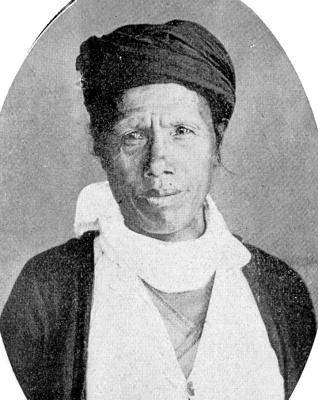
May 11 to May 17 Traversing the southern slopes of the Yushan Range in 1931, Japanese naturalist Tadao Kano knew he was approaching the last swath of Taiwan still beyond colonial control. The “vast, unknown territory,” protected by the “fierce” Bunun headman Dahu Ali, was “filled with an utterly endless jungle that choked the mountains and valleys,” Kano wrote. He noted how the group had “refused to submit to the measures of our authorities and entrenched themselves deep in these mountains … living a free existence spent chasing deer in the morning and seeking serow in the evening,” even describing them as

As a different column was being written, the big news dropped that Chinese Nationalist Party (KMT) caucus whip Fu Kun-chi (傅?萁) announced that negotiations within his caucus, with legislative speaker Han Kuo-yu (韓國瑜) of the KMT, party Chair Cheng Li-wun (鄭麗文), Taichung Mayor Lu Shiow-yen (盧秀燕) and Taiwan People’s Party (TPP) Chair Huang Kuo-chang (黃國昌) had produced a compromise special military budget proposal. On Thursday morning, prior to meeting with Cheng over a lunch of beef noodles, Lu reiterated her support for a budget of NT$800 or NT$900 billion — but refused to comment after the meeting. Right after Fu’s

Yesterday, the Democratic Progressive Party (DPP) nominated legislator Puma Shen (沈伯洋) as their Taipei mayoral candidate, the Chinese Nationalist Party (KMT) put their stamp of approval on Wei Ping-cheng (魏平政) as their candidate for Changhua County commissioner and former legislator Tsai Pi-ru (蔡壁如) of the Taiwan People’s Party (TPP) has begun the process to also run in Changhua, though she has not yet been formally nominated. All three news items are bizarre. The DPP has struggled with settling on a Taipei nominee. The only candidate who declared interest was Enoch Wu (吳怡農), but the party seemed determined to nominate anyone
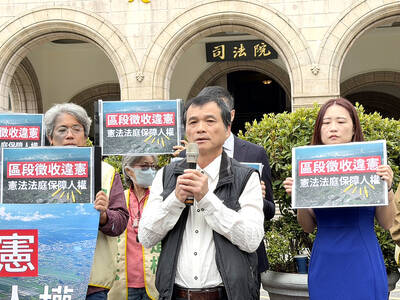
What government project has expropriated the most land in Taiwan? According to local media reports, it is the Taoyuan Aerotropolis, eating 2,500 hectares of land in its first phase, with more to come. Forty thousand people are expected to be displaced by the project. Naturally that enormous land grab is generating powerful pushback. Last week Chen Chien-ho (陳健和), a local resident of Jhuwei Borough (竹圍) in Taoyuan City’s Dayuan District (大園) filed a petition for constitutional review of the project after losing his case at the Taipei Administrative Court. The Administrative Court found in favor of nine other local landowners, but


 RSS
RSS