

We have friends around the world. It is happy fate that our paths cross," were the words written over puppet theater group I Wan Jan Puppet Troupe's (亦宛然) curtains in 1974. At that time, seven foreigners had come from France, Japan, Korea, Australia and the US to study the traditional Taiwanese art form under the legendary puppet master Lee Tian-lu (李天祿).
After they returned to their home countries and set up their respective puppet theaters, many more foreigners got to know puppet theater. As Taiwanese puppet theater gained more international attention, young people here started to see the traditional art form in a new light. "It was like bees pollinated flowers," said Han Chen Chian-hua (陳俊翰), a puppetry instructor at several college puppetry clubs.
To emulate the late puppet master, Chen has volunteered to be an instructor at Hsu Chiou Puppet Theater Restaurant (敘舊布袋戲餐廳 ), a Taiwanese puppet theater-themed restaurant, to teach foreigners the art of puppetry. It will be the first puppet theater course aimed at foreigners. Once five people have enrolled on the free course, Chen said, he can start teaching them right away.
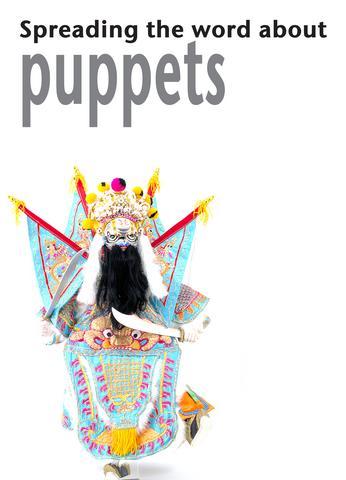
The course, he said, would start with weight-training, which has beginners lift a puppet weighing 2kg, in one hand for five minutes. This is extended to 30 minutes over the six-month course. Even trained puppeteers, Chen said, find it difficult to hold the heavy puppet through a performance, which often lasts for an hour. This is the so-called TV puppet, which stands at 120cm and is larger and flashier than the traditional hand puppet, which is not much longer than a hand.
Today's TV puppets are basically modified Ching-guang puppets (金光布袋戲). They are larger and modernized traditional hand puppets which were created for outdoor performances in the 1970s and then for TV appearances in the 1980s.
From the 1990s, the Pili Channel (霹靂布袋戲) enthralled the country's youth with well-edited special-effects and computer animation-filled TV shows. In what was generally a martial-arts period setting, drama series that featured themes of justice, revenge, conspiracy, mystery and love were played out before its audience of up to 1 million people. Almost every college has its student puppetry club, made up of avid Pili fans. The channel also came up with several computer games and the movie Legend of the Sacred Stone. The puppet series' protagonist, a mysterious demigod Zu Huan Chen, has become a household name.
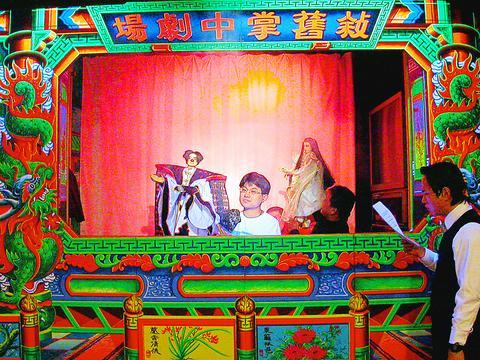
PHOTO: VICO LEE, TAIPEI TIMES
Chen Chian-hua (陳建華), proprietor of Hsu Chiou, decided to go with the flow and have students learn TV puppetry instead of traditional puppetry.
"It's so popular, everyone knows about these characters from the TV series. They have more appeal for beginners," Chen said. The popularity of puppet show costume plays, in which fans dress up and role-play their favorite puppet characters, is a mark of the popularity of TV puppet shows. Taiwan is the only place in the world, Han Chen said, where "cosplayers" play TV puppet characters, rather than Japanese manga characters.
As TV puppets are all the rage in Taiwan, Chen said he believed that foreigners who want to gain a deeper understanding of Taiwanese culture would find it helpful to learn puppetry.
"Taiwan is the only place where traditional Chinese puppetry has evolved and moved into mainstream media and become something fashionable. There must be people from other countries who want to find out how this traditional art form has not only survived but thrived among young fans," Chen said.
A practical reason for teaching TV puppetry is that it is easier to learn. While hand puppets take four years to learn, TV puppets take only months. On the fifth week of the course, students will practice with Chen Wu Hsuan Long Chi (真武玄龍記) a short play about a young man who gives up his studies to pursue martial arts and then goes on a journey to fight crime and preserve justice. Han Chen wrote the script using characters from TV puppet dramas and included several Taiwanese folk songs.
Although the audience does not have to understand the significance of the masks and other rules to understand the a TV puppet performance, the use of colloquial Taiwanese and references to Taiwanese customs are still a major part of the shows.
The teaching is conducted in Chinese with props such as a transparent puppet to instruct non-Chinese-speakers. Language, Han Chen said, is not a problem in learning and appreciating puppetry. "I have seen Japanese puppet shows and been deeply moved by their solemnity and magnificent beauty. But I don't speak any Japanese at all and understand none of the play's Japanese lines. Puppets can communicate with humans without using language," Chen said.
Chen said he also hoped that the course would lead to Westernized versions of Taiwanese puppet theater. "Since TV puppets are already innovative, anything is possible now. You may speak English lines, even perform English stories," Chen said, adding, however, that some quintessential Taiwanese ideas and traditional verses would be lost.
"Still, two things never change in Taiwanese puppetry, one is that it's performed by puppets only; and the other is that one person does the voice-overs for all the characters, or it's not Taiwanese puppet theater anymore," Chen Chian-hua said.
"As long as you're human, you will be attracted to puppet shows. No matter where you come from, you will enjoy Taiwanese puppet theater," Chen said.
The Nuclear Safety Commission (NSC, 核安會) on Sept. 24 approved the re-operation plan that Taiwan Power Co (Taipower, 台電) filed in March for the Ma-anshan Nuclear Power Plant in Pingtung County, after three rounds of review and 589 comments. Taipower now has to carry out the work in the plan and its own inspections on ageing, radiation and seismic resistance, then report back to the commission for review and on-site checks. Minister of Economic Affairs Kung Ming-hsin (龔明鑫) has named 2028 as the earliest restart. The NSC has given no date. THE DEBATE No challenge has been identified as to whether Ma-anshan
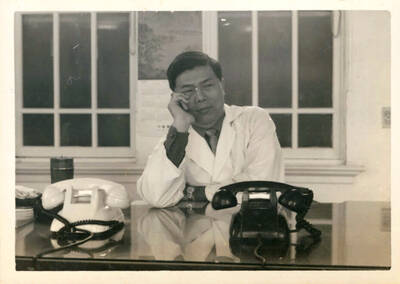
Oct. 12 to Oct. 18 After 11 years in prison on Green Island, Yen Shih-hung (顏世鴻) was finally due for release when a camp guard asked him for NT$20,000 to help pay his bride price. Yen refused. The next day, officials deemed that he had “failed to improve his thinking” and ordered him to undergo further political reeducation on Siaoliouciou (小琉球), where prisoners were also subjected to forced labor. He spent another 19 months there before regaining his freedom in January 1964. Yen’s punishment stemmed from his joining the Taiwan Provincial Student Affairs Committee

Cognitive warfare, says the Ministry of National Defense (MND), is the People’s Republic of China’s (PRC) use of “political, economic, cultural, military and legal means, with the intent to divide internal unity and undermine social stability” in Taiwan. Last week offered several examples. PRC media in October last year reported that the Chongqing Municipal Public Security Bureau had opened an investigation into Democratic Progressive Party (DPP) Legislator Puma Shen (沈伯洋), the DPP’s mayoral candidate for Taipei in next month’s election, for “Taiwan independence” activities. This was a cognitive warfare ploy, designed to unsettle the targeted person and to establish the idea

In pandemic preparedness work, scientists like to focus on the technical challenges: identifying pathogens, diagnosing infections, understanding their effects and developing vaccines and treatments. Each step promises progress through human innovation, investment and planning. The WHO, for example, brings experts together to identify and prioritize emerging disease threats and collect the evidence needed to prepare for them. But preparedness depends on more than scientific innovation. As the past week has shown, politics is the elephant in the room in all of this. No one could have predicted we would be talking about pneumonic plague, and that the death of a single


 RSS
RSS