


As if the waterfront were not enough, there is now something new to do when you visit Tamsui. Added to the usual itinerary of strolling down the town's old streets, tasting the local snacks and watching the sunset over the Tamsui River, you can now go photograph Tamsui's new mounted police.
At the Taipei County Police Bureau Mounted Unit's (台北縣政府警察局騎警隊) inauguration ceremony at Tamsui's Fishermen's Wharf on April 19, curious onlookers crowded round to catch a glimpse of the 18 policemen and policewomen who make up the unit.
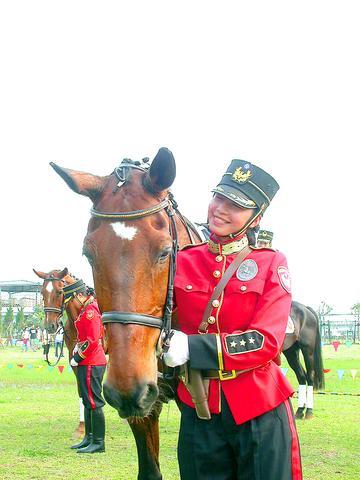
PHOTO: VICO LEE, TAIPEI TIMES
Tourists of all ages were excited to see this unit take to the streets, seeming to echo County Commissioner Su Chen-chang's (蘇貞昌) words at the ceremony: "In the future, our countrymen won't have to go abroad to realize their childhood dream of taking photos with mounted police."
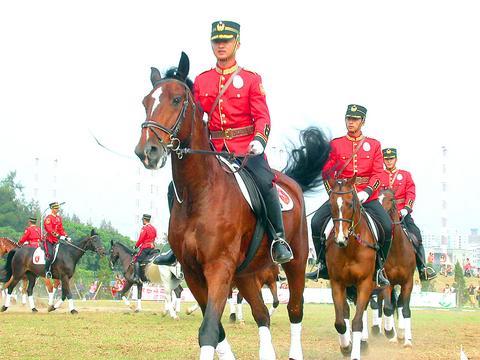
They are Taiwan's first mounted police force. Despite complaints of an insufficient budget, the 10 male and eight female police officers were clad in crimson uniforms with a golden insignia, costing NT$60,000.
The uniforms where eye-catching enough, but the height of the officers -- all men are above 175cm and women over 160cm ? along with a ready smile and a knack for striking a pose with their mounts, seems to suggest that they will be more than up the to task of becoming the townships premier tourist attraction.
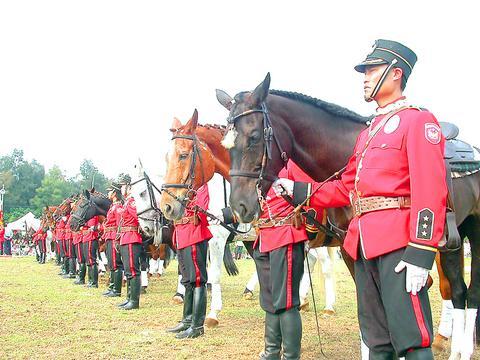
Apart from standing watch at Fishermen's wharf in Tamshui, the mounted police's duties will include patrolling the area around the recently opened Shihsanhang Museum of Archeology (十三行博物館) in Pali and the recently cleaned-up Erchung Waterfront Park (二重疏洪道親水公園) in Sanchung.
Teams of two, a man and a woman, will be on patrol at these locations from 9am to 11am and from 3pm to 5pm on weekends and national holidays. They will put on a three-minute show of formation riding every hour, the better for tourists to photograph them.
Riders from the Taipei County Riding Club (台北縣馬術推廣中心) will initially patrol with the teams to provide technical assistance, should it be required.
The creation of this mounted police unit was inspired by its existing counterparts abroad, said Wang Chin-yuan (王景源), a Taipei County councilor. "During a research trip to the Czech Republic last year, we saw the mounted police perform to the admiration of tourists. They loved the mounted police so much they posed with the police for photos. It was like when we Taiwanese see a snowstorm, we rush outside when the local residents all rush indoors. Tourists like to see something novel, something that offers a fresh experience. Mounted police are just such a thing."
Wang cited the performances by the elite military police at the entrance of the Martyrs' Shrine in Taipei to show that similar sights have proved very popular with tourists.
The idea of creating a mounted police unit had been suggested to the Taipei County Police Bureau before this but had not met with a positive response until Huang Mao-suei (黃茂穗), a long-time rider himself, took the position of bureau chief.
The mounted police, Wang predicted, will appeal most to domestic and Chinese tourists.
In China, in Yuyi county, Jiangsu Province, and Wenzhou county, Zhejiang Province, all-female mounted units have been established in the past two years to promote tourism.
"At present, visitors to Tamsui experience the town by way of tasting its an a-gei (阿給), iron eggs, or ice cream -- the local specialties. The mounted police are meant to be something more, a spectacle," Wang said.
According to Wang, this spectacle is unlike the various scenic splendors that are the most often touted tourist draws. One of Taiwan's most famous is the sunrise over Mount Ali. "Many tourists make it a point to see the sunrise on Mount Ali, but when you think of it, a sunrise is a sunrise. In comparison, mounted police are more representative of the country," Wang said.
The mounted unit may even acquire a new uniform to make them more distinctive. "The current costume promotes a more international image," Wang said. "Maybe we can think about creating a more Asian look. Perhaps a Manchurian-style outfit," Wang said.
In addition to creating another tourist attraction, an important aim of the unit is to change public perceptions of the police as rigid law enforcers. "The aim is not limited to law enforcement but rather to creating an amiable and helpful image for the police in general," Wang said.
Hastily put together to cater to the need of new tourist spots, the unit has rented 16 horses from Taipei County Riding Club. As only five of the mounted squad members have any experience riding horses, all recruits were put through a crash course consisting of grooming, stabling, harnessing and, of course, riding. The course, which usually takes six months to complete, was condensed to five weeks.
Even the way a mounted police patrol operates had to be learned from overseas. As actual training with mounted police abroad would be too expensive, the new unit had to rely on books. "We learned from the library of the National Police University and, most of the time, the Internet, to see what other countries' units do," said Lin Chuan-bao (林全保), chief of the staff duty administration division at the Taipei County Police Bureau.
Unlike the mounted police forces in Canada and the UK, the Taipei County police mounted unit has a disproportionate number of policewomen. "It was natural because in Taiwan, more women than men have the hobby of horse-riding," Lin said.
With only 18 members, 12 of whom also have non-patrol related jobs, the numbers are not adequate to patrol the three current locations, Lin said. He is nevertheless confident that the situation will change next year, when, he says, the budget for the unit will be increased.
As one of the main functions of this unit is to cater to the tourist trade, English-language proficiency has also been a priority for squad members. Training includes English conversation courses, proper demeanor toward foreign tourists and dignitaries, tourist psychology, tour guiding and proper conduct in the presence of heads of states. The training in riding will also continue for some time to come.
Tsuei Ta-wei (崔大偉), leader of the mounted unit, has had no experience riding horses. "The riding is the most difficult part of the training. The balancing and coordination are not as easy as they look, and since we only had five weeks, there was no time for rest, even when our legs were sore," Tsuei said.
Having served only in the administrative branch of the police force, Tsuei said that joining the mounted unit gave him a welcome opportunity to combine his interest in outdoor activities with his job.
"The training was harsh but it made me enthusiastic about horse riding. I would like to continue this," Tsuei said.
All the unit members still retain their weekday jobs within the police force and are simply paid overtime for the extra duties. Tsuei attends to his work at the foreign affairs division of the Taipei County Police Bureau, but gets one day a week for training.
Lin Chuan-bao insisted that as police, the mounted unit's paramount duty is still safeguarding civilians. "Preventing crime and keeping up orderly traffic are the major tasks for the mounted unit. ... Being tourist attractions comes second," he said.
If one asks Taiwanese why house prices are so high or why the nation is so built up or why certain policies cannot be carried out, one common answer is that “Taiwan is too small.” This is actually true, though not in the way people think. The National Property Administration (NPA), responsible for tracking and managing the government’s real estate assets, maintains statistics on how much land the government owns. As of the end of last year, land for official use constituted 293,655 hectares, for public use 1,732,513 hectares, for non-public use 216,972 hectares and for state enterprises 34 hectares, yielding
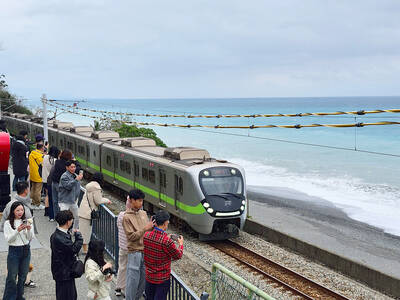
The small platform at Duoliang Train Station in Taitung County’s Taimali Township (太麻里) served villagers from 1992 to 2006, but was eventually shut down due to lack of use. Just 10 years later, the abandoned train station had become widely known as the most beautiful station in Taiwan, and visitors were so frequent that the village had to start restricting traffic. Nowadays, Duoliang Village (多良) is known as a bit of a tourist trap, with a mandatory, albeit modest, admission fee of NT$10 giving access to a crowded lane of vendors with a mediocre view of the ocean and the trains
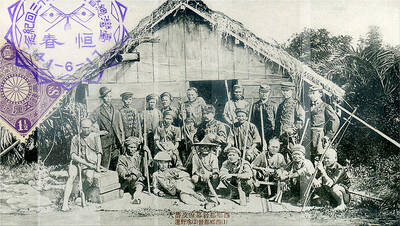
Traditionally, indigenous people in Taiwan’s mountains practice swidden cultivation, or “slash and burn” agriculture, a practice common in human history. According to a 2016 research article in the International Journal of Environmental Sustainability, among the Atayal people, this began with a search for suitable forested slopeland. The trees are burnt for fertilizer and the land cleared of stones. The stones and wood are then piled up to make fences, while both dead and standing trees are retained on the plot. The fences are used to grow climbing crops like squash and beans. The plot itself supports farming for three years.
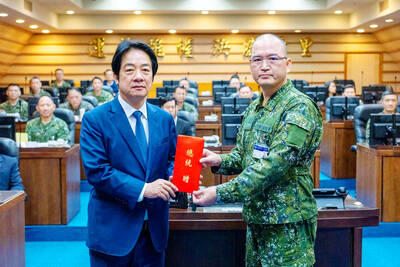
President William Lai (賴清德) on Nov. 25 last year announced in a Washington Post op-ed that “my government will introduce a historic US$40 billion supplementary defense budget, an investment that underscores our commitment to defending Taiwan’s democracy.” Lai promised “significant new arms acquisitions from the United States” and to “invest in cutting-edge technologies and expand Taiwan’s defense industrial base,” to “bolster deterrence by inserting greater costs and uncertainties into Beijing’s decision-making on the use of force.” Announcing it in the Washington Post was a strategic gamble, both geopolitically and domestically, with Taiwan’s international credibility at stake. But Lai’s message was exactly


 RSS
RSS