


I call up the Tokyo hotel, give the desk clerk the correct alias, then wait for her to ring the room.
It's 7am and Adam Yauch, whose been a Beastie Boy since the band was formed 22 years ago, wants to do the interview an hour early. His young daughter has gotten him up -- his PR agent tells me -- and he wants to get the day started. He's a 38-year-old father with, apparently, a 38-year-old father's schedule.

PHOTO: TRA
Like the two Tibetan Freedom Concerts he has to play this weekend. The first is in Tokyo on Saturday and the second a day later here in Taipei.
Yauch is indeed a 38-year-old father. And an MC and bass player from the band that bridged the New York City divide from punk rock to hip-hop and defined a generation. He's been doing this since he was 16. Now, at this moment, he's with the others, the Beastie Boys, in Tokyo, where they've come out of a hibernation of sorts for this weekend's two shows.
"I've picked Tokyo -- well, we're all coming from different parts of the country, so we all have to meet up somewhere anyway. And we like it here. This works well for us," says Yauch.
In the interview Yauch, stage name MCA, gives no outstanding impression. He's just another reasonable, mature adult. And, as such he has his own private space, so he doesn't really care for you getting deep in his business, which in his case also includes his band's business. But he tolerates the questions because he's a spokesman for a group that's sold more than 21 million albums. The price of fame.
"Are you still on track to release a new album -- the first real new album since 1998 -- by early 2004?"
"We're working on it. We'll see how it goes."
"Can we expect more activity from the Beastie Boys in the way of touring or releases anytime soon?"
"I don't know."
He's actually more into the responsibility of fame. Or to put it another way, he's more forthcoming on the state of the world, politics, his own causes and crusades. He's the one who's consistently directed the Beastie Boys towards philanthropy and political activism: a 1999 benefit for the jailed Afro-American journalist and alleged cop-killer Abu Jamal; in the wake of Sept. 11, a benefit for two (especially at that time) underfunded charities, the New York Association for New Americans and the New York Women's Foundation; and later this month, a benefit for the family of slain New York hip-hop legend Jam Master Jay.
The most consistent cause, though, has been human rights and religious freedom for Tibetans. The groundwork was laid when Yauch first came into contact with Tibetan Buddhism in the early 1990s on visits to Kathmandu, Nepal. By 1994 his interest in the religion, as well as his budding interaction with the Dalai Lama, came out into the open with the release of Ill Communication, which featured the track Bodhisattva Vow and a few others sampling Tibetan Buddhist chants. The first Tibetan Freedom Concert followed in 1996. The tenth takes place in Taipei on Sunday.
Talking to Yauch about Tibet gets him rattling on:
"There were something like 6,000 monasteries destroyed by the Chinese -- around a million Tibetans were slaughtered by the Chinese."
It's all basically true, and stale. Yauch speaks repeatedly about Tibetan issues, and there have been consequences, though not always what you'd think. As a rally cry for the Beastie Boys -- not to mention Richard Gere, Brad Pitt, Harrison Ford, and plenty of other big names in Hollywood -- some see "Free Tibet" as an empty slogan, or as Columbia University professor Robert Thurman once put it, Tibetans have become, "the baby seals of the human rights movement."
Die-hard Beastie Boys fans have even been unmoved for their own reasons. One fan site, preferring music to spirituality, turns on the Dalai Lama: "For some he is considered as His Holiness the Dalai Lama, yet for others he is considered to be the reason that the Beastie Boys have not released more albums since 1992."
Yauch shrugs it off.
"I don't pay too much attention to that stuff. Somebody's always gonna say something."
These days he puts action up against cynicism. Tibetan Freedom Concerts have raised over US$830,000 for more than 100 charities and foundations that do everything from house and feed Tibetan refugees in India and Nepal to Tibetan freedom PR work in first world countries like the US and Japan. His Milarepa Foundation in 2001 successfully used petitions to block World Bank funding for a program that would move more ethnic Chinese into Tibet.
In regard to the Taipei concert, money raised will go the Rato Monastery, which was founded in Tibet in the 14th century but is still rebuilding after reestablishing in India in 1983.
But the Taipei concert also signifies something else, the Tibetan Freedom Concert's first ethnic Chinese audience. Yauch has been to Taiwan three times before, the first time to attend a wedding, the second time in 2001 with the Dalai Lama, and then a third time to check into possibilities for a concert.
"We have to get closer to the source of the problem. Playing for Tibetan Freedom in America or Japan is one thing, but here is an ethnic Chinese population and it's closer to the root of what's going on."
"Would you play China?"
"Yes, we'd love to. We've even tried to before but couldn't get permission. Now I'm not sure they'd allow us in for political reasons."
"Does playing in Taiwan mean you're lending support to Taiwanese independence?"
He diplomatically waffles a bit on this one.
"I don't really know enough about the problem to say. Taiwan has made great strides in building a peaceful, democratic society that observes human rights and religious freedoms, and I can see every reason why Taiwanese people would want to keep that."
And here, I think to myself, was this really supposed to happen? Was an interview with the Beastie Boys' MCA really supposed to turn to the question of Taiwanese independence? At least he's fairly up to date on the issue and doesn't mind talking about it. But what about the music?
So I ask. And he confirms what's obvious, that politics definitely does influence some of the music.
"I think music can also just be about fun, can also just be a distraction. And there's nothing wrong with that."
Finally, a reason to look forward to the new album. So will we hear any new songs on Sunday?
"A couple," he says.

Taiwan’s English education system is being pulled apart by three opposing forces. Bilingual Nation 2030 pulls students toward English and global communication. Artificial Intelligence (AI) readiness pulls them toward digital judgment, verification and AI-mediated work. But Taiwan’s old exam culture pulls them back toward memorization, grammar drills, timed reading and correct answers. If the education system keeps using old exams to define success, it risks producing graduates who are neither genuinely bilingual nor genuinely AI-ready, but trained for tasks machines can already perform. The first force is Bilingual Nation 2030. Launched in 2018, the policy aimed to “help Taiwan’s workforce connect
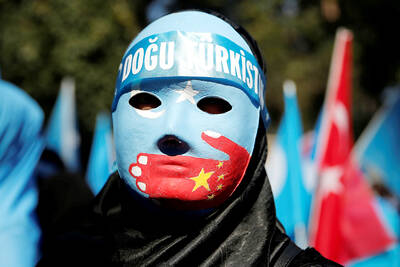
It seems every few days one bumps into one of those “real man” comments in which Taiwan is urged to “face reality” or similar, and “make a deal,” with the speaker implying that soon it will be too late. “Deal” advocates always present themselves as having a superior grip on reality, and the manly ability to make the “hard choice.” Their testosterone-laden language often echoes that of Taiwan sellout advocates. Note that such commentary always specifies a process (“make a deal, work with, make progress”), never the end state of what occupation by a violent authoritarian colonialist state will entail. In

“Taiwan’s Opposition Leader Comes to US With a Message Straight Out of Beijing” read a May 31 headline in the Wall Street Journal. Top US administration officials and members of Congress almost certainly read the WSJ, and if there was a bullet point takeaway that people in Washington should absorb ahead of Chinese Nationalist Party (KMT) Chair Cheng Li-wun’s (鄭麗文) arrival in DC on June 9, that headline is it. The last few columns have discussed this very topic, and the timing is not coincidental. While those top officials likely do not read the Taipei Times, judging by the number
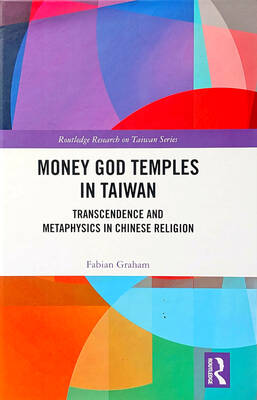
As someone who normally steers clear of books with “transcendence” or “metaphysics” in their subtitles, this reviewer — a casual observer of local belief systems since the 1990s — found Fabian Graham’s Money God Temples in Taiwan a challenging read. Those who’ve only dipped their toes into temple culture will likely need to parse several sections with special care if they’re to keep up with the author, a British ethnographic researcher whose previous books have investigated religious practices among ethnic Chinese in Southeast Asia. This scholarly volume examines a facet of Taiwan’s religious landscape that didn’t exist a century ago, and


 RSS
RSS