


A word often used when writing about the strange fictions of Banana Yoshimoto is "kitsch." With its implication of pseudo-art, of something masquerading as literature but which is in reality relatively mindless and tawdry, it's not a flattering description. In this case, is it fair? And if not, what is these books' true character?
One point to bear in mind with this author is that her books occupy a territory somewhere between the literary and the popular. She is published in England by a very fastidious publisher, but her books are frequently concerned with what is often seen as "popular" subjects -- ghosts, young love, the dreams of adolescence. Yet there is a distancing from her subject matter -- in other words, she holds teenage infatuation at arm's length and muses on it, albeit in wistful fashion. Banana Yoshimoto is Marcel Proust meets Hello Kitty.
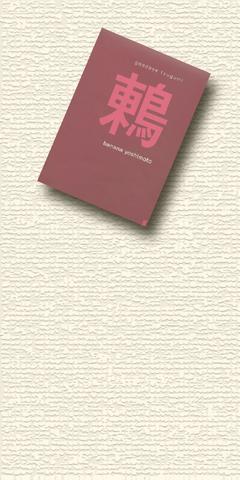
An example that illustrates this occurs early in this novel. The narrator claims to sense the presence of the sea in central Tokyo. "I feel like hurling away the bags I'm carrying from Yamano Records or Printemps or wherever, and dashing off to stand on that dirty concrete embankment beneath which the tide is forever dawdling ... . It occurs to me that this is what people mean by `nostalgia': the pain of knowing that this powerful yearning will eventually fade."
Here, the references to designer stores is a nod in the direction of youth fashion. But the interest in her own unfocused longing, and especially the thought that it won't last, is pure Proust. (But that this is not by any means the usual meaning of "nostalgia" may allow us to remember not to take Banana in her more philosophic moments too seriously).
Goodbye Tsugumi centers on a teenager who suffers from a number of physical disorders. They're unspecified, but the upshot is that she won't live long. But this girl, Tsugumi, is the last person in the world to want sentimental sympathy. She knows she can look forward to less life than her able-bodied friends, but seems to live more vigorously as a result. She's unpredictable, plays practical jokes, and is aggressive almost whenever she speaks. But she also has the power to charm, and fools around with every good-looking boy in town.
The action mostly takes place in a Japanese coastal resort. The narrator, Maria, "named after the Virgin Mother," is Tsugumi's cousin, and she and Tsugumi spent their childhood living in the town's Yamamoto Inn which Tsugumi's parents owned, and where both their mothers worked. But while Maria is at college in Tokyo a decision is made to sell up. As a result, Maria goes back to her childhood home to spend one last summer in the house she grew up in.
The gist of the plot is that Tsugumi falls for a boy called Kyoichi. His father is constructing a big hotel in the area, and as a result Kyoichi is victimized by local teenagers whose parents stand to lose by the new development. When they kill his dog, Tsugumi plans her grotesque revenge.
This "new" novel is in reality not new at all. Although the English translation (by Michael Emmerich) is new, the novel itself came out in Japanese in 1989. This suggests something else about Yoshimoto. She has in fact published far more books in Japanese than have appeared in English. It's as if she turns them out effortlessly in her native language, and as a result they are considered in Japan as relatively ephemeral entertainments. But abroad they are released more selectively, and so seem more special. At home she's a dispenser of romantic adolescent dreams. Abroad, she's literature.
The book reads oddly as a result of this time lapse. No one has a mobile phone and no one sends e-mails. This is perfectly natural for 1989, but the English translation is clearly intended to appeal to today's teenagers and is awash with contemporary American teenage expressions.
So -- is this novel really kitsch? Does it exist in a world of plaster saints and teen fashions, T-shirts bearing meaningless slogans, pink socks and schoolgirl hats? The answer has to be "not entirely." Such a culture avoids reality. It doesn't want to know about war or politics, and not much about disability either. It wants to know about how many little bears you have hanging from your backpack, not George W. Bush and Iraq. And when real people get killed in such wars, it looks only at its own tears, and whether they reflect the sunlight as they trickle down the cheek.
So what does Goodbye Tsugumi have beyond this? A little, but not much. When the novel opens, Maria's father is married to someone else and Maria's mother is only his lover. He eventually gets a divorce and marries Maria's mother. The relationship between Maria and her father is one of the better things in the book, but not a lot is made of it and it's never developed.
It could also be argued that Banana Yoshimoto has missed a major opportunity here. She's set up someone with a heightened perception of her own mortality, but the things she does in this foreshortened life are neither particularly interesting nor very significant. This turned out to be the last summer of Tsugumi's life, but all we have are the feelings of the narrator, and these don't add up to much. How sad it was! How alive she seemed! And that's about as far as it goes.
Good novels have characters who are brought to life in engaging and credible ways, not least by the way they speak. This is true of Tsugumi herself, but not of the others. And although Tsugumi is a memorable character, she doesn't develop. It's true teenagers see the world like this -- even though they themselves mature fast, they aren't old enough to have much conception of change.
Banana Yoshimoto was 25 when she wrote this novel, so for her to adopt this adolescent perspective then was understandable. But perhaps Faber could now give us a sample of what she has been writing in more recent years. It would be interesting to know if she is able to evolve beyond what we have here, the limited sensibility of adolescence.
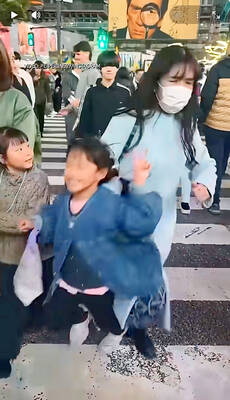
It starts out as a heartwarming clip. A young girl, clearly delighted to be in Tokyo, beams as she makes a peace sign to the camera. Seconds later, she is shoved to the ground from behind by a woman wearing a surgical mask. The assailant doesn’t skip a beat, striding out of shot of the clip filmed by the girl’s mother. This was no accidental clash of shoulders in a crowded place, but one of the most visible examples of a spate of butsukari otoko — “bumping man” — shoving incidents in Japan that experts attribute to a combination of gender

The race for New Taipei City mayor is being keenly watched, and now with the nomination of former deputy mayor of Taipei Hammer Lee (李四川) as the Chinese Nationalist Party’s (KMT) candidate, the battle lines are drawn. All polling data on the tight race mentioned in this column is from the March 12 Formosa poll. On Christmas Day 2010, Taipei County merged into one mega-metropolis of four million people, making it the nation’s largest city. The same day, the winner of the mayoral race, Eric Chu (朱立倫) of the Chinese Nationalist Party (KMT), took office and insisted on the current

Last week the government announced that by year’s end Taiwan will have the highest density of anti-ship missiles in the world. Its inventory could exceed 1,400, or enough for the opening two hours of an invasion from the People’s Republic of China (PRC). Snark aside, it sounds impressive. But an important piece is missing. Lost in all the “dialogues” and “debates” and “discussions” whose sole purpose is simply to dawdle and delay is what the Chinese Nationalist Party (KMT) alternative special defense budget proposal means for the defense of Taiwan. It is a betrayal of both Taiwan and the US. IT’S
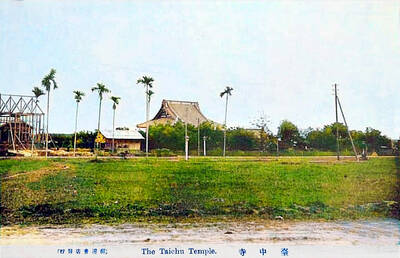
March 16 to March 22 Hidden for decades behind junk-filled metal shacks, trees and overgrowth, a small domed structure bearing a Buddhist swastika resurfaced last June in a Taichung alley. It was soon identified as a remnant of the 122-year-old Gokokuzan Taichuu-ji (Taichung Temple, 護國山台中寺), which was thought to have been demolished in the 1980s. In addition, a stone stele dedicated to monk Hoshu Ono, who served as abbot from 1914 to 1930, was discovered in the detritus. The temple was established in 1903 as the local center for the Soto school


 RSS
RSS