


Starting Feb. 10 the National Theater and Concert Hall will close for almost five weeks. While the closure in itself is not unusual -- it is time set aside for annual maintenance and repairs -- this year the period during which the venues will be closed has been slightly extended until March 16 in order to complete the first part of an ambitious renovations and upgrading project that is going change the look of this venerable cultural institution and also bring its facilities up to international standard.
When it was first completed, it was one of the most advanced venues of its kind, but 15 years on, theater technology has moved forward apace, and the governing body of the CKS Cultural Foundation, under which the National Theater, National Concert Hall, Experimental Theater and Recital Hall operate, felt it was necessary to bring it into line with national-level performance venues in the developed world.
Planning for this extensive project began soon after Ju Chung-ching (朱宗慶) took office as the director of the CKS Cultural Foundation, and with the aid of an NT$45-million grant of financial support from the Ministry of Education, in addition to money from the foundation's own budget, both the interiors and exteriors of the two landmark performance venues will undergo extensive renovations.
"The National Theater and National Concert Hall are unique buildings that have a powerful symbolic function in Taiwan," Ju said. "So we approached the prospect of exterior renovation with considerable solemnity."
While Ju aims to integrate the buildings more completely with the city around them, broadening their functions as a performance venues and public spaces, he said it was important that the basic look of the buildings remained unchanged.
The most noticeable change will be the removal of the unsightly steel barricades that cut the theater and concert hall off from Aikuo East Road and Hsinyi East Road respectively. These will be replaced by a low concrete strip designed to match the graceful lines of the building's Chinese-style eves. Flag posts and billboards will further give color to the perimeter of the building. On the Aikuo East Road side, a fountain is also planned, as is space for outdoor performances. Under Ju's directorship, significant effort has already been made to extend the performance space of the venues from their formal main auditoriums into the loggia and palazzo outside.
On the Hsinyi Road side, a sunken area is being mooted which will serve as a coffee area looking onto the attractive tree-lined boulevard.
These two major external construction projects are still in the final stages of planning, but organizers hope that work will begin in July or August and be completed by the end of the year. More immediately, the CKS Cultural Foundation will be using the five-week period from Feb. 10 to undertake significant internal renovations.
These will include everything from a significant increase of women's lavatory facilities to an upgrading of the National Theater's lighting lineup, the installation of LCD units for the presentation of subtitles, and the installation of more advanced units for stage drops -- allowing for greater flexibility -- and the improvement of facilities for live broadcast and recording.
According to Li Shih-ming (李世明), head of the maintenance division, the buildings will also be subject to extensive structural testing. "While they seem very safe, the effect of the 921 earthquake on the buildings' structural integrity needs to be examined."
Another area that is being focused on is the artists' dressing rooms. Prototypes have already been built, which are considerably more luxurious than those that have been used for the last 15 years. "We also took into consideration the requirements both of local and foreign artists performing here," said a CKS spokesperson. "In the past there had been complaints that the rooms did not meet the needs of Taiwanese performers, who are often of a smaller build than their Western counterparts."
Ju emphasized the care with which this current refurbishment project has been embarked on. The advantage that the organization now has is 15 years of experience as Taiwan's premier performance venue and the accumulated comments of visiting groups.
Tseng Wen-hsian (

“Taiwan’s Opposition Leader Comes to US With a Message Straight Out of Beijing” read a May 31 headline in the Wall Street Journal. Top US administration officials and members of Congress almost certainly read the WSJ, and if there was a bullet point takeaway that people in Washington should absorb ahead of Chinese Nationalist Party (KMT) Chair Cheng Li-wun’s (鄭麗文) arrival in DC on June 9, that headline is it. The last few columns have discussed this very topic, and the timing is not coincidental. While those top officials likely do not read the Taipei Times, judging by the number
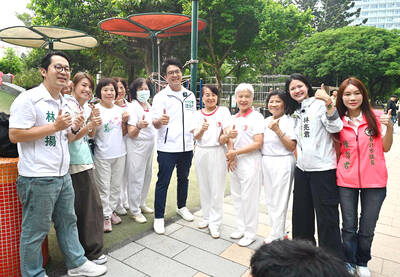
With weighty, anxiety-inducing geopolitical topics dominating the headlines, checking in on the wild and weird state of local politics can take some of the edge off. This November’s elections will determine who will be in charge of fixing potholes in your neighborhood, not the potholes in Taiwan’s complicated geopolitical space. Recently, after an online interview with a Taipei-based journalist, I commented that Taipei journalists never go further than the MRT can take them. He laughed and agreed. Naturally, the Taipei mayoral race is eating up much of the press attention. TAIPEI CITY Democratic Progressive Party (DPP) candidate Puma Shen (沈伯洋) has
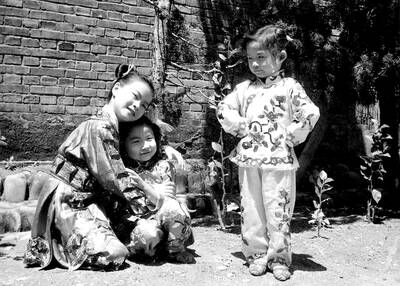
Audiences in Leicester, Cardiff, London and Sheffield will this month gather to watch a series of black-and-white Taiwanese-language films made more than 70 years ago. On the surface, these screenings commemorate the seventieth anniversary of taiyupian (台語片) — Taiwanese-language cinema. Yet the significance of these events extends far beyond nostalgia or film history. They represent a remarkable chapter in Taiwan’s ongoing effort to recover, preserve and reinterpret a cultural heritage that was once thought to have largely disappeared. The centerpiece of the program is the Ho Chi-ming (何基明) directed Xue Pinggui and Wang Baochuan (薛平貴與王寶釧), a film produced in 1955 and
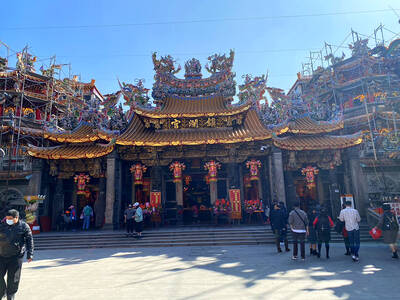
In December of 2008 Lee E-tin (李乙廷), a Miaoli county legislative hopeful, was convicted of vote-buying. Rather than buy votes retail, voter by voter, in the usual manner, Lee had done it wholesale, in a commendably efficient manner: he had visited local temples and made donations to gain their support. Because he did not normally make donations to temples, the court ruled he was attempting to improperly influence voter behavior. The case indicates how important temples are in influencing political life. Both judge and politician appeared to see them in the same way. Beijing sees them that way as well. Democratic Progressive


 RSS
RSS