


In December of 2008 Lee E-tin (李乙廷), a Miaoli county legislative hopeful, was convicted of vote-buying. Rather than buy votes retail, voter by voter, in the usual manner, Lee had done it wholesale, in a commendably efficient manner: he had visited local temples and made donations to gain their support. Because he did not normally make donations to temples, the court ruled he was attempting to improperly influence voter behavior.
The case indicates how important temples are in influencing political life. Both judge and politician appeared to see them in the same way. Beijing sees them that way as well.
Democratic Progressive Party (DPP) Taichung city councilor Tsai Yao-chieh (蔡耀頡) in late 2024 reported that temples were arranging week-long tours to temples in Fuzhou, China. The trips, apparently aimed at the 18-35 age group, provided free accommodation and travel for a seven day, six night tour. Tsai, speaking in an interpellation session, described how temples near National Chin-yi University in the city’s Taiping District (太平), an industrial area on the east side of the city, had distributed posters offering the trips. According to Tsai, participants were asked to register an account on WeChat, and reported brainwashing attempts.
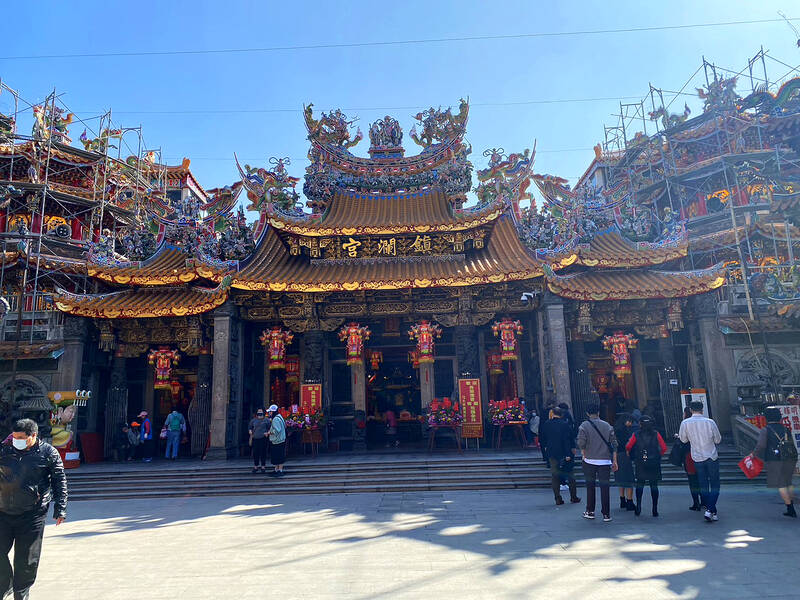
Photo: Chang Hsuan-che, Taipei Times
The Ministry of the Interior (MOI) said in response to the issue that many temples on both sides of the strait interacted, but a small number of temples in Taiwan were engaged in “united front” activities. Yet it appears they could have enormous potential influence.
MAZU CULT
As I have noted before, the Mazu cult is a major vector of “united front” efforts. Benjamin Sando, in a detailed report for Global Taiwan Institute, laid out the numerous interconnections of the Dajia Jenn Lann Temple (大甲鎮瀾宮), a major Mazu worship center run by the Yen (顏) family of Taichung and overseen by the Taiwan Mazu Fellowship headed by Cheng Ming-kun (鄭銘坤), and the efforts of the People’s Republic of China (PRC) to use the Mazu cult in its “united front” work.
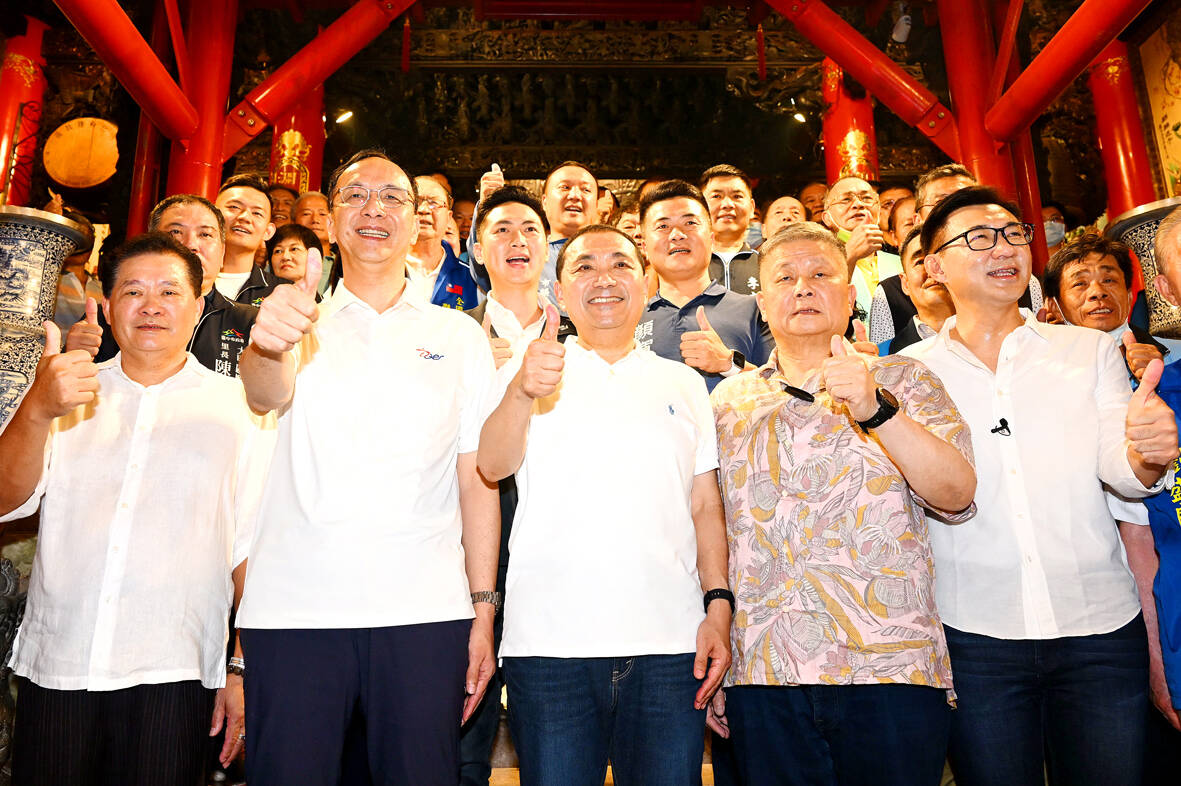
Photo: Liao Yao-tung, Taipei Times
The effort is not only political, but commercial. Sando observes: “it has long been documented that Taiwan Mazu Fellowship board members have invested in PRC-based real estate development projects around Mazu cultural sites in the PRC.”
In Tianjin, Jenn Lann Temple has erected a sister temple site on land developed by a local corporation that lists Cheng Ming-kun as a director. Cheng has also brought Taiwanese businesses over to the PRC to do business, according to Sando.
Although Mazu is the most important component, the PRC’s temple-centered “united front” effort is large and includes many different temples. A 2024 report from IORG, which uses open-source research to identify these activities, stated that cross-strait religious exchanges supported by the Chinese Communist Party (CCP) included at least 116 events, 40 Taiwanese temples and approximately 16,000 Taiwanese participants. The report identified former president Ma Ying-jeou (馬英九) of the Chinese Nationalist Party (KMT) and heavyweight KMT politician Wang Jin-pyng (王金平) as the two highest-ranking participants. In addition to 40 temples, IORG also identified 45 social organizations, including 28 associations, 11 clan associations and foundations, fellowship associations, hometown associations and a media company.
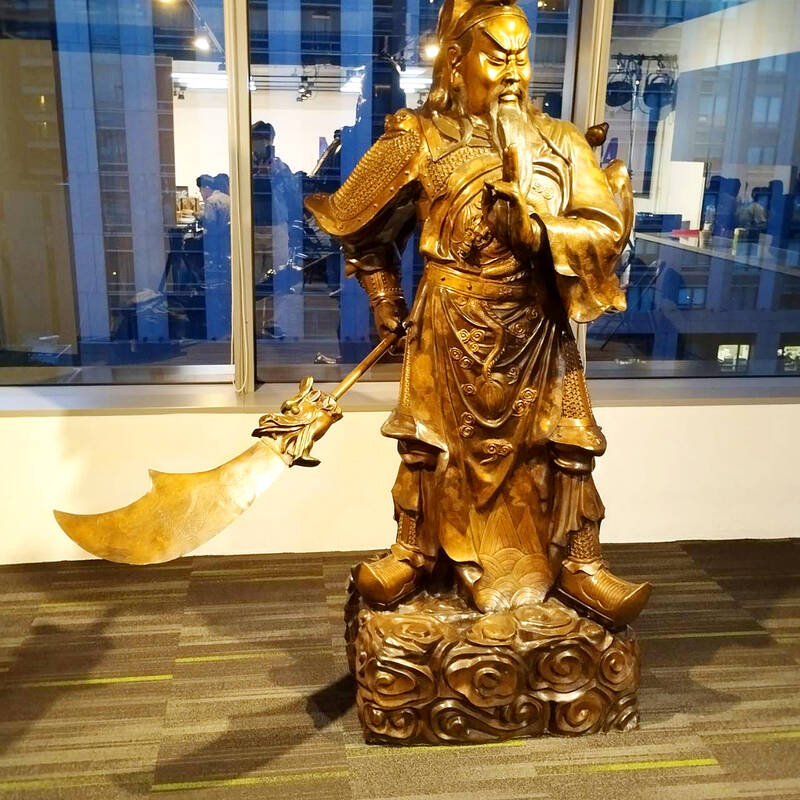
Photo: Shi Hsiao-kuan, Taipei Times
The IORG report also highlights the way PRC propaganda uses religion and history to advance its Taiwan narratives. The Yellow Emperor is used to claim that both sides of the Taiwan Strait belong to the “descendants of Yan and Huang” and the “Chinese nation,” while the deity Guan Gong (關公) is used to evoke “loyalty to the country.” PRC narratives portray Taiwanese visits to the PRC under these programs as Taiwanese returning home to trace their origins.
A 2024 paper in Foreign Policy Analysis contended that the effort to use Mazu worship to suborn Taiwan does have measurable effects. Exploring Mazu temples in Kaohsiung, it contrasted the city proper with the smaller Mazu temples in nearby villages. The paper’s analysis showed that in the 2018 election in which the Democratic Progressive Party (DPP) share of votes in Kaohsiung city fell compared to 2014, it dropped more in neighborhoods with Mazu temples than in those without a Mazu temple. Similarly, in 2020, when the DPP vote recovered somewhat, it recovered less in neighborhoods without Mazu temples. However, the researchers did not find this effect in rural areas.
The paper argued that in the villages Mazu temples have stable funding derived from collections from local farmers for several generations. “Therefore,” the authors said, “there is not much incentive for village Mazu temples to receive funding from outsiders, including the Chinese government’s Mazu tourist invitations.”
In the city, Mazu temples are associated with workers who migrate to the cities but do not have stable relationships with the local Mazu temple. This drives temple officials to seek outside funds and organize events and activities.
MANAGING RELATIONS
The problems faced by the PRC in suborning Taiwan temples are outlined in a paper by Chang Kuei-min (張貴閔). First, Chang notes, the PRC’s centralized control of religion limits the agency of PRC actors in influencing local temples. Second, Taiwanese temples are decentralized, which creates further coordination problems for PRC actors. Finally, Taiwanese temple leaders are well aware of PRC imperatives and have “deployed pragmatic coping strategies to sideline Beijing’s political intentions.”
For example, many temples in Taiwan have ancestral temples in China. “The Chinese state and its local agents have quickly learned to utilize the spiritual and material resources of ancestral temples to pursue their political and economic agendas,” Chang writes.
However, because they have been separated for so long, temple officials have lost track of these relationships, reducing their emotional leverage. Further, temples in Taiwan, which have also become ancestral temples, are reluctant to concede that important status.
As Chang notes, and as the Jenn Lann Temple’s interests in the PRC show, temple to temple relations between the PRC and Taiwan are often bound up with the business affairs of temple directors. This causes friction between businessmen, temple officials and pilgrims who have different agendas for their cross-strait trips.
“In my fieldwork, the violation of religious order was a common reason why participants withdrew from cross-strait religious exchanges,” Chang writes.
Taiwanese temple officials, who like most Taiwanese do not want to be annexed to the PRC, have also become adept at evading politics on PRC trips.
Ironically, the self-serving nature of many temples’ exchanges with the PRC, where temple officials are actually cashing in on business opportunities as rewards from the PRC handlers, helps undermine the PRC’s efforts to subvert Taiwan via religion. Taiwanese temple officials and pilgrims appear to treat the PRC as nearly all Taiwanese who interact with it treat it: as a place from which to extract benefits, but not one to join; as a threat, surely, but one that can be managed.
Notes from Central Taiwan is a column written by long-term resident Michael Turton, who provides incisive commentary informed by three decades of living in and writing about his adoptive country. The views expressed here are his own.


Taiwan’s English education system is being pulled apart by three opposing forces. Bilingual Nation 2030 pulls students toward English and global communication. Artificial Intelligence (AI) readiness pulls them toward digital judgment, verification and AI-mediated work. But Taiwan’s old exam culture pulls them back toward memorization, grammar drills, timed reading and correct answers. If the education system keeps using old exams to define success, it risks producing graduates who are neither genuinely bilingual nor genuinely AI-ready, but trained for tasks machines can already perform. The first force is Bilingual Nation 2030. Launched in 2018, the policy aimed to “help Taiwan’s workforce connect

“Taiwan’s Opposition Leader Comes to US With a Message Straight Out of Beijing” read a May 31 headline in the Wall Street Journal. Top US administration officials and members of Congress almost certainly read the WSJ, and if there was a bullet point takeaway that people in Washington should absorb ahead of Chinese Nationalist Party (KMT) Chair Cheng Li-wun’s (鄭麗文) arrival in DC on June 9, that headline is it. The last few columns have discussed this very topic, and the timing is not coincidental. While those top officials likely do not read the Taipei Times, judging by the number
With weighty, anxiety-inducing geopolitical topics dominating the headlines, checking in on the wild and weird state of local politics can take some of the edge off. This November’s elections will determine who will be in charge of fixing potholes in your neighborhood, not the potholes in Taiwan’s complicated geopolitical space. Recently, after an online interview with a Taipei-based journalist, I commented that Taipei journalists never go further than the MRT can take them. He laughed and agreed. Naturally, the Taipei mayoral race is eating up much of the press attention. TAIPEI CITY Democratic Progressive Party (DPP) candidate Puma Shen (沈伯洋) has
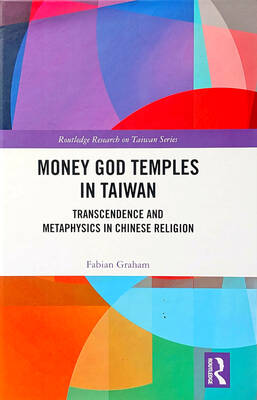
As someone who normally steers clear of books with “transcendence” or “metaphysics” in their subtitles, this reviewer — a casual observer of local belief systems since the 1990s — found Fabian Graham’s Money God Temples in Taiwan a challenging read. Those who’ve only dipped their toes into temple culture will likely need to parse several sections with special care if they’re to keep up with the author, a British ethnographic researcher whose previous books have investigated religious practices among ethnic Chinese in Southeast Asia. This scholarly volume examines a facet of Taiwan’s religious landscape that didn’t exist a century ago, and


 RSS
RSS