


The New York-based Cat Power (a.k.a. Chan Marshall) has won critical acclaim since 1994's Dear Sir EP. The 1996, the Myra Lee EP received rave reviews for its raw energy and mature lyricism. Moon Pix, a collection of poignant songs released two years later, is widely considered the band's masterpiece. It's also the album that established Marshall's fan base in Taiwan.
The hauntingly gloomy atmosphere throughout the album both in music and lyrics is powerful enough to push potential suicides over the edge. Marshall sings her characteristically arcane lyrics as a lament. The vocals, with their evocative imagery and intense emotions, may be Cat Power's greatest appeal.
In 2000's The Covers Record, consisting of 12 remakes of songs in variety of genres -- songs like the Rolling Stone's Satisfaction and Velve Underground's I Found a Reason -- are thoroughly reconstructed and at the same time rendered eerily beautiful.
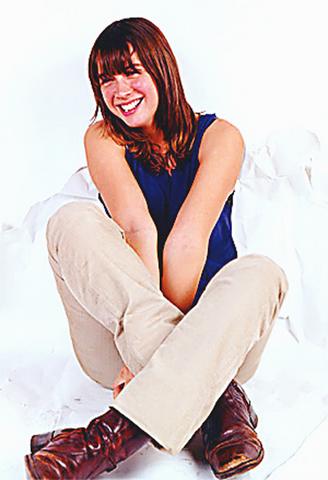
PHOTO COURTESY OF MAGNUM MUSIC ENTERTAINMENT
Cat Power is going to release the long-awaited You Are Free, her first album of original material in four years. Eddie Vedder, the Pearl Jam singer, is a guest singer on the album while Foo Fighters's frontman Dave Grohl plays drums on one track.
Although the album will be hitting store shelves worldwide on Feb 19, audiences in Taiwan will be able to purchase the new album starting today, as it is released here to coincide with tonight's concert. Cat Power's next stops are Japan and then Paris, where Marshall is most celebrated and often compared with 1970s art-pop diva Brigitte Fontaine.
Three days before the concert, Marshall talked with Taipei Times about her music in a free-association manner, much like the way she writes her lyrics. "I'm not famous at all. I can sit in a coffee place and think. That's a good thing, Marshall," said.
As for her new album You Are Free. It may not be easy-listening but a more go-getting positivism and confidence can be detected in the songs.
"As a woman, as an person, I'm much more confident than when the band started," she said, referring to her reluctance to name the band -- which is basically a one woman outfit with backing changing from album to album -- after herself.
"Music is not my entire life. Music is just something I do. I don't sing first thing in the morning. Also, I wasn't that confident at the time, Marshall said.
"When I set up the group, I didn't really have any self esteem. I felt really like a loser. My friends have passed away from drugs, suicide, Aids and stuff. I've seen that other side of life. I know that life can be really hard and ugly. Then I realized it doesn't have to be like that. If it already is, then try to enjoy your life, make you own life and make your own decisions."
On the new album the group made a Michael Hurley cover, The Werewolf Song. "Maybe I nurture [the cover songs] more. I look up to the songs I'm covering. These are the songs that sometime in my life have helped me. Doing covers is honoring the songs. I don't like my own songs as much. They remind me of where they come from. Sometimes they are not good things to remember. A friend. A situation. I wrote the songs to get out of them. I'd rather not look back at them again."
While providing a quintessentially female point of view in her own songs, Marshall's covers are mostly of male rockers' works. "Ninety-nine percent of the people in rock bands are guys. They dominate," Marshall said. "However, there are indeed some great female rockers, Kim Gordon, Patti Smith, Debbie Harry, there aren't many ... Courtney Love was pretty -- damn rock n' roll, there aren't many," she shakes her head. "It'll probably take 20 years or 50 years to change that."
Tonight Cat Power will be performing at Zeitgeist at 8pm with special guest Chen Shan-ni (陳姍妮). Tomorrow and Sunday, Chan Marshall will be performing as part of the Leaf Mini Music Festival with 12 Taiwanese bands. Tomorrow's show runs from 4pm-10pm at Zeitgeist. Sunday's performance is at the same time at Nuno's Live House (老諾音樂世界) in Taichung.
All tickets are NT$550 and are available at Tower Records, Eslite Music and the venues.

If one asks Taiwanese why house prices are so high or why the nation is so built up or why certain policies cannot be carried out, one common answer is that “Taiwan is too small.” This is actually true, though not in the way people think. The National Property Administration (NPA), responsible for tracking and managing the government’s real estate assets, maintains statistics on how much land the government owns. As of the end of last year, land for official use constituted 293,655 hectares, for public use 1,732,513 hectares, for non-public use 216,972 hectares and for state enterprises 34 hectares, yielding

The small platform at Duoliang Train Station in Taitung County’s Taimali Township (太麻里) served villagers from 1992 to 2006, but was eventually shut down due to lack of use. Just 10 years later, the abandoned train station had become widely known as the most beautiful station in Taiwan, and visitors were so frequent that the village had to start restricting traffic. Nowadays, Duoliang Village (多良) is known as a bit of a tourist trap, with a mandatory, albeit modest, admission fee of NT$10 giving access to a crowded lane of vendors with a mediocre view of the ocean and the trains

The March/April volume of Foreign Affairs, long a purveyor of pro-China pablum, offered up another irksome Beijing-speak on the issues and solutions for the problems vexing the People’s Republic of China (PRC) and the US: “America and China at the Edge of Ruin: A Last Chance to Step Back From the Brink” rang the provocative title, by David M. Lampton and Wang Jisi (王緝思). If one ever wants to describe what went wrong with US-PRC relations, the career of Wang Jisi is a good place to start. Wang has extensive experience in the US and the West. He was a visiting

One of the challenges with the sheer availability of food in today’s world is that lots of us end up spending many of our waking hours eating. Whether it’s full meals, snacks or desserts, scientists have found that it’s not uncommon for us to be mindlessly grazing at some point during all of our 16 or so waking hours. The problem? As soon as this food hits the bloodstream in the form of glucose, it initiates the release of the hormone insulin. This in turn activates a switch present in every one of our cells, which is responsible for driving cell


 RSS
RSS