


What began this summer as a search for a legendary underwater town off the coast of Penghu by members of the Underwater Archeological Institute (UAI,
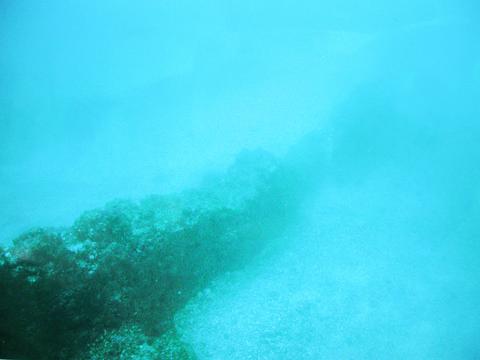
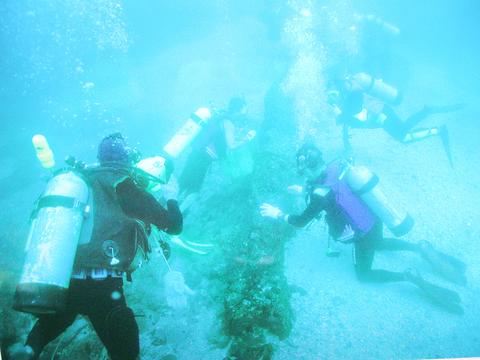
The expedition failed to locate the town they were searching for, but in late July, the group instead stumbled, or rather swam across, a 100m-long wall-like structure 28m beneath the murky waters of the archipelago's Hsichi (
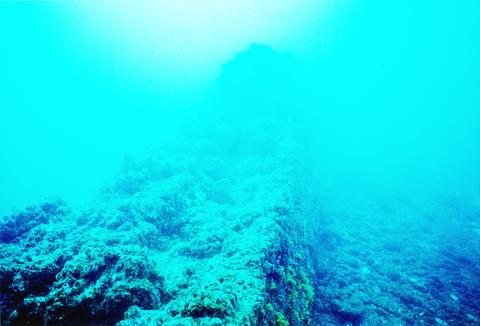
PHOTO COURTESY OF UAI
Measuring 50cm in width, one meter in height and 100m in length and positioned on an east-west axis, the mysterious underwater edifice might not have been what the team was searching for, but the find has still managed to stoke imaginations across the nation.
The public was so enthralled with the news that after Public Television Service (
"It was a huge surprise. Scores of people called in wanting more information and a longer, more in-depth show [about the wall]," said Ke Chin-yuan (柯金源), PTS news assignment editor. "Because the existence of such things in Taiwan is not mentioned in history books, is not common knowledge and is rarely, if ever, the topic of TV a documentary, the program sparked a huge amount of interest."
Home to roughly one thousand predominantly elderly civilians and a coast guard detachment, the Hsichi and Tungchi islets -- which together have a land mass of less than two-square kilometers and no paved roads -- were, until earlier this week, Taiwan's most forgotten outposts.
I told you so
The rest of Taiwan may have been awe struck by the find, but the island's residents remained blase about the events that took place on their doorstep. They've been trying to get people to believe in stories of sunken cities for years.
"The stories are part of Penghu's unwritten history. I've known of other such structures in the area since the late 1970s. But it was in 1992 that I first began to hear stories of a submerged town and the possibilities of an entire temple somewhere in the area," recalled expedition leader, Steve Shieh (
Regardless of the stir it has caused, the recent find is not the first such discovery to take place in Taiwan's territorial waters. In 1982, a Japanese research team discovered a 100m-long cross-like structure in waters off of Penghu's Hujing Island (虎井島). Since then three other underwater wall-like structures have been pinpointed by independent underwater survey teams.
Widespread acceptance of the recent expedition's findings owes a lot to the fact that it is the first such expedition to receive assistance from the nation's only official marine archeological team -- the National Museum of History's Marine Archeology Team (
Formed in 1995 to excavate the scattered remains of a Chinese Qianlong (
"It was a great opportunity for us to get involved with such a venture. Not only did our presence mean that there were qualified archeologists and anthropologists on hand, but it gave the expedition a lot of credibility," explained Yang Shi-zhao (
Supposedly stretching from somewhere in what is today the South China Sea to Hawaii and encompassing many of the Pacific Islands, Mudalu (姆大陸) was, according to the legend, home to Asia's earliest peoples, the Ketagalan (凱達格蘭族), who supposedly lived in Asia sometime between seven and 15 thousand years ago.
Quite possibly Asia's earliest civilization, the Ketagalan peoples were reportedly incredibly advanced for the time, with both the know-how to create household utensils, a written language and the ability to construct pyramids and megaliths. Just how the Ketagalan could have been so advanced, however, is where the legend gets a bit sketchy and, as some believe, quite unearthly.
Close encounters
According to historian Lin Sheng-yi (
"It's quite obvious from looking at the few surviving pieces of Ketagalan artwork that they were in contact with alien peoples and UFOs. Artifacts clearly depict both UFOs and the radio waves emitted by them," explained Lin. "There can be no doubt that the recent find is a Ketagalan settlement, as its linear proportions clearly point to advanced construction knowledge."
Highly skeptical of the ideas put forward by members of KTIS regarding visiting aliens, archeologists and researchers are not totally dismissive of possible links to Mudalu. While still waiting for more precise dating results, experts have dated the structure to somewhere in the region of seven to 20 thousand years old.
"I'm still open to suggestions, but if the legend of Mudalu is to be believed, then bulwarks could possibly be found off the coast not only of Penghu, but Hualien and Taitung. One of the most famous finds, that took place 20 years ago, was off the coast of Okinawa," continued Yang. "I certainly don't believe in the UFO connection, but the existence of a long forgotten settlement is certainly plausible."
Although the involvement of the museum's undersea archeology team has given the expedition a previously unheard of level of credibility, there are still questions as to the find's origins.
Volcanic phenomenon
The most significant of these is the lack of human remains or manmade objects in the vicinity. The lack of credible evidence leads many to continue to believe that the edifices are the result of volcanic activity.
Caused when lava flows are forced through joints in the structure of igneous rock beds, linear lave formations are found throughout the Pacific Ocean's "ring of fire." One of the most prominent such structures is in fact located at Hsishan (西山) on Penghu's Hujing Island. Although the Hsishan formations are vertical examples of linear lava flows, the existence of these formations in such close proximity to the finds means volcanic activity cannot be dismissed.
"When Penghu was created by volcanic activity millions of years ago it is quite possible that lava flowed into rock beds and over the years became flat and wall-like," explained Tsao Nu-chung (
Shieh and his ten-man team remain adamant, however, that the structures found in Penghu are manmade. Sonar soundings taken by members of the National Sun Yat-sen University's department of marine environment (中山大學海洋環境學系) point to another four such structures; all of which cover roughly the same area and have nearly the same dimensions.
"If [the walls] were the result of volcanic activity then we would have an octopus shape on the seabed. The tentacles being the lava flows and in the center, where the body is, there would a crater," continued Shieh. "We didn't find a crater anywhere in the area, however. This certainly rules out volcanic activity."
Money matters
The hullabaloo surrounding these mysterious structures could be short lived, however. Marine archeology is an expensive business. The cost of the recent two-month trip was upwards of a quarter of a million NT dollars.
According to Yang, present funding is less than adequate if the nation's small number of marine archaeologists are to be allowed to continue their work. Funding is so small that Taiwan's marine archeologists and the work they carry out is more restricted than that of their Chinese counterparts at Beijing's National Museum of Chinese History (中國歷史博物館).
The first institute in China to develop a center of marine archaeology, the museum's team has been exploring seabeds off the coast of China since 1985. It has made valuable finds in the seas off Fujian, Shandong and Liaoning provinces.
"China's underwater archeology teams receive much more funding than we do, as it comes directly from the country's cultural bureau. Our annual budget for research has to be divided between more than one agency," explained Yang. "This very much limits what and where we can operate."
Regardless of the problems faced by lack of funds, Shieh is determined to return to the seas off Penghu next April. With the continued backing of NMHMAT and the help of PTS and Sun Yat-sen University, the team plan to continue their search for the town and, if funds allow, look for the legendary temple as well.
"We'll be back there in early April. Until then the seas around Penghu are far too choppy to undertake an expedition of this type," said Shieh. "With one find under our belts, I'm hopeful that next year we will be able to secure more funds and maybe international interest in our search for long forgotten underwater cities."

If a leisurely afternoon of high-end dining and watching the scenery roll by from the comfort of a plush armchair sounds like a good time to you, consider a trip on the Sea Breeze (海風號). This culinary, cultural and scenic experience is the perfect setting for a date, a celebratory outing with a small group of friends or a relaxing solo ride. The price tag is steep, especially if you consider the short distance the train actually covers over the 3.5-hour journey. But what you’re paying for on the Sea Breeze isn’t transportation; it’s the comfort, the service, the exclusivity, the

June 15 to June 21 According to legend, a giant from Orchid Island (Lanyu, 蘭嶼) named Si Mangangavang once built a large tatala canoe capable of carrying 16 people. He set sail southward to the Batanes in the Philippines, where he traded with the local Ivatan people. One of the goods they coveted was cowhide, which the Tao people of Orchid Island used to make armor. Through continued trade, the Tao and Ivatan forged close ties, and Si Mangangavang became good friends with a Batanes giant named Si Vakag. This story, collected in a 1998 book by ethnologist Yu Guang-hong (余光弘)
Taiwan’s renewable shortfall is a problem of execution, not resources. Japan’s long-cycle, joined-up energy planning is the model worth studying — but what Taiwan can borrow is the institutional machinery, not the politics. When Nvidia CEO Jensen Huang (黃仁勳) used his visit to Taipei last month to warn that the country needs far more electricity, he was naming a constraint its own planners already know well: Taiwan Power Co (Taipower, 台電) expects demand from the semiconductor and artificial intelligence (AI) sector alone to exceed 5 gigawatts (GW) by 2030. The harder question is not whether to build more capacity but which

One of the wildest things about the reception of Chinese Nationalist Party (KMT) Chair Cheng Li-wun (鄭麗文) in the international media is the way her words are presented without being contextualized, let alone challenged. The Financial Times, for example, interviewing her during her visit to New York, said that she blamed the halt to exchanges between Taiwan and the People’s Republic of China (PRC) for raising tensions. “There has been no dialogue, so you can see that the situation is almost on the brink of war,” the Financial Times quoted her as saying, without any hint that the PRC, not


 RSS
RSS