

Su Chao-pin (蘇照彬) is one of the luckiest among new filmmakers in Taiwan. The first film script he wrote, The Cabbie (運轉手之戀), went to the Berlin Film Festival and won two Golden Horse awards in Taipei. The second script Double Vision (雙瞳), was a multi-million dollar, international project, produced by Columbia Asia. And now with his third script, Better Than Sex (愛情靈藥), he has become the director, recruiting pop stars like Chen Sheng (陳昇), Kwan Liang (光良) and Liu Hung-hua (劉虹樺) to play in his directing debut.
For a guy who was a computer science major and thought he would write programs all his life, his two years in film has been extra-ordinary. Soon after he became a creative director at MTV Taiwan and won an award for Best Creative Copywriting at the China Times' Advertising Awards, he was invited to write film scripts.
"I like watching bad films. And I've seen too many bad ones. This is very useful for me. I learned a lot from those films when I began writing," said Su with a child-like face, wearing his signature big, thick, black glasses. His friends nicknamed him Da Mu (
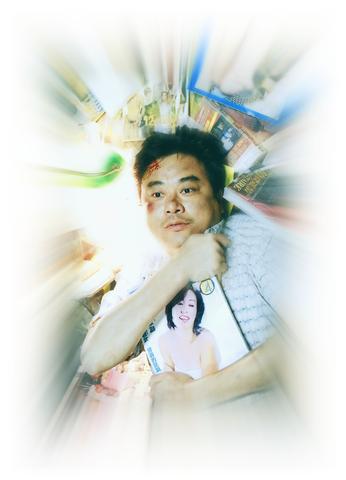
Having a background totally different from Taiwan's film production circle gave Su freedom when he began writing films, which turned out to be a plus for his films. He is free from the influence and traditions set up by his predecessors, filmmaking masters who are usually into art and culture, and free to concentrate on what, in his mind, a good story is. The result is that he can always present something refreshing. There is a fluent drama with black humor and exciting car chase scenes in The Cabbie, and there is the psycho thriller about murder and investigation in Double Vision, there is the sex comedy for Taiwan's young adults, Better Than Sex. If you include the gangland action film A Chance to Die (
Su said when he began writing the script he had only two films in his mind, Blair Witch Project and The Sixth Sense. Now, he has found fun in writing thrillers with sci-fi elements. After Double Vision, which is right now in post-production, he is planning to write another sci-fi script for an English-language film.
"The film has totally changed the image of Taiwanese films being melancholy and depressing," said Mai Jen-jieh (
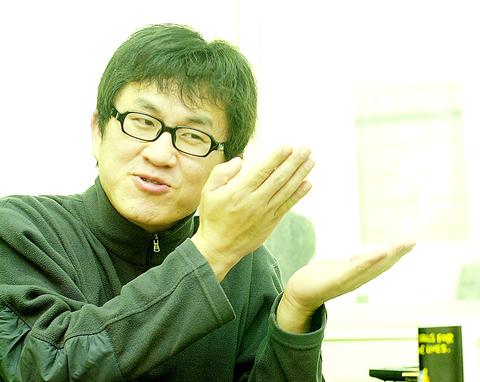
PHOTO: GEORGE TSORNG, TAIPEI TIMES
In Better Than Sex, Lin Tsu-chuang (
One day, Cheng the porn bookshop owner suddenly dies and leaves Lin a key to a secret path where Lin finds out there lives a porn star and her policeman husband (Leon Dai). Here, Lin discovers Cheng's secret and takes a place to peep in on the couple's bedroom everyday. Lin finally realizes that the porn world does not equal sex and that loving a person is really "better than sex." But Lin Xiao-ying, who was disappointed in love, becomes a rascal girl. She takes an electric bat, begins robbing convenient stores and is chased by policeman Leon Dai.
Basically, Better Than Sex looks like a Taiwanese version of American Pie. It has silly, daring and extremely funny comedic elements. It has pop singers playing the good-looking teenagers. And it has the music of rock star Chang Chen-yue (
The cinematic technique of the film is not impressive, and is most of the time scrappy and looks like a music video or commercial. And the actors are mediocre. But the wicked and daring story ideas make up for these flaws for a first-time director. Most importantly, Su has successfully gripped the major entertainment elements of a film, which have been lacking in Taiwanese filmmaking.
"This film is purely intended for Taiwan's teenagers," said Su. He said he originally just wanted to make a film filled with music. "Because I see tens of thousands of teenagers go to music concerts but not to movie theaters. Then I thought if I could bring at least 3000 of them to come to see my film, which also has music and rock stars, I would make it for the film," he said. And plus, Su added, jokingly, if the film earns box office receipts of NT$20 million, he would go running naked in front of the presidential hall.
From the sale of advance tickets, which have just passed the 3000 mark, Su should be going to the gym more often.

The flooding in Kaohsiung after the recent torrential rains has become an issue for mayoral candidates of both major parties. Chinese Nationalist Party (KMT) Kaohsiung mayoral candidate Ko Chih-en (柯志恩) brought in hydraulic-engineering professor Lee Hong-yuan (李鴻源), who called for comprehensive flood control measures on the Dianbao Creek (典寶溪), according to local media. Ko attacked the Democratic Progressive Party (DPP) for being behind on flood control measures, but as the city administration observed, there are many weaknesses in how the government can mitigate extreme rainfall. Nor is the river entirely under the management of the city. The low-lying Dianbao River

A decade ago, Taiwanese television had an image problem. When representatives of Taiwan’s Public Television Service (PTS) traveled to Singapore to meet Netflix, they brought two dramas: A Touch of Green (一把青, 2015), a sweeping story of war, displacement and military families, and Wake Up (麻醉風暴, 2015), a tightly constructed medical thriller. They were not simply trying to sell programs. They were trying to change an idea of Taiwan. International perceptions of Taiwanese television, PTS executives recalled in interviews conducted for my joint research with Chairman Hu Yuan-hui (胡元輝), were still strongly associated with the idol dramas that had enjoyed enormous regional popularity
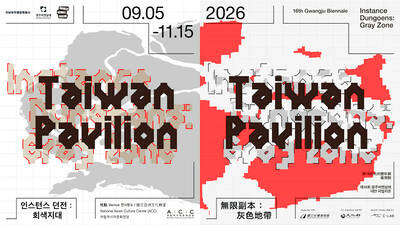
The name “Taiwan” is to appear at South Korea’s Gwangju Biennale when it opens on Saturday, after months of objections from Taiwanese artists and government agencies over an attempted name change. China Pavilion personnel halted installation and left the venue on Friday, after China’s Ambassador to South Korea Dai Bing (戴兵) objected to the restoration of the “Taiwan Pavilion” name. As of Monday, the Chinese side was reportedly preparing to withdraw, although its formal withdrawal had not been completed. The pavilion dispute began on June 10, when the ministry and participating artists said organizers had changed “Taiwan Pavilion” to “NTMoFA Pavilion,” referring

The Chinese Nationalist Party (KMT)-controlled legislature in February 2006 established the National Communications Commission (NCC). One of the purposes of the NCC was to circumvent the control of the Government Information Office (GIO), long the KMT’s tool for overseeing the local media, by the administration of Democratic Progressive Party (DPP) president Chen Shui-bian (陳水扁). The NCC’s commissioners were originally apportioned according to the ratio of party control of the legislature. However, the Council of Grand Justices later ruled that agencies required greater coordination with the Executive Yuan, which then began sending a list of expert nominees for approval by the


 RSS
RSS