


For the last 10 years, Dan Ryan's has been doing the same thing. It has changed little either in decor or in menu. The reason for this is that having found a good recipe, it has had little reason to tinker with a good thing. It is not surprising that it has a strong base of regular customers, both foreign and local, who appreciate the fact that it has never tried to compromise on its American style.
Dark wood, sporting memorabilia and souvenirs of a 1940s Chicago, this is a little piece of the American heartland in Taiwan. Its Superbowl day has become a tradition among many expatriates, a tradition that the restaurant maintains although it has long ceased to be profitable. "It is about tradition," said Nia Chen (陳佩儀), the restaurant manager.
The restaurant announces proudly on its menu that it serves American portions, a warning that should not be taken lightly. Attentive wait staff warn the unwary, for at Dan Ryan's even a salad can easily constitute a main course. But the great standards hark back to the days of the railway tycoons when appetites were big and there was always time for another beer. Start off with the clam chowder, a solid soup with nice big clams inside. Move on another house special, the slab of ribs. Ribs are ribs, and there isn't a whole lot of variation wherever you go. Dan Ryan's doesn't try anything fancy, but top-quality local pork and the right touch with the grill, make this a sure hit with dedicated carnivores. For something a little lighter, go for the cioppino, an Italianesque seafood and rice combo that is not too easy to place geographically but with its hints of cajune spiciness and Mediterranean seasonings, sizeable chunks of crab, fish, and whole prawns and mussels, this is a veritable feast that could easily be shared between two light eaters. Dan Ryan's also provides some of the best burgers and hot sandwiches in town. The Ruben sandwich is especially recommended, but is definitely not for the calorie conscious.
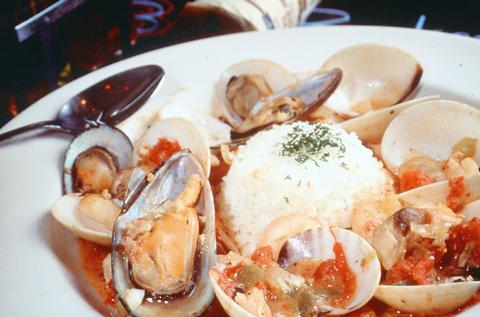
PHOTO COURTESY OF DAN RYAN'S
Indeed, Dan Ryan's keeps faith with an earlier age most obviously in its desserts, which make no concessions. It's brownie, imported directly from New York, is about as dense and chocolaty as you could want, and topped with a giant scoop of Hagan Daaz macadamia nut ice cream, you are looking at a temptation that is likely to break the will of the most ardent weight watcher.
While Dan Ryan's is firmly placed in the upper bracket of eateries, it continues to offer incredible value for money, and for some reason that is an important part of the restaurant's charm, it manages to maintain a high level of professionalism while avoiding fussy pretentiousness.
The bar is simple and competent, avoiding fancy cocktails for a good control of the basics. And in any case, beer is the drink of choice for most customers, according to Chen.

If one asks Taiwanese why house prices are so high or why the nation is so built up or why certain policies cannot be carried out, one common answer is that “Taiwan is too small.” This is actually true, though not in the way people think. The National Property Administration (NPA), responsible for tracking and managing the government’s real estate assets, maintains statistics on how much land the government owns. As of the end of last year, land for official use constituted 293,655 hectares, for public use 1,732,513 hectares, for non-public use 216,972 hectares and for state enterprises 34 hectares, yielding

The small platform at Duoliang Train Station in Taitung County’s Taimali Township (太麻里) served villagers from 1992 to 2006, but was eventually shut down due to lack of use. Just 10 years later, the abandoned train station had become widely known as the most beautiful station in Taiwan, and visitors were so frequent that the village had to start restricting traffic. Nowadays, Duoliang Village (多良) is known as a bit of a tourist trap, with a mandatory, albeit modest, admission fee of NT$10 giving access to a crowded lane of vendors with a mediocre view of the ocean and the trains

The March/April volume of Foreign Affairs, long a purveyor of pro-China pablum, offered up another irksome Beijing-speak on the issues and solutions for the problems vexing the People’s Republic of China (PRC) and the US: “America and China at the Edge of Ruin: A Last Chance to Step Back From the Brink” rang the provocative title, by David M. Lampton and Wang Jisi (王緝思). If one ever wants to describe what went wrong with US-PRC relations, the career of Wang Jisi is a good place to start. Wang has extensive experience in the US and the West. He was a visiting

One of the challenges with the sheer availability of food in today’s world is that lots of us end up spending many of our waking hours eating. Whether it’s full meals, snacks or desserts, scientists have found that it’s not uncommon for us to be mindlessly grazing at some point during all of our 16 or so waking hours. The problem? As soon as this food hits the bloodstream in the form of glucose, it initiates the release of the hormone insulin. This in turn activates a switch present in every one of our cells, which is responsible for driving cell


 RSS
RSS