


As a new ensemble, Leng Pu Fang Theater Group (冷不防劇團) plans to offer something entirely original for its first performance. Titled Delicacy (味道), the show is a harp concert mixed with theater performance.
Concert harpist Chen Shu-hsing (陳淑杏), the founder of the Blue Paradise Harp Trio, will perform selections from J.S. Bach's Sonatas and Partitas for Unaccompanied Violin, Isreali composer Ami Maayani's Toccata and Maqamat, and Taiwanese composer Li Che-yi's (李哲藝) Games for Pedals.
The theater part of the performance is inspired by and meant to accompany the harp pieces and tells the story of a man's failures at communication with others after having lost his senses of taste and smell. The acting is performed almost as a dance to the flowing harp music and provides some comical satire on the degree to which humans are in thrall to their senses.
"What we know and think of a smell or taste is greatly influenced by cultural experience. For instance, the smell of durians is fragrant for people in some cultures but repellant for those in others. So is the smell of stinky tofu. Our sensory experience is not reliable since it is culturally determined," said director Yang Shih-ping (楊士平).
Delicacy will be performed tomorrow at 7:30pm and Sunday at 2:30om and 7:30pm at the Experimental Hall of the National Theater. For tickets, call the National Theater at 2343-1364.
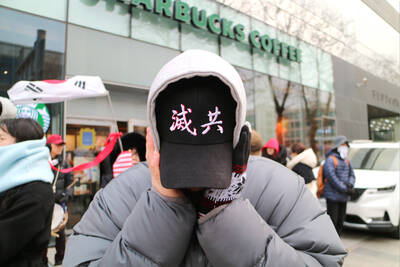
On a harsh winter afternoon last month, 2,000 protesters marched and chanted slogans such as “CCP out” and “Korea for Koreans” in Seoul’s popular Gangnam District. Participants — mostly students — wore caps printed with the Chinese characters for “exterminate communism” (滅共) and held banners reading “Heaven will destroy the Chinese Communist Party” (天滅中共). During the march, Park Jun-young, the leader of the protest organizer “Free University,” a conservative youth movement, who was on a hunger strike, collapsed after delivering a speech in sub-zero temperatures and was later hospitalized. Several protesters shaved their heads at the end of the demonstration. A
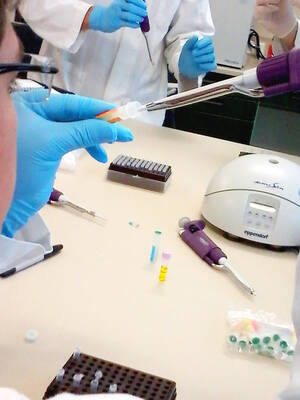
Google unveiled an artificial intelligence tool Wednesday that its scientists said would help unravel the mysteries of the human genome — and could one day lead to new treatments for diseases. The deep learning model AlphaGenome was hailed by outside researchers as a “breakthrough” that would let scientists study and even simulate the roots of difficult-to-treat genetic diseases. While the first complete map of the human genome in 2003 “gave us the book of life, reading it remained a challenge,” Pushmeet Kohli, vice president of research at Google DeepMind, told journalists. “We have the text,” he said, which is a sequence of
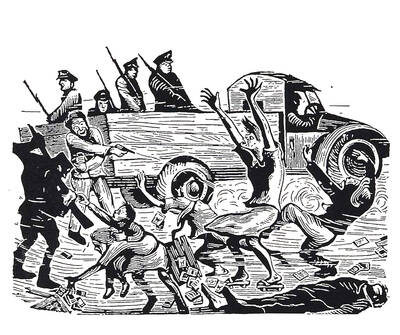
In August of 1949 American journalist Darrell Berrigan toured occupied Formosa and on Aug. 13 published “Should We Grab Formosa?” in the Saturday Evening Post. Berrigan, cataloguing the numerous horrors of corruption and looting the occupying Republic of China (ROC) was inflicting on the locals, advocated outright annexation of Taiwan by the US. He contended the islanders would welcome that. Berrigan also observed that the islanders were planning another revolt, and wrote of their “island nationalism.” The US position on Taiwan was well known there, and islanders, he said, had told him of US official statements that Taiwan had not
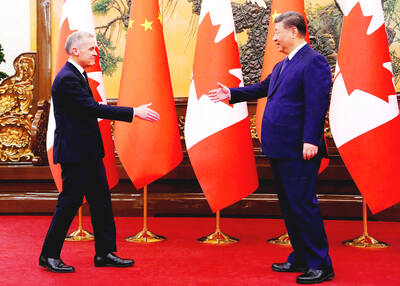
Britain’s Keir Starmer is the latest Western leader to thaw trade ties with China in a shift analysts say is driven by US tariff pressure and unease over US President Donald Trump’s volatile policy playbook. The prime minister’s Beijing visit this week to promote “pragmatic” co-operation comes on the heels of advances from the leaders of Canada, Ireland, France and Finland. Most were making the trip for the first time in years to refresh their partnership with the world’s second-largest economy. “There is a veritable race among European heads of government to meet with (Chinese leader) Xi Jinping (習近平),” said Hosuk Lee-Makiyama, director


 RSS
RSS